 AI Summit
India set to stake its claim in global AI race with power-packed tech leaders’ summit
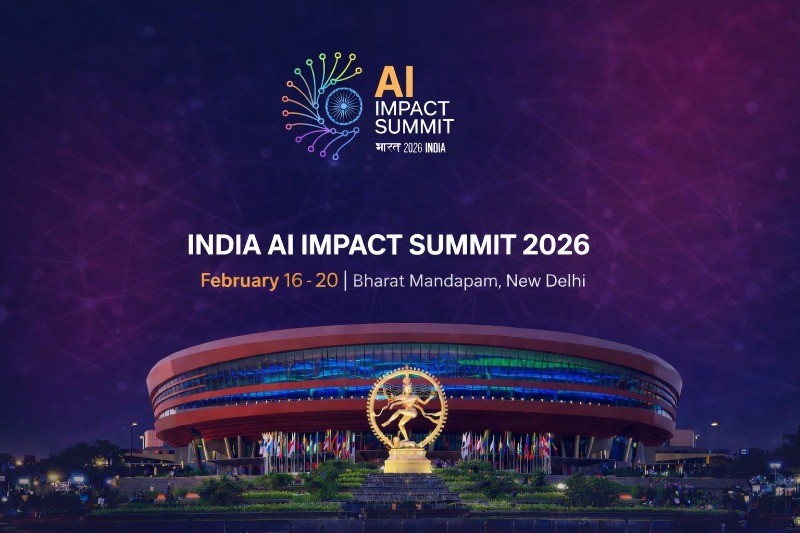
New Delhi/IBNS: India is all set to inaugurate one of the world’s largest artificial intelligence summits on Monday evening, as Prime Minister Narendra Modi looks to position the country as a decisive player in the global race to develop frontier AI models.
World leaders, technology chiefs, AI founders and investors are converging in New Delhi for the India AI Impact Summit, which is being billed as potentially the biggest congregation of AI decision-makers to date.
Among those expected are Sundar Pichai of Alphabet Inc., Sam Altman of OpenAI Inc., Dario Amodei of Anthropic PBC, and Alexandr Wang of Meta Platforms Inc.
Renowned researchers such as Yann LeCun and Arthur Mensch are also part of the guest list.
Macron and Modi to anchor final sessions
The summit’s concluding sessions on February 19 and 20 will feature a keynote address by Emmanuel Macron, followed by remarks from Prime Minister Modi, underscoring the geopolitical and economic stakes attached to artificial intelligence.
For Modi, the event is an opportunity to highlight India’s vast pool of engineers, its rapidly expanding digital economy, and its ambition to influence how the next generation of AI technologies is built and deployed.
India’s digital scale as strategic advantage
India’s pitch rests heavily on scale. The country has digital infrastructure built on data from more than a billion citizens, linked through Aadhaar, the world’s largest biometric identity system.
Officials argue this gives India a unique foundation to deploy AI across governance, payments, healthcare, education and public services.
“By overlaying AI on digital identity, payment rails and governance stacks, India is trying to compress decades of development into years,” said Abhishek Singh, additional secretary at the Ministry of Electronics and Information Technology, adding that systems built for India could have global applications.
India’s record of leapfrogging technology cycles is central to this argument.
While it missed the personal computer boom, it became a global software services hub and expanded from limited landline connectivity to nearly a billion smartphones in less than two decades.
Exporting India’s digital blueprint
India is already exporting parts of its digital architecture.
MOSIP, an open-source platform inspired by Aadhaar, is helping countries such as the Philippines, Morocco and Uganda build national identity systems.
Some governments are also developing digital payment platforms on similar foundations.
In terms of AI competitiveness, India currently ranks third globally behind the United States and China, according to the Stanford Institute for Human-Centred AI.
Global tech firms expand India footprint
Major AI companies are responding. OpenAI and Anthropic are setting up operations in India to tap enterprise clients, developers and government agencies.
Google and Meta are expanding data centre capacity to serve one of the fastest-growing markets for models such as ChatGPT, Gemini and Claude.
Chipmaker Nvidia Corp., facing US export restrictions on advanced processors to China, has also identified India as a strategic counterweight, although its chief executive withdrew from the summit at the last moment, citing unforeseen circumstances.
Concerns over research depth
Despite the momentum, analysts caution that years of underinvestment in core research could slow India’s AI ambitions.
Aakrit Vaish, founder of AI-focused fund Activate, said India’s true breakthrough would depend on strengthening its research ecosystem so it does not become merely a testing ground for Western algorithms.
Push for India-specific AI models
Efforts to build locally attuned AI systems are already underway.
Researchers are set to unveil voice-first models designed to handle India’s linguistic diversity, covering dozens of regional languages.
At the summit, government-backed BharatGen will debut Param2, a 17-billion-parameter model supporting 22 Indian languages.
Sarvam AI, backed by Lightspeed Venture Partners and Khosla Ventures, is expected to reveal an even larger voice-first model.
Both initiatives aim to deliver low-cost AI tools at scale, generating data that could transform classrooms, clinics and agricultural fields.
Affordability as a differentiator
The emphasis on affordability is deliberate.
“In India and much of the developing world, cost cannot be an afterthought,” said Rishi Bal, chief executive of BharatGen, arguing that lower-cost models could accelerate adoption across governance, education, healthcare and farming.
Himanshu Tyagi, co-founder of San Francisco-based Sentient AI, said India could still make up lost ground by focusing on advanced reasoning in areas such as science and robotics, noting that the next wave of intelligence will rely heavily on data beyond the internet.
As global attention turns to New Delhi this week, India’s challenge will be translating summit-stage ambition into sustained research depth and globally competitive AI systems.
Support Our Journalism
We cannot do without you.. your contribution supports unbiased journalism
IBNS is not driven by any ism- not wokeism, not racism, not skewed secularism, not hyper right-wing or left liberal ideals, nor by any hardline religious beliefs or hyper nationalism. We want to serve you good old objective news, as they are. We do not judge or preach. We let people decide for themselves. We only try to present factual and well-sourced news.
Support objective journalism for a small contribution.