


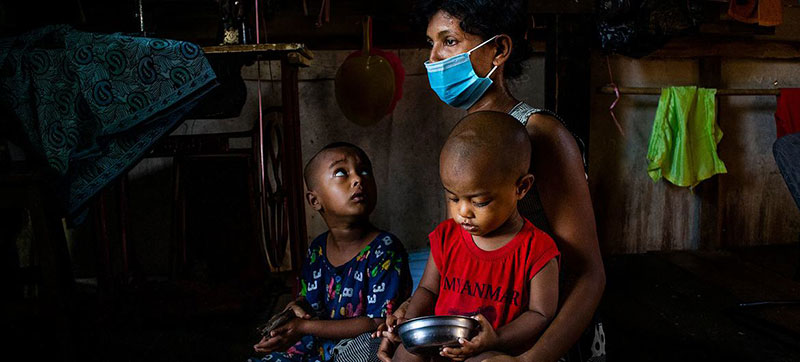
 Myanmar Crisis
People of Myanmar face ‘unprecedented’ crisis in 2022
New York: The people of Myanmar are facing an unprecedented political, socioeconomic, human rights and humanitarian crisis with needs escalating dramatically since the military takeover and a severe COVID-19 third wave.
According to a UN Humanitarian Needs Overview published on Friday by OCHA, the turmoil is projected to have driven almost half the population into poverty heading into 2022, wiping out the impressive gains made since 2005.
The situation has been worsening since the beginning of the year, when the military took over the country, ousting the democratically elected Government. It is now estimated that 14 out of 15 states and regions are within the critical threshold for acute malnutrition.
A displaced child in Kachin State, Myanmar., by OCHA/P. Peron
For the next year, the analysis projects that 14.4 million people will need aid in some form, approximately a quarter of the population. The number includes 6.9 million men, 7.5 million women, and five million children.
Reasons
Price hikes, COVID-19 movement restrictions and ongoing insecurity have forced the most vulnerable people to emergency strategies to buy food and other basic supplies.
Prices for key household commodities have risen significantly, making some food items unaffordable. At the same time, farming incomes have been affected by lower prices for some crops, higher input prices, and limited access to credit.
Monsoon floods in July and August have also affected more than 120,000 people, resulting in crop losses and contributing to food insecurity.
For 2022, the humanitarian affairs office OCHA, says the outlook “remains dire”.
The political and security situation is “expected to remain volatile” and a fourth wave of COVID-19, due to relatively low vaccination rates and the emergence of new variants, is considered a rising risk.
A homeless family in Yangon in Myanmar has few social support structures it can call on., by ILO Photo/Marcel Crozet
Prices are only expected to decrease marginally, while farm gate prices will likely remain low. As a result, consumer prices are projected to be higher, with incomes continuing to decrease.
Other threats
According to OCHA, the “unrelenting stress on communities is having an undeniable impact on the physical and mental health of the nation, particularly the psychological well-being of children and young people.”
The risk and incidence of human trafficking, already on the rise in 2021, is expected to further escalate.
In areas affected by conflict, entire communities, including children, are being displaced, increasing the risks for girls and boys to be killed, injured, trafficked, recruited and used in armed conflict.
In 2020 and 2021, learning was disrupted for almost 12 million children, nearly all the school-aged population, and even though schools had began to reopen, the prospect of a full return to classroom education remains slim for many.
Support Our Journalism
We cannot do without you.. your contribution supports unbiased journalism
IBNS is not driven by any ism- not wokeism, not racism, not skewed secularism, not hyper right-wing or left liberal ideals, nor by any hardline religious beliefs or hyper nationalism. We want to serve you good old objective news, as they are. We do not judge or preach. We let people decide for themselves. We only try to present factual and well-sourced news.
Support objective journalism for a small contribution.


