 Sheikh Hasina
'Whatever fate awaits me, I will return to my people': Sheikh Hasina vows Bangladesh comeback
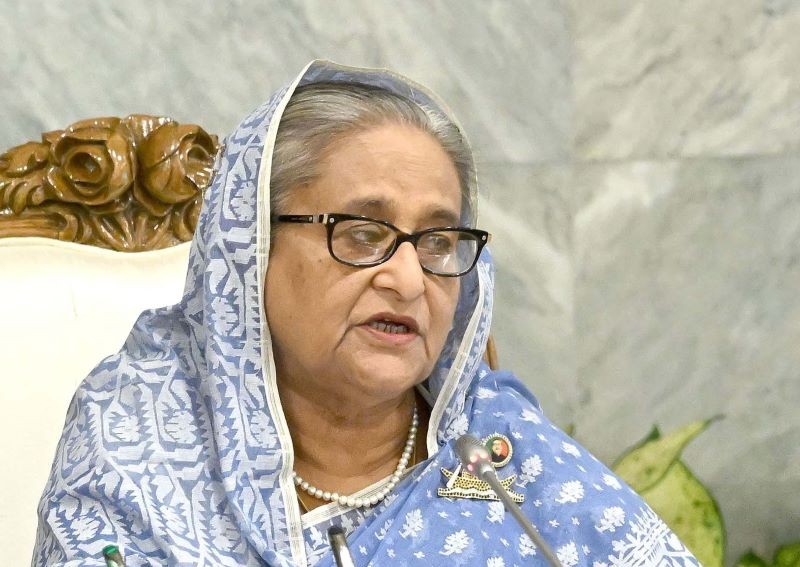
Former Bangladesh Prime Minister Sheikh Hasina on Wednesday declared that she would return to Bangladesh regardless of the consequences, saying no force could separate her from the people of her country.
Addressing the Foreign Correspondents' Club (FCC) of South Asia virtually, Hasina also appealed to the international community to support what she described as Bangladesh's struggle for democracy.
Gets emotional remembering family killed in 1975
During her speech, Hasina broke down while paying tribute to her father, Bangladesh's founding leader Sheikh Mujibur Rahman, who was assassinated along with most of his family in a military coup on August 15, 1975.
"Before I speak about the present crisis, I pay my deepest homage to the Father of the Nation, Bangabandhu Sheikh Mujibur Rahman, to the valiant national leaders, and to the three million martyrs of our War of Liberation.
"I also remember with profound grief members of my own family, whom I lost on 15 August, 1975," she said, struggling to hold back tears.
She added that although she had been "forced away" from Bangladesh, she had "never been separated" from its people.
'Not a peaceful student movement'
Referring to the July-August 2024 unrest that led to her ouster from office, Hasina rejected the description of the protests as a peaceful student movement.
She alleged that the unrest was a well-organised campaign aimed at bringing about regime change rather than a spontaneous student-led protest.
Alleges political persecution
Hasina further claimed that following August 5, violence in Bangladesh turned into a campaign of political persecution targeting members of her party, the Awami League.
She alleged that party leaders and workers have been killed, forcibly disappeared and arrested from their homes in the aftermath of her removal from power.
Background
Sheikh Hasina left Bangladesh on August 5, 2024, after weeks of nationwide protests triggered by a controversial government jobs quota system evolved into a broader anti-government movement.
As demonstrations intensified and turned violent, hundreds of people were killed in clashes between protesters and security forces.
With the military reportedly refusing to continue enforcing a crackdown and the situation in Dhaka deteriorating rapidly, Hasina resigned as prime minister after more than 15 consecutive years in power and departed the country. She flew to India, where she has remained since.
Following her exit, Nobel Peace Prize laureate Muhammad Yunus was appointed head of Bangladesh's interim government.
The new administration launched investigations into alleged abuses during Hasina's tenure, while several cases, including those related to corruption and crimes against humanity, were initiated against the former prime minister.
Hasina has rejected the allegations, maintaining that her government was removed through a planned conspiracy rather than a democratic uprising.
Support Our Journalism
We cannot do without you.. your contribution supports unbiased journalism
IBNS is not driven by any ism- not wokeism, not racism, not skewed secularism, not hyper right-wing or left liberal ideals, nor by any hardline religious beliefs or hyper nationalism. We want to serve you good old objective news, as they are. We do not judge or preach. We let people decide for themselves. We only try to present factual and well-sourced news.
Support objective journalism for a small contribution.