 Pakistan
‘System has collapsed’: Why Mohsin Naqvi’s bombshell has fuelled fresh coup fears in Pakistan
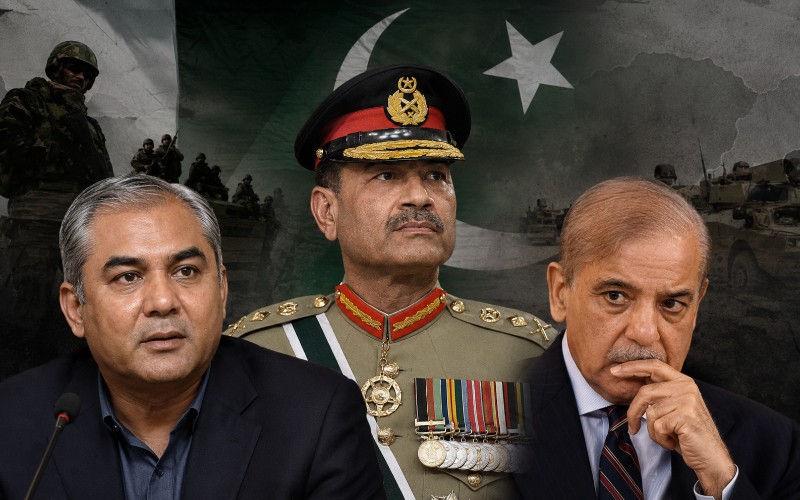
Questions over Pakistan’s political future have intensified after Interior Minister Mohsin Naqvi described the country’s governance system as having effectively “collapsed”, prompting fresh speculation about whether Field Marshal Asim Munir could move from behind-the-scenes influence to formal political control.
The remarks have attracted particular attention because Naqvi is widely regarded as one of Munir’s closest allies within Pakistan’s powerful military establishment.
Coming at a time when the civilian government is facing mounting political, economic and security pressures, his comments have fuelled debate over whether Pakistan’s long-running hybrid system of military and civilian rule could be approaching another turning point.
Pakistan has experienced repeated military interventions since independence, including direct takeovers in 1958, 1977 and 1999.
The question now being raised by political observers is whether Munir’s expanding authority could eventually lead to another formal military takeover or instead deepen the existing system in which elected institutions continue to function while the military retains decisive influence.
Naqvi’s remarks fuel speculation
Naqvi’s comments came during a public conference, where he argued that Pakistan’s existing administrative structure was no longer adequately delivering for the population or meeting the aspirations of young people.
He said Prime Minister Shehbaz Sharif was working hard, but suggested that even working 18 hours a day would not be enough to resolve the country’s problems under the current system.
Naqvi also proposed reorganising Pakistan’s administrative structure by dividing its four provinces into smaller administrative units.
He said these could be provinces or other forms of administrative divisions, with the stated objective of bringing power closer to people at the local level.
The remarks became significant because of Naqvi’s position within the political establishment and his close association with Munir.
Rather than being interpreted simply as a call for administrative reform, his comments have been examined by Pakistani political observers as a possible indication of wider changes being considered by the establishment.
Military spokesperson backs Naqvi’s assessment
The debate intensified after Pakistan’s military spokesperson, Director General of Inter-Services Public Relations (DG ISPR) Ahmed Sharif Chaudhry, was asked about Naqvi’s comments.
Chaudhry initially said he did not want to comment on political matters.
He subsequently endorsed Naqvi's views and criticised the political administration's performance.
He argued that Pakistan’s security could not be ensured unless the administration effectively fulfilled its responsibilities.
The comments have been interpreted by observers as another indication of the increasingly close relationship between Pakistan’s civilian administration and its security establishment.
The interpretation is particularly significant because the military has historically played a central role in Pakistan’s political system, including during periods when civilian governments formally remained in office.
From hybrid rule to direct military control?
Pakistan’s political system has often been described as a hybrid arrangement in which elected governments operate alongside a military establishment that retains considerable influence over national security, foreign policy and other major areas of state policy.
The current debate centres on whether Munir’s expanding authority could take that arrangement further.
Unlike previous military rulers who formally seized power, Munir has so far remained within the military establishment while the civilian government continues to operate.
Political developments since Imran Khan’s removal from office in 2022 have nevertheless strengthened perceptions of increased military influence.
The crackdown on Pakistan Tehreek-e-Insaf (PTI), military trials involving civilians, disputes surrounding the 2024 general election and the formation of a coalition government involving rival political parties have all contributed to the debate over the balance between civilian institutions and the military establishment.
Munir’s elevation to the rank of field marshal has further added to his prominence within Pakistan’s power structure.
Pakistan’s history of military takeovers
The possibility of another military intervention is particularly sensitive because of Pakistan’s political history.
General Ayub Khan took power in 1958, marking Pakistan’s first military coup. In 1969, General Yahya Khan replaced Ayub Khan.
General Zia-ul-Haq overthrew Prime Minister Zulfikar Ali Bhutto in 1977, while General Pervez Musharraf removed Prime Minister Nawaz Sharif in 1999.
These takeovers followed different political circumstances but established a recurring pattern in which the military intervened directly when civilian political arrangements became unstable.
Pakistan has also experienced periods in which the military exercised substantial influence without formally dissolving civilian institutions.
That distinction has become important in the current debate.
A formal coup would involve the military taking direct control, potentially suspending or altering constitutional arrangements.
Meanwhile, a continuation of hybrid rule would leave Parliament and the civilian government functioning while major policy decisions remain heavily influenced by the military establishment.
Claims of a new political order remain unverified
Former Pakistan Army officer and YouTuber Adil Raja has claimed that the military leadership has already discussed replacing the existing political order.
In a YouTube video, Raja alleged that Munir could become president while Naqvi could serve as prime minister, with a civilian political structure retained to provide what he described as a “democratic facade”.
Raja also claimed that constitutional changes could be pursued to facilitate the proposed arrangement and that Naqvi had been tasked with securing political support.
These claims have not been independently established and remain allegations.
Pakistani political scientist and author Ayesha Siddiqa has separately criticised the existing informal distribution of power.
She argued that Munir should either “head home and take the army into the barracks” or “step into the field once and face the nation” by formally imposing martial law.
Her comments reflect the wider debate over whether military influence should remain exercised through informal mechanisms or be openly acknowledged through direct political authority.
Yousuf Nazar questions the establishment’s responsibility
Dawn columnist and Pakistani author Yousuf Nazar has also focused on the significance of Naqvi’s remarks.
Nazar argued that public attention had understandably centred on the Interior Minister but maintained that Naqvi’s comments should be viewed in the context of the broader establishment.
“The media and politicians have understandably focused on Mohsin Naqvi. But the interior minister speaks for the establishment, more precisely for Field Marshal Asim Munir,” Nazar said.
He added that Munir’s accumulation of authority carried a corresponding responsibility for the country’s condition.
“By assuming so much power, directly or indirectly, the field marshal has assumed a huge historic responsibility... If the system has collapsed, it is impossible for the Field Marshal to detach himself from it,” Nazar said.
Nazar also questioned whether the establishment had correctly diagnosed Pakistan’s problems.
He argued that the country faced deeper structural issues, including elite capture, institutional arrogance and a political culture in which powerful individuals exercise disproportionate control over public institutions.
Administrative restructuring raises questions
Naqvi’s proposal to reorganise Pakistan’s provinces has added another dimension to the political debate.
Pakistan has four provinces, and demands for new administrative units have emerged periodically.
In Punjab, proposals have been raised for a separate South Punjab or Bahawalpur province, while demands for a Seraiki province have also featured in political discourse.
In Sindh, calls for greater autonomy and the separate political identity of Karachi have periodically surfaced.
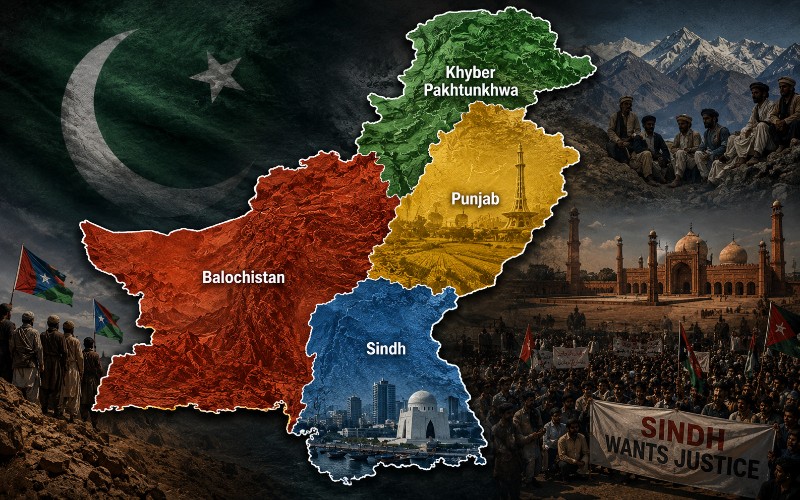 Photo: AI composition by ChatGPT
Balochistan presents a different challenge, with an ongoing separatist insurgency, while Khyber Pakhtunkhwa has its own complex political and ethnic dynamics linked to the wider Pashtun region.
Any major restructuring of the provincial system would have significant political implications, particularly in a country where provincial identity, ethnic representation and control over resources remain sensitive issues.
The details of any proposed restructuring, however, have not been publicly established.
Balochistan and KP add to pressure
The debate over political restructuring comes as Pakistan faces multiple security challenges.
Balochistan continues to experience an armed separatist conflict, while Khyber Pakhtunkhwa faces militant violence and security pressures.
Pakistan-occupied Jammu and Kashmir (PoJK) has also witnessed political unrest and protests over governance and economic concerns.
These pressures have strengthened the military’s argument that security and effective administration must remain closely linked.
At the same time, expanding military involvement in civilian governance raises questions over the future role of elected institutions and political parties.
Imran Khan factor
The political future of jailed former prime minister Imran Khan remains another important element in the debate.
Khan, who remains in Adiala Jail, has refused to compromise with the military establishment and has continued to challenge its political influence.
His supporters have repeatedly raised concerns about his legal cases and his treatment in detention.
The confrontation between Khan and the military leadership has become one of the defining political struggles in contemporary Pakistan.
Any further expansion of Munir’s authority would have direct implications for PTI and its supporters.
Khan’s continued popularity also means that a formal political intervention by the military could encounter a different political environment from previous coups.
Is another coup actually imminent?
The available claims do not establish that a military coup is imminent.
Retired Indian Army Major General CM Seth has interpreted Naqvi’s remarks as a possible indication of political developments ahead and suggested that Munir could eventually take direct control and declare martial law.
He described this as his assessment rather than confirmed information.
Raja’s claims about an alleged military plan also remain unverified.
What has been established through the public remarks is that senior figures associated with Pakistan’s security establishment are openly discussing shortcomings in civilian governance and possible administrative restructuring.
The significance of Naqvi’s remarks lies less in proving that a coup has been decided and more in highlighting the extent to which Pakistan’s military establishment remains central to debates over the country’s political and administrative future.
Whether Munir ultimately seeks formal political office, strengthens the existing hybrid arrangement or leaves the civilian structure intact remains uncertain.
According to political experts, for now, the speculation reflects a familiar question in Pakistan’s political history: whether military influence will remain behind the civilian façade or eventually become direct and formal once again.
Support Our Journalism
We cannot do without you.. your contribution supports unbiased journalism
IBNS is not driven by any ism- not wokeism, not racism, not skewed secularism, not hyper right-wing or left liberal ideals, nor by any hardline religious beliefs or hyper nationalism. We want to serve you good old objective news, as they are. We do not judge or preach. We let people decide for themselves. We only try to present factual and well-sourced news.
Support objective journalism for a small contribution.