


 Pakistan Army
Amid political unrest, Pakistan Army reaffirms its dominant role
In the labyrinth of Pakistan’s political theatre, a single image has captured the essence of power dynamics more poignantly than any high-profile political gathering could.
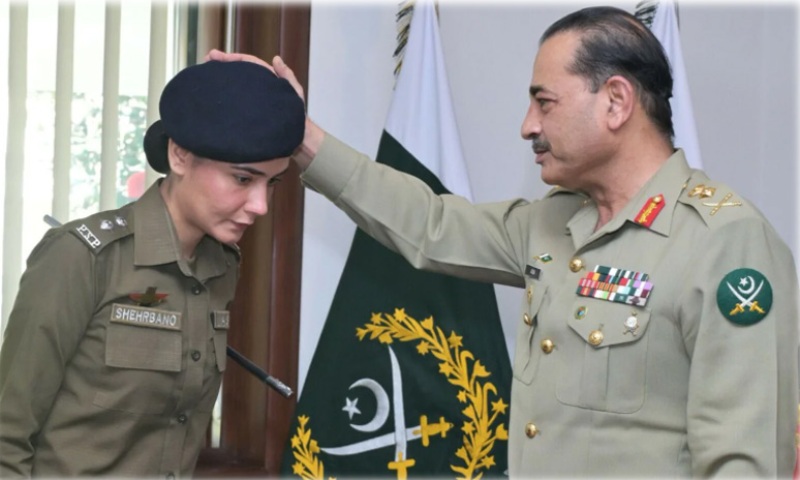
The photograph of General Asim Munir, the army chief, placing his hand over Assistant Superintendent of Police Syeda Shehrbano Naqvi’s head, commending her bravery, is emblematic of the military’s enduring influence in the Islamic Republic of Pakistan.
ASP Shehrbano Naqvi’s act of valor, rescuing a woman targeted by a mob under a blasphemy accusation, merits national recognition. Yet, the commendation didn’t come from the police hierarchy or a civilian leader but from the army chief. This gesture, while commendable for acknowledging bravery, underscores a troubling narrative: the military, not civilian authorities, is perceived as the ultimate guardian of justice and order in Pakistan.
This incident isn’t isolated. It reflects a broader reality where the military, often seen as the arbiter of power, continues to overshadow civilian governance. The recent elections only reinforce this perception. Despite the electorate’s voice, manifest in the surprising success of Imran Khan’s PTI, the military’s shadow looms large, influencing outcomes and political alignments behind the scenes.
The post-election developments, with Nawaz Sharif’s PML(N) and the PPP navigating the political maze under the army’s watchful eye, highlight a persistent theme in Pakistan’s polity: the military’s role as the de facto power broker. This is not merely about facilitating government formation but about steering the nation’s direction, often at the expense of democratic principles.
The implications are profound, not just for Pakistan’s internal dynamics but for its regional relationships, particularly with India. As the new government grapples with economic challenges and strives for stability, the undercurrents of military influence could shape Pakistan’s path forward, impacting its domestic and foreign policy.
For a nation yearning for democratic maturity, the ongoing scenario presents a conundrum. While the military’s role in ensuring national security is undeniable, the balance of power needs recalibration. True progress requires strengthening civilian institutions, ensuring they can operate independently of military oversight, thus fostering a democratic environment where the rule of law prevails, not just in letter but in spirit.
As Pakistan stands at this crossroads, the international community watches closely. The choices made today will determine not only the future but also its role on the global stage. In this intricate dance of power, the hope is that civilian voices will not be overshadowed by military boots, paving the way for a Pakistan where democracy is not just an ideal but a lived reality.
(Text and courtesy: Khalsavox.com)
Support Our Journalism
We cannot do without you.. your contribution supports unbiased journalism
IBNS is not driven by any ism- not wokeism, not racism, not skewed secularism, not hyper right-wing or left liberal ideals, nor by any hardline religious beliefs or hyper nationalism. We want to serve you good old objective news, as they are. We do not judge or preach. We let people decide for themselves. We only try to present factual and well-sourced news.
Support objective journalism for a small contribution.


