 UNWTO,G20
Heads of UNWTO and OECD press for coordinated action to restart tourism and save livelihoods
Madrid/IBNS: The pandemic crisis has undoubtedly devastated the tourism economy but it has also created an opportunity to rethink tourism development.
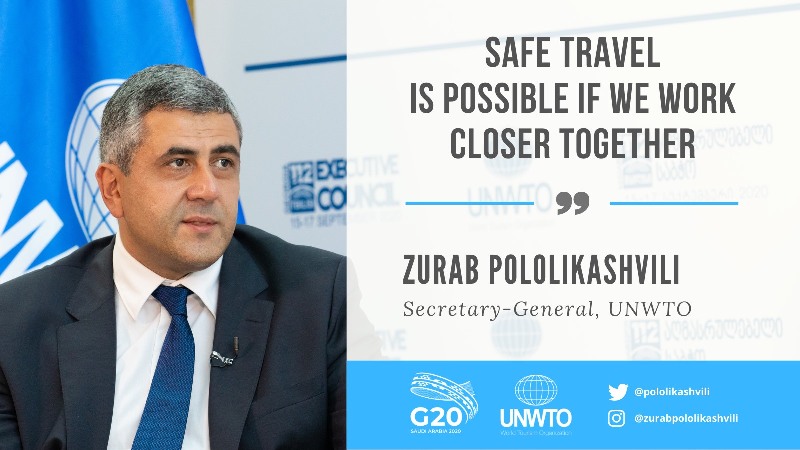
The observation was made in their message issued by secretaries-general Zurab Pololikashvili of the World Tourism Organisation (UNWTO) and Ángel Gurría of the Organisation of Economic Co-operation and Development (OECD) on the eve of the G20 Tourism Ministers meeting (October 7) under the Saudi Presidency.
Excerpts from the message:
“Tourism is a major driver of the world economy, accounting for 7 per cent of international trade.
Globally, tourism generates directly or indirectly one in every ten jobs.
Tourism was one of the first sectors to be deeply affected by the COVID-19 containment measures, and with the ongoing travel restrictions and the looming global recession, it also risks being among one of the last to recover.
With a 60-80 per cent decline in international tourism foreseen for 2020, and a drop of between US $910 billion and $1.2 trillion in exports, today over 100 million direct tourism jobs are at risk.
Apart from this direct impact, the tourism economy is also linked to many other sectors, including construction, agro-food, distribution services and transportation, all of which exacerbate the size of the shock.
COVID-19 has revealed the macroeconomic importance of tourism in most OECD and G20 economies.
Many businesses across the sector are fighting to survive, with a disproportionate effect on women, young people, rural communities, indigenous peoples and informal workers – groups that are more likely to be employed in micro or small tourism businesses.
This crisis is also creating an even greater hardship for low-income and developing economies, and their local communities, which disproportionately depend on tourism and hence face a serious risk of higher poverty.
The current crisis has also exposed gaps in government and industry preparedness and response capacity.
Policy action at national and international levels, as well as heightened coordination, are urgently needed across sectors and borders to restore traveller and business confidence, stimulate demand and accelerate tourism recovery.
This crisis is an opportunity to rethink tourism development.
The recovery must involve transforming the sector, re-inventing tourism destinations and businesses, re-building the tourism ecosystem, and innovating and investing in sustainable tourism.
At its heart, tourism is about experiences, including the tastes of local food, the exploration of local landscapes, and the sights of historical significance.
But it is mostly about people – be they local guides, accommodation operators or other service providers who make your journey special or help you to do business and reach international markets.
As such, our collective response must put people first and live up to the pledge of leaving nobody behind.
This crisis should be an opportunity to ensure a fairer distribution of tourism’s benefits and advance the transition towards a carbon-neutral and more resilient tourism economy.”
As the leaders of the OECD and UNWTO, they called for strong and urgent action across three fronts to sustain millions of livelihoods.
First, strengthened multilateral co-operation and robust support are critical to reactivate travel.
According to them, collaboration and consistency of travel regulations at bilateral, regional and international levels are the stepping-stones that will allow tourism to restart safely, accelerate economic recovery and provide hope for millions of people.
Second, governments must approach tourism recovery in a more integrated manner – involving all levels of government, private sector and civil society in a practical and actionable plan to revive the tourism sector.
Highlighting that tourism services are interdependent, they pointed out that the fragmented and diverse nature of the sector means it sits across various policy areas such as health, transport, environment, foreign affairs, and economic policies.
All countries should also reinforce their coordination mechanisms to help businesses, workers and destinations, particularly those that are most vulnerable such as SMEs, with sustainability as a guiding principle for recovery.
To achieve a sustainable and resilient tourism economy, the private sector must also be closely involved in policy design, the leaders said.
They also said that recovery policies should aim to accelerate the digital transformation and the transition towards a low carbon economy for the future.
Third, it is necessary to reshape tourism towards responsibility and inclusion.
The tourism sector can have an important environmental and social effect, whether through greenhouse gas emissions, by impacting fragile natural and cultural environments or affecting host communities, the leaders pointed out.
Research indicates that tourism transport related emissions account for 8 per cent of global greenhouse gas emissions.
The leaders believe that the pandemic has revealed an opportunity for more diversified, ‘slower’, smaller, and more authentic experiences.
Support Our Journalism
We cannot do without you.. your contribution supports unbiased journalism
IBNS is not driven by any ism- not wokeism, not racism, not skewed secularism, not hyper right-wing or left liberal ideals, nor by any hardline religious beliefs or hyper nationalism. We want to serve you good old objective news, as they are. We do not judge or preach. We let people decide for themselves. We only try to present factual and well-sourced news.