


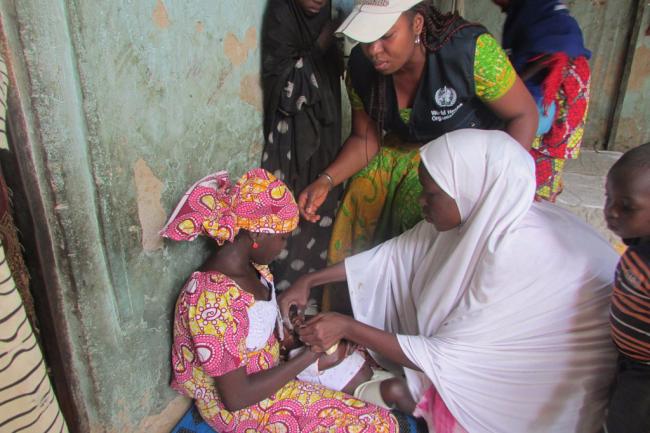
UN health agency working to boost malaria prevention and control in north-eastern Nigeria
To manage malaria in the Borno state of north-eastern Nigeria, the World Health Organization (WHO) and its partners are strengthening surveillance systems to monitor cases and outbreaks; increasing people's access to care in clinics and to health facilities; spraying insecticides and distributing bed nets as part of vector control; and administering malaria drugs to children under five every month from July to October.
Following more than eight years of conflict in Borno, some 3.7 million people need humanitarian assistance – and all are at risk for malaria. WHO estimates that through October, 8,500 people are infected weekly – with more expected.
“The most effective way to reduce deaths in emergencies in fragile States, especially those facing malnutrition, is by boosting malaria prevention and control, however, this is often not viewed as the top priority during an emergency response,” said Dr. Pedro Alonso, Director of WHO's Global Malaria Programme. “We are working with our WHO colleagues and many partners to change this.”
WHO estimates that over half of recorded deaths there are due to malaria – comprising more than all other diseases combined, including cholera, measles and hepatitis E. The vulnerable population, consisting of 58.8 per cent children, stands at risk of disease outbreaks.
With more than 60 per cent of health facilities only partially functioning, many people have no had access for years to regular health services, including vaccinations and basic medicines. In addition to security concerns, deadly malnutrition is rising in parts of the state.
Tackling health emergencies
“Malaria, malnutrition, fragile States and civil strife often feed each other,” said Dr. Alonso, adding: “Wherever we have a humanitarian crisis in a malaria endemic country, we can almost always be sure that malaria is the number one killer.”
However, malaria is preventable and curable, and increased efforts over the last 15 years have drastically reduced related mortality rates by more than 60 per cent, averting six million deaths.
Following a visit, WHO malaria experts commissioned a modelling exercise that concluded that joint actions could be prevent up to 10,000 deaths in Borno state alone.
In early July, the first of four monthly rounds of mass drug administration reached more than 880,000 of the 1.1 million under-age-five children targeted.
WHO hopes for $2.5 million to mobilize the emergency intervention and is relying on the existing polio vaccinator infrastructure to carry out the operation, which faces Boko Haram security threats.
“We will give one curative dose of antimalarial drugs to a defined population, in this case children under-five,” said Dr. Alonso. “In Borno state, we are giving an antimalarial drug to a child, whether they have malaria infection or not, to ensure they are cleared of parasites at that point and to protect them for four weeks. It's a necessary temporary fix to reduce malaria deaths for the next six months.”
WHO has trained community health workers to offer rapid and read diagnostic tests, provide treatment and advise on prevention.
“We will not know the full impact of our efforts until November, but we are confident that taking these steps will go a long way in reducing deaths and suffering of people from malaria so they can get on with their lives,” said Dr. Wondi Alemu, WHO Representative in Nigeria.
Photo: WHO Nigeria/L. Ozor
Source: www.justearthnews.com
Support Our Journalism
We cannot do without you.. your contribution supports unbiased journalism
IBNS is not driven by any ism- not wokeism, not racism, not skewed secularism, not hyper right-wing or left liberal ideals, nor by any hardline religious beliefs or hyper nationalism. We want to serve you good old objective news, as they are. We do not judge or preach. We let people decide for themselves. We only try to present factual and well-sourced news.
Support objective journalism for a small contribution.


