


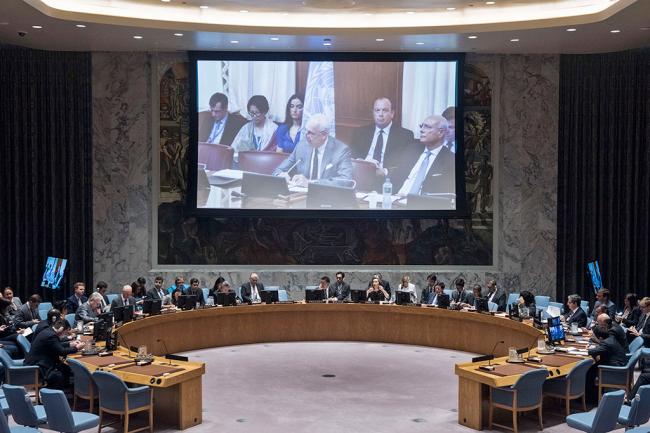
UN envoy maps out 'ideal trajectory' to next round of intra-Syrian talks in Geneva
“We are at a time of testing whether the political will exists for real de-escalation and more meaningful political talks and move beyond preparatory talks,” Staffan de Mistura, UN Special Envoy for Syria, told the Security Council via videoconference from Geneva.
His briefing focused on the latest developments and some of the possible future steps ahead to create a conducive environment to bring the six-year war to an end.
He said that “the ideal trajectory” over the coming two weeks would be progress in the next round of the Astana talks on 4 and 5 July.
The process taking place in the Kazakh capital is led by Russia, Turkey and Iran and produced agreement on a ceasefire between warring parties in Syria in late December 2016. Five months later, a deal was struck to set up “de-escalation zones” in Syria to prevent incidents and military confrontation between the warring parties. These zones are expected to also give greater humanitarian access to the 6.3 million people still living the country on Tuesday.
“Let's give de-escalation efforts a fair chance to succeed because that is what people are asking in order to bringing the violence further down and enabling confidence-building,” de Mistura said.
Since the three guarantor States signed the de-escalation memorandum on 4 May in Astana, violence is clearly down, he said, noting that hundreds of Syrian lives continue to be spared every week, and many towns have returned to some degree of normalcy. But in some areas, the fight and violence has been continuing and in fact intensified.
And the overall improvement of the security situation has regrettably not yielded equally significant progress on humanitarian access to areas where the needs are the greatest, he added.
“With every week that passes, we know it, without a final arrangement for the de-escalation zones being indeed finalized, the fragility of the ceasefire regime and the risk posed by the fragility increases,” warned de Mistura.
Next, Astana talks would be followed by a further set of joint technical expert meetings with the opposition groups in the same week, and then a continued discussion and dialogue among international stakeholders, including at the G20 Summit in Hamburg on 7 and 8 July, in which Syria cannot be avoided as a subject, he said.
“I hope that a combination of these elements would help shape an environment conducive for the next round of intra-Syrian talks in Geneva in the months to come,” the UN envoy said, noting that it “would bring us one step forward on the journey towards our shared goal” of implementing the resolutions of this Council, in particular resolution 2254 (2015), which laid out the pathway to peace.
UN Photo/ Kim Haughton
Source: www.justearthnews.com
Support Our Journalism
We cannot do without you.. your contribution supports unbiased journalism
IBNS is not driven by any ism- not wokeism, not racism, not skewed secularism, not hyper right-wing or left liberal ideals, nor by any hardline religious beliefs or hyper nationalism. We want to serve you good old objective news, as they are. We do not judge or preach. We let people decide for themselves. We only try to present factual and well-sourced news.
Support objective journalism for a small contribution.


