


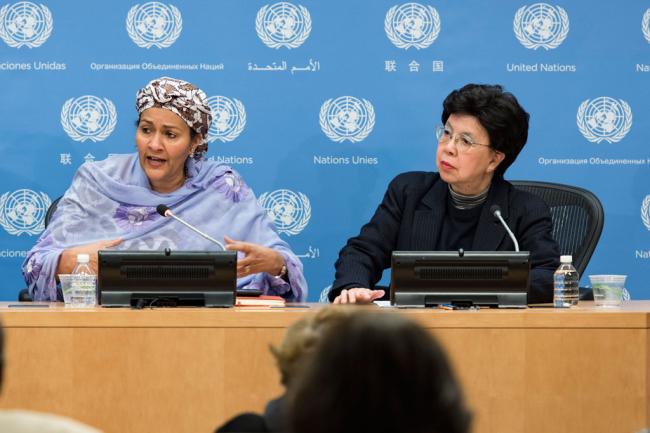
UN announces interagency group to coordinate global fight against antimicrobial resistance
“As we enter the era of sustainable development, I would like to emphasize that antimicrobial resistance really does pose a formidable threat to the attainment of the Sustainable Development Goals (SDGs), particularly in our developing countries,” Mohammed told reporters at UN Headquarters in New York.
Antimicrobial resistance happens when microorganisms (such as bacteria, fungi, viruses, and parasites) change when they are exposed to antimicrobial drugs – antibiotics, antifungals, antivirals, antimalarials, and anthelmintics. Microorganisms that develop antimicrobial resistance are sometimes referred to as “superbugs.”
As a result, says WHO, the medicines become ineffective and infections persist in the body, increasing the risk of spread to others.
Mohammed said the creation of the UN joint agency group to combat AMR and advise on the global effort, is a sign of how seriously UN Member States were taking the threat.
Last September, Member States adopted the Political Declaration of the High-Level Meeting on Antimicrobial Resistance that contained a request for the UN Secretary-General to establish such a body.
She said AMR is a “multi-sectoral problem” affecting human and animal health, agriculture, as well as the global environment and trade. Clean water, sustainable food production and poverty alleviation are but a few of the challenges it poses.
“Many UN agencies will need to engage in this fight, as will other international organizations, non-governmental organizations, civil society, and critically, the general public,” she explained, welcoming the Secretary-General’s establishment of the group, which would seek to provide practical guidance on the ways to combat AMR and to recommend how global efforts could and should be better coordinated.
WHO chief Chan said antibiotic resistance is already prolonging illness worldwide, and the political declaration was a vital commitment to help tackle the scourge globally.
She said the inter-agency group would support governments across the world, as well as advising on the “use and abuse” of antibiotics for people, and livestock.
Chan promised that the group, appointed by the Secretary-General, would “get to work right away.”
The group will be comprised of high-level representatives from relevant UN agencies, other international organizations, and individual experts across different sectors, including animal health, agriculture, and environment.
It will produce a report to the Secretary-General for the UN General Assembly session starting in September 2018.
UN Photo/Mark Garten
Source: www.justearthnews.com
Support Our Journalism
We cannot do without you.. your contribution supports unbiased journalism
IBNS is not driven by any ism- not wokeism, not racism, not skewed secularism, not hyper right-wing or left liberal ideals, nor by any hardline religious beliefs or hyper nationalism. We want to serve you good old objective news, as they are. We do not judge or preach. We let people decide for themselves. We only try to present factual and well-sourced news.
Support objective journalism for a small contribution.


