


UN aid chief spotlights challenges delivering relief inside war-torn Syria, urges continued support
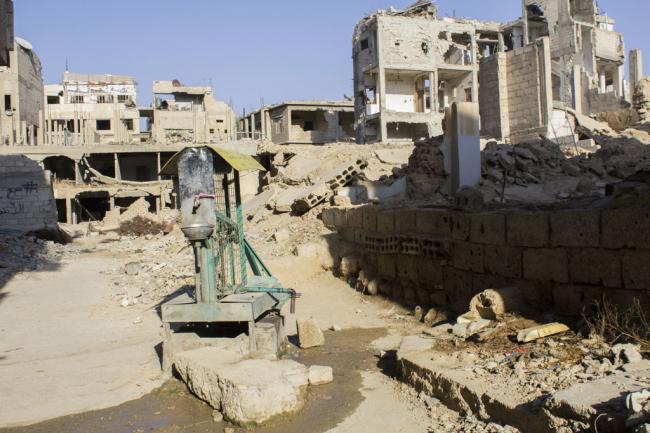
New York, Nov 30(Just Earth News): The conflict in Syria – now into its seventh year, longer than World War II – continues to ratchet up misery on its people, with millions living in besieged and hard-to-reach areas, a third of the country’s children out of school, and over half of its health facilities rendered inoperable, the United Nations top relief official said on Wednesday.
The situation is most dire in rural Damascus’ eastern Ghouta (where 94 per cent of the besieged population is located), where fighting has seen a recent escalation and where, despite efforts of humanitarians, only about 100,000 out of an estimated population of 400,000 have received food assistance this year.
“The available evidence suggests severe acute malnutrition rates among children in eastern Ghouta have increased five-fold in the past ten months,” said Mark Lowcock, the UN Emergency Relief Coordinator and Under-Secretary-General for Humanitarian Affairs, briefing the Security Council.
Deaths of people, especially children, from preventable can be prevented if aid convoys can be increased and made more regular, he expressed, adding: “Against this background, news over the last two days of a ceasefire in eastern Ghouta would be – if true and if sustained – important.”
In his briefing, the senior UN relief official also spoke of the recently released 2018 Humanitarian Needs Overview for Syria as well as of increased displacement in north-west Syria, worsening fighting in north-east Syria, threats of explosive remnants of war and improvised explosive devices and the precarious humanitarian access as a result.
“At the same time, new restrictions on access and aid delivery in the north-east are limiting access to a number of people we had previously been able to reach with help,” said Lowcock, noting that since 9 November, the UN has faced a series of bureaucratic impediments imposed by the parties in the area resulting in the curtailment of humanitarian assistance for much of the past month.
Further, concerning delivery of aid, he also updated the Security Council of the efforts of UN actors to ensure aid reaches those that need it as well as of the challenges they face in the process.
“It is clear that each of the three modes of delivery [to Government-controlled areas, cross-line deliveries, and cross-border assistance] is critical for the people of Syria, and that there is complementarity between them. As needs remain high, it is important to preserve all means of access,” said the UN official, stressing that the renewal of the Security Council resolution 2165 (2014), which authorized the UN and relief agencies to use the most direct routes for aid delivery is “essential to save lives.”
Concluding his briefing, Lowcock also told the Security Council that following consultations with the authorities, he plans to visit Syria in early January 2018 to assess the situation and to discuss assistance to those in need can be improved.
Photo: UNOCHA
Source: www.justearthnews.com
Support Our Journalism
We cannot do without you.. your contribution supports unbiased journalism
IBNS is not driven by any ism- not wokeism, not racism, not skewed secularism, not hyper right-wing or left liberal ideals, nor by any hardline religious beliefs or hyper nationalism. We want to serve you good old objective news, as they are. We do not judge or preach. We let people decide for themselves. We only try to present factual and well-sourced news.
Support objective journalism for a small contribution.


