


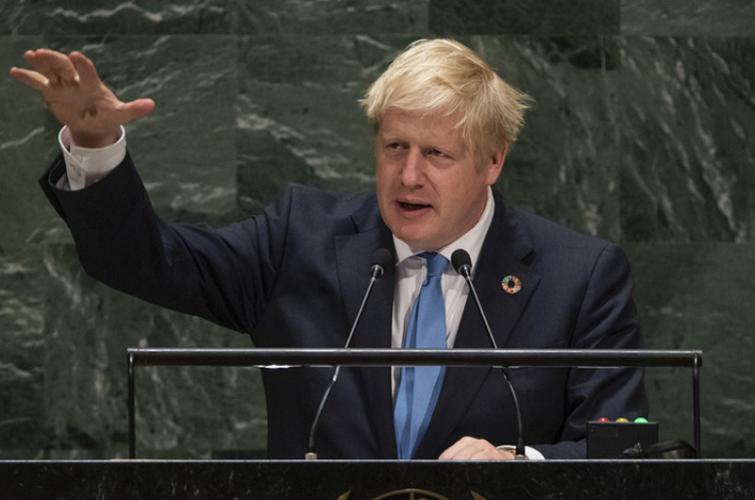
UK’s Johnson warns of dystopian digital future, calls on UN to set global standards for emerging technologies
New York: United Kingdom Prime Minister Boris Johnson on Tuesday evening focused his address at the UN mainly on the looming threat of artificial intelligence run amok, but also made a brief reference to Brexit – comparing the process of the UK’s delayed departure from the European Union to classical Greek mythology.
Johnson told the United Nations General Assembly’s annual general debate that the experience of Brexit was like Zeus’ eternal punishment of Prometheus.
He said that “no one can ignore the gathering force affecting every Member of this Assembly” that is digitalization. Addressing the future of privacy, he said that while people may keep their personal secrets from friends, family, their doctors or others, “it takes real effort to conceal them from Google”.
Citing the comprehensive and pervasive effects of this new technology, pushing humanity towards an “antiseptic urban environment”, he said in the future and even the present, it places every citizen under surveillance. A “future Alexa” of connectivity will monitor every aspect of daily human life. With a cloud of data lowering ever more oppressively over the human race, people may have no control “over how or when the precipitation will take place”.
The Prime Minster described data as the crude oil of the present day, with no one knowing who owns or can use it.
Expressing concern about whether the machines will decide if people are eligible for a mortgage or insurance, he wondered: “How do you plead with an algorithm?” Digital authoritarianism is “not the stuff of dystopian fantasy” but an emerging reality in some countries.
While the United Kingdom is a global leader in technology, he noted that some States have been caught unaware by the effects of the Internet, what he called the most momentous invention since print. Like nuclear power, it is capable of both great good and harm, but he wondered whether artificial intelligence will be a boon for humanity or produce “pink-eyed terminators” here to “cull the human race”. He cited the deep human impulse to mistrust any technological innovation, noting the influence of anti-vaxxers.
At the same time, he rejected any anti-science pessimism. Highlighting the rise of nanotechnology and neural interface technology, he cited breakthrough developments “helping the deaf to hear and the blind to see”.
In the developing world, he noted that millions of people in Africa without bank accounts can now use an app to fill that gap. The values that inform tech design will shape the future of humanity, which will either face an Orwellian world of suppression or one of learning, threatening famine and disease but not freedoms, he said.
The mission of the United Kingdom and all who share its values is to ensure that emerging technologies must promote that freedom, openness and pluralism, said Mr. Johnson. On that point, he called on the UN to guarantee that no one is left behind, calling for a common set of global principles to shape the norms and standards of emerging technologies.
“The United Kingdom has by far the biggest tech sector anywhere in Europe, with half a million people working in it,” he said, and invited Member States to attend a technology summit in London in 2020.
Photo caption and credit:
UN Photo/Cia Pak
Boris Johnson, the Prime Minister of the United Kingdom, addresses the 74th session of the UN General Assembly.
Support Our Journalism
We cannot do without you.. your contribution supports unbiased journalism
IBNS is not driven by any ism- not wokeism, not racism, not skewed secularism, not hyper right-wing or left liberal ideals, nor by any hardline religious beliefs or hyper nationalism. We want to serve you good old objective news, as they are. We do not judge or preach. We let people decide for themselves. We only try to present factual and well-sourced news.
Support objective journalism for a small contribution.


