


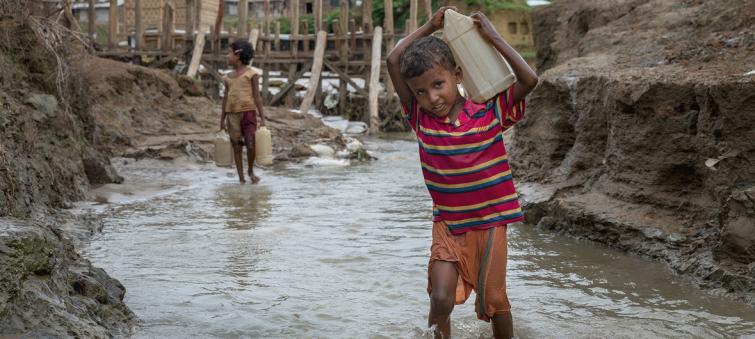
'There has never been a more urgent time,' to safeguard children's right to safe water and sanitation, says UNICEF
New York, Aug 28 (IBNS): Access to safe drinking water is a right critical to a child’s survival, yet protracted crises have left some 420 million children without basic sanitation, and 210 million lacking access to safe drinking water, the UN Children’s Fund (UNICEF) said on Tuesday.
In the first volume of a new report, Water under Fire, the agency outlines how water, sanitation and hygiene services can be planned, financed and executed to safeguard healthy livelihoods for children in fragile and conflict-affected areas.
From Cox’s Bazar to Ukraine to Yemen and similar places of extreme vulnerability, as seen, “the situation is dire for children,” UNICEF Associate Director for Water, Sanitation and Hygiene (WASH), Kelly Ann Naylor said, acknowledging that conflict-related crises are increasing in frequency, are more prolonged, and maiming the lives of more people.
“Humanitarian assistance alone will not resolve these issues, but through cross-sector partnerships we can build sustainable and resilient water, sanitation and hygiene services that can create a more stable and peaceful future for children and their families.”
Deadly as bullets
In fragile contexts, lacking safe water and sanitation further restricts the right to health; shutting down hospitals, increasing exposure to preventable diseases, and exacerbates existing conflicts.
Data published by UNICEF in March revealed that scarce clean water supply could be as deadly as bullets, where children under the age of 15 are nearly three times more likely to die from diseases linked to poor sanitation conditions than from violence.
Fragility and armed conflict have increased worldwide over the last decade, the report notes, displacing millions of people globally and straining host communities that must deliver basic services, including water and sanitation to growing populations.
Water is at risk of becoming a “threat multiplier” for war-torn countries from Africa’s Sahel region, to the Middle East., with climate change impacts compounding the effects of a growing water crisis and indirectly accelerating hunger and health crises for entire populations.
Peacebuilding through ‘WASH’
Turning to implementable solutions under way in Bangladesh, Ethiopia, Lebanon, Nigeria, Somalia, the Occupied Palestinian Territory, Yemen and beyond, the report aims to replicate and scale up these efforts into a framework for ensuring resilient water and sanitation services for children globally.
In South Sudan, a result of improved sanitation education has aided households in addressing malnutrition and reducing incidents of gender-based violence, while a joint effort by Tripoli and Lebanon to close water service gaps paved the way for social cohesion between the previously divided groups.
In tandem with the Water Under Fire Campaign launched on 22 March, the report seeks to ensure the rights to water and sanitation for all, while moving toward sustainable development and peace.
Nearing 30 years since the adoption the UN child rights treaty, the Convention on the Rights of the Child, Ms. Naylor stressed, “there has never been a more urgent time to safeguard the right to water and sanitation for every child.”
Photo Caption and Credit:
UNICEF/Patrick Brown
A young boy carries water in Cox's Bazar, Bangladesh. (10 July 2018)
Support Our Journalism
We cannot do without you.. your contribution supports unbiased journalism
IBNS is not driven by any ism- not wokeism, not racism, not skewed secularism, not hyper right-wing or left liberal ideals, nor by any hardline religious beliefs or hyper nationalism. We want to serve you good old objective news, as they are. We do not judge or preach. We let people decide for themselves. We only try to present factual and well-sourced news.
Support objective journalism for a small contribution.


