


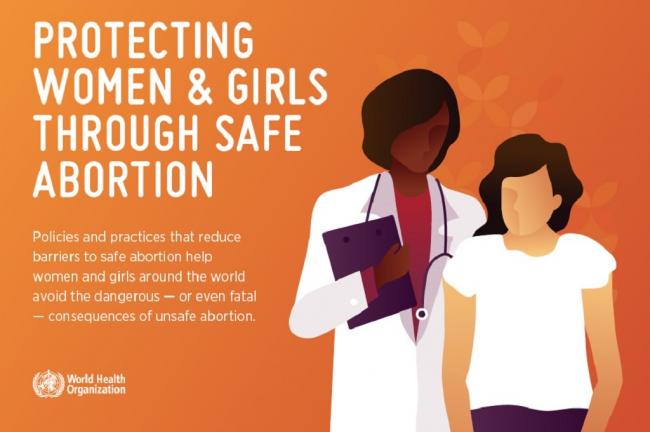
Some 25 million unsafe abortions occur each year, UN health agency warns
“Increased efforts report are needed, especially in developing regions, to ensure access to contraception and safe abortion,” says Bela Ganatra, a scientist and the lead author of the study, The Lancet, released on Thursday by the World Health Organization (WHO) and the Guttmacher Institute.
“Despite recent advances in technology and evidence, too many unsafe abortions still occur, and too many women continue to suffer and die,” added Ganatra of WHO's Department of Reproductive Health and Research.
For the first time, the study includes sub-classifications within the unsafe abortion category as less safe or least safe. The distinction allows for a more nuanced understanding of the different circumstances of abortions among women who are unable to access safe abortions from a trained provider.
The risk of severe complications or death is negligible if procedures follow WHO guidelines and standards. About 55 per cent of all abortions from 2010 to 2014 were conducted safely.
Some 31 per cent of abortions were “less safe,” meaning they were either performed by a trained provider using an unsafe or outdated method such as “sharp curettage,” or by an untrained person using a safe method like misoprostol, a drug that can induce an abortion.
About 14 per cent were “least safe” abortions provided by untrained persons using dangerous methods, such as introduction of foreign objects and use of herbal concoctions. Complications from “least-safe” abortions can include a failure to remove all of the pregnancy tissue from the uterus, haemorrhage, vaginal, cervical and uterine injury, and infections.
The study also found that in countries where abortion is completely banned or permitted only to save the woman's life or preserve her physical health, only one in four abortions were safe; whereas, in countries where abortion is legal on broader grounds, nearly 9 in 10 abortions were done safely. Restricting access to abortions does not reduce the number of abortions.
Most abortions that take place in Western and Northern Europe and North America are safe. These regions also have some of the lowest abortion rates.
The proportion of abortions that were safe in Eastern Asia, including China, was similar to developed regions. In South-Central Asia, however, less than one in two abortions were safe. In Latin America, only one in four abortions were safe. Less than one in four abortions in Africa, excluding Southern Africa, were safe.
Infographic: WHO
Source: www.justearthnews.com
Support Our Journalism
We cannot do without you.. your contribution supports unbiased journalism
IBNS is not driven by any ism- not wokeism, not racism, not skewed secularism, not hyper right-wing or left liberal ideals, nor by any hardline religious beliefs or hyper nationalism. We want to serve you good old objective news, as they are. We do not judge or preach. We let people decide for themselves. We only try to present factual and well-sourced news.
Support objective journalism for a small contribution.


