


Latin America and Caribbean region deadliest for journalists in 2019
New York/IBNS: Twenty-two journalists were reported killed in the Latin America and Caribbean region in 2019, making it the deadliest part of the world for the press, followed by 15 in Asia-Pacific, and 10 in Arab States.
The figures come from the Observatory of Killed Journalists database, which is maintained by the UN Educational, Scientific and Cultural Organization (UNESCO). It shows that, over the last decade, 894 journalists were murdered, an average of almost 90 per year: journalist killings in 2019 dropped by almost half compared to 2018 (from 99 to 56), but members of the press still face extreme risks, in all regions of the world.
Local coverage more dangerous than war reporting
The UNESCO data shows that targeting local affairs, such as politics, corruption and crime, is more dangerous for journalists than covering war zones. Last year, almost two-thirds of cases occurred in countries not experiencing armed conflict, and the vast majority involved reporters covering their local patch.
In November 2019, on the International Day to End Impunity Against Journalists, UNESCO launched a campaign, #KeepTruthAlive, to draw attention to the dangers faced by journalists close to their homes, highlighting the fact that 93 per cent of those killed worked locally. The campaign featured an interactive map, providing a vivid demonstration of the scale and breadth of the dangers faced by journalists worldwide.
An attempt to silence criticism
In a statement released on Monday, UNESCO declared that attacks on journalists are an attempt to silence critical voices and restrict public access to information.
Aside from the risk of murder, journalists increasingly experience verbal and physical attacks in connection with their work. Over recent years, there has been a marked rise in imprisonment, kidnapping and physical violence, amid widespread rhetoric hostile to the media and journalists.
Women in the media are particular targets, says UNESCO: they are often targets of online harassment, and face threats of gender-based violence.
UNESCO is committed to improving the safety of journalists worldwide and ensure that crimes against them do not go unpunished.
A report published by the agency in November 2019 showed that only 10 per cent of attacks are prosecuted, and less than one in eight cases recorded by UNESCO since 2006 have been resolved.
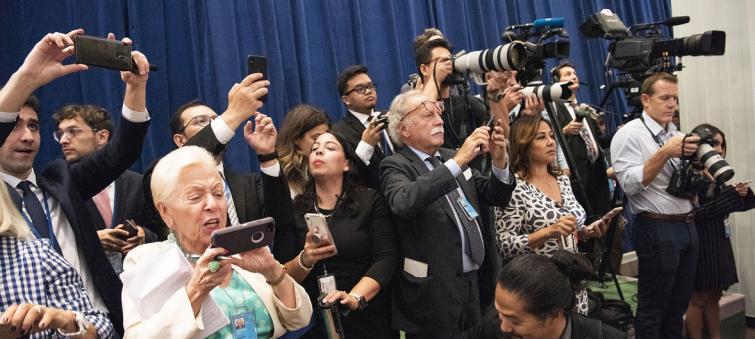
Photo caption and credit:
UN Photo/Rick Bajornas
Journalists at the UN (file)
Support Our Journalism
We cannot do without you.. your contribution supports unbiased journalism
IBNS is not driven by any ism- not wokeism, not racism, not skewed secularism, not hyper right-wing or left liberal ideals, nor by any hardline religious beliefs or hyper nationalism. We want to serve you good old objective news, as they are. We do not judge or preach. We let people decide for themselves. We only try to present factual and well-sourced news.
Support objective journalism for a small contribution.


