


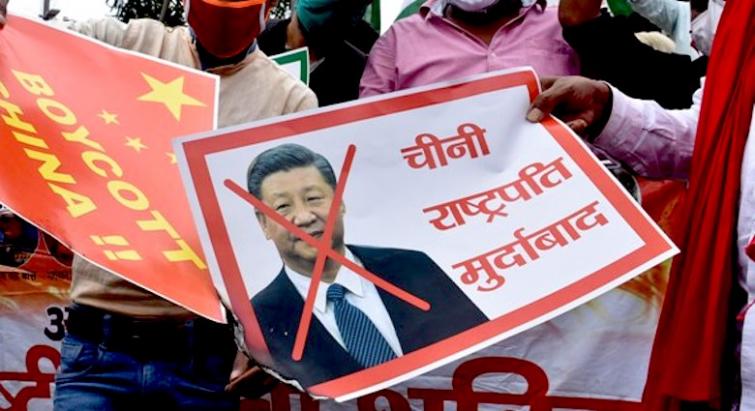
Countries should find strategy that ceases to empower China: IPAC
Washington: Stating that the Galwan standoff between Chinese and Indian Army officials has shown the return of 'major power violence' in the world, a global organisation of parliamentarians from democracies has said countries should work together to find a strategy that ceases to empower President Xi Jinping’s country.
In an article posted by Inter-Parliamentary Alliance on China, the organization said: "The world’s democracies today still have time to change course. Three decades on from the end of the Cold War, the lesson of Galwan in 2020 is that major power violence has returned. If we wish to prevent its further advance, we will have to work together to find a strategy that ceases to empower Xi Jinping’s China."
The article written by Jonathan D. T. Ward, an expert in China-India relations, further said: "In 2020, we have not reached the bloody days of Maoist China, but we must remind ourselves that China’s leaders today consider themselves direct heirs to the Maoist program of national resurrection, which brought conflict with multiple neighbors and bloodshed to the region."
"This month’s violence with India comes as Chinese power presses against all fronts: waging cyber-intrusions against Australia, introducing a stringent national security law in Hong Kong despite international agreements and against the protests of the international community, and probing the region militarily from the Taiwan Straits to the South China Sea, all against the backdrop of a global pandemic which has now claimed hundreds of thousands of lives worldwide," he said.
In the decades following the founding of the People’s Republic of China in 1949, Communist Party leaders used the Chinese military not only against India, but also the United States, Vietnam, Taiwan, the Soviet Union, and the United Nations Command in Korea, an international force comprised of troops from nations including the United Kingdom, Thailand, Canada, Australia, New Zealand, Turkey, Colombia, and Ethiopia.
"To use an example of the years just after 1949, the People’s Liberation Army prepared an invasion of Taiwan, fought United Nations troops in Korea and entered Tibet," read the article.
.jpg)
At least 20 Indian soldiers were killed during a clash with their Chinese counterpart during a violent standoff in Galwan Valley last week.
Support Our Journalism
We cannot do without you.. your contribution supports unbiased journalism
IBNS is not driven by any ism- not wokeism, not racism, not skewed secularism, not hyper right-wing or left liberal ideals, nor by any hardline religious beliefs or hyper nationalism. We want to serve you good old objective news, as they are. We do not judge or preach. We let people decide for themselves. We only try to present factual and well-sourced news.
Support objective journalism for a small contribution.


