


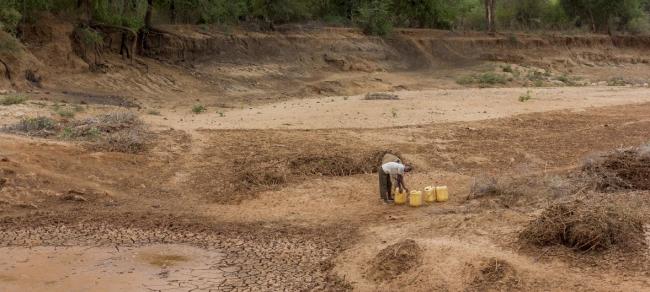
Avoid ‘mutual aggravation’ of the complex link between water scarcity, forced migration, UN agency warns
New York, Mar 21 (JEN): Severe lack of water affecting two-thirds of the global population for at least part of the year is manifesting into complex challenges, the United Nations food security agency has warned, calling for urgent and comprehensive adaptation efforts to address the situation.
The worst impacted are those dependent on agriculture, explained José Graziano da Silva, the Director-General of the UN Food and Agriculture Organization (FAO), noting that some among them, especially the poorest, may see no alternative to migrate and in search of better livelihoods.
“Migration should be a choice, and not the only remaining option,” he stressed.
Exploring this intricate linkages in its new report, Water Stress and Human Migration, the UN agency also found that full information on these dynamics is lacking for India, Central Asia, the Middle East and central Sahel – areas expected to be hit with above-average surface temperature increases and worsening water scarcity in the next 30 years.
Furthermore, inadequate infrastructure coupled with rising temperatures, human demand (such as for agriculture, energy and industrial sectors) and greater rainfall extremes are expected to add to the water stress.
“While some studies demonstrate a correlation between water stress and higher outmigration, the causal interaction is still not clearly understood,” states the report, underscoring the importance to ensure that the water scarcity and migration does not become a case of “mutual aggravation.”
Adapting to water woes can help ease burden
Better adaption strategies, including ones that account for climate change impacts, to mitigate the compulsion to migrate is therefore vital.
“Analyzing water scarcity trends and engaging in preparedness are particularly valuable, allowing time to intervene to mitigate pressure for forced migration,” said Eduardo Mansur, a senior FAO official on water and land issues.
“Enabling proactive adaptation is a more effective and sustainable strategy than offering a reactive humanitarian response in the face of large-scale distress,” he added.
At the same time, the report also highlights that migrants can positively contribute to water management and development in both origin and host communities through good practices, skills and knowledge transfer, and the use of remittances.
In addition, it also calls for increased attention to the concept of environmental migration as well as more data to understand and pre-empt trends in a timely way.
The launch of the report comes ahead of the with World Water Day observed annually on 22 March as well as the World Water Forum, currently underway in the Brazilian capital, Brasilia.
The theme for this year’s World Water Day is ‘Nature for Water’ which exploring nature-based solutions to present-day water challenges.
Flore de Preneuf/World Bank
Support Our Journalism
We cannot do without you.. your contribution supports unbiased journalism
IBNS is not driven by any ism- not wokeism, not racism, not skewed secularism, not hyper right-wing or left liberal ideals, nor by any hardline religious beliefs or hyper nationalism. We want to serve you good old objective news, as they are. We do not judge or preach. We let people decide for themselves. We only try to present factual and well-sourced news.
Support objective journalism for a small contribution.


