


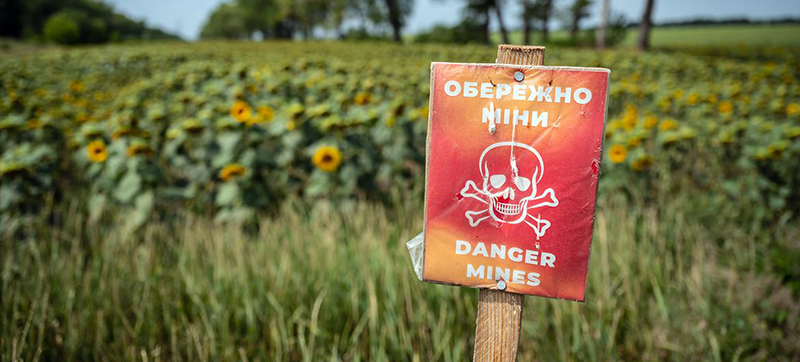
 Ukraine
Agencies join forces with deminers to reclaim agricultural land in Ukraine
New York: Ukraine’s severely damaged agricultural sector will receive a boost from two UN agencies they announced on Thursday, partnering with a Swiss mine action foundation to help make land safe and productive again amidst the ongoing Russian invasion.
The Food and Agriculture Organization (FAO) and the World Food Programme (WFP) have designed a new joint programme for smallholder farmers and rural families most affected by the conflict.
The goal is to clear farmland impacted by the fighting of mines and other explosive remnants of war, safely allowing it to produce crops once again.
The agencies will work jointly with Fondation Suisse de Déminage (FSD), a non-governmental organization based in Geneva, whose core function is demining.
Saving rural livelihoods
According to UN and partners’ Rapid Damage and Needs Assessment, published in February, Ukraine’s production of grain and oilseeds decreased by 37 percent in 2022 following the full-scale invasion.
Almost 90 percent of small-scale crop producers surveyed by FAO in Ukraine reported a decrease in revenue due to the war, and one in four reported having stopped or significantly reduced agricultural activity. The joint initiative will help get the derailed sector back on track.
The programme has already started in the Kharkiv region and will later expand to the Mykolaiv and Kherson regions of Ukraine, focusing on farmers with land plots smaller than 300 hectares as well as rural families growing food for their own consumption.
“Many families and small-scale farmers in front-line regions are not planting this season because they know their fields are dangerous or they are risking their lives to plant on mined lands or contaminated soils,” noted Pierre Vauthier, Head of FAO’s country office.
He hopes that the soil reclamation will secure people’s return to farming while boosting production for domestic and international markets.
Step by step
Using satellite imagery FAO, WFP, and FSD experts will identify and map areas requiring demining. Demining teams will then survey and clear the land, prioritizing plots that can be made safe quickly. Soil testing will also be conducted to assess contamination from exploded weapons.
Meanwhile, FAO and WFP will survey small farmers and rural families to determine their needs for restarting agricultural production and will provide direct in-kind or cash support where possible.
They will also work in partnership with local communities and authorities as well as the Ukrainian food ministry.
“Making the land safe and free of explosive remnants of the war is the first step to rebuilding resilient and prosperous rural communities in Ukraine, who have been on the frontlines of this war,” said Denise Brown, the UN Humanitarian Coordinator in Ukraine, who believes this will help prevent long-term dependence of rural communities on humanitarian assistance.
Thinking long-term
The project, with a total budget of $100 million, currently faces a funding gap of $90 million.
The agencies said that when implemented successfully, the initiative could result in annual savings of up to $60 million in direct food assistance to rural communities.
The move has received support from the UN’s Ukraine Humanitarian Fund and private donors.
Emphasizing its timeliness, Matthew Hollingworth, WFP Representative and Country Director in Ukraine, warned that if urgent action is not taken there would be direct consequences for food security and healthy diets.
Support Our Journalism
We cannot do without you.. your contribution supports unbiased journalism
IBNS is not driven by any ism- not wokeism, not racism, not skewed secularism, not hyper right-wing or left liberal ideals, nor by any hardline religious beliefs or hyper nationalism. We want to serve you good old objective news, as they are. We do not judge or preach. We let people decide for themselves. We only try to present factual and well-sourced news.
Support objective journalism for a small contribution.


