


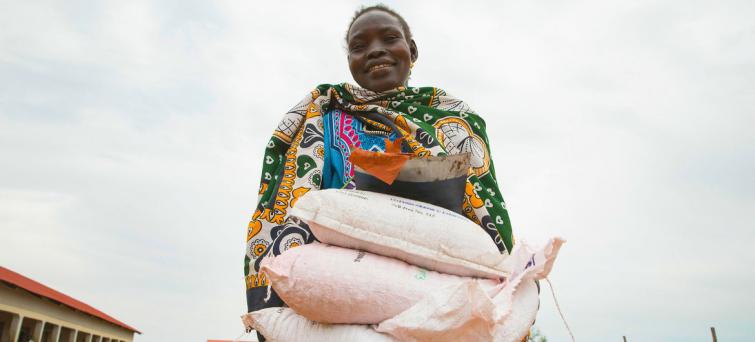
Act now to avert COVID-19 global food emergency: Guterres
New York/IBNS: Although the COVID-19 pandemic could push nearly 50 million more people into extreme poverty, this and other dire impacts of the crisis can be avoided if countries act immediately to shore up global food security, the UN Secretary-General said on Tuesday.
For his latest policy brief on the pandemic, António Guterres focused on the need to safeguard everyone’s access to food and adequate nutrition: for now, and in the future.
“Unless immediate action is taken, it is increasingly clear that there is an impending global food emergency that could have long term impacts on hundreds of millions of children and adults”, he said, in a video message to accompany the launch.
Millions already going hungry
As the Secretary-General pointed out, millions were already grappling with hunger and malnutrition before the pandemic.
While there is more than enough food in the world to feed everyone, more than 820 million people still do not get enough to eat, and numbers no doubt will rise.
Meanwhile, some 144 million children worldwide under the age of five are stunted, meaning they are too small for their age, mainly due to malnutrition.
Guterres added that even in countries with abundant food, COVID-19 risks disrupting food supply chains.
“Our food systems are failing, and the COVID-19 pandemic is making things worse,” he said.
The UN policy brief lays out three main recommendations geared towards saving lives and livelihoods, which also support the transition to a greener future.
Food services essential
First, countries should designate food and nutrition services as essential, while also implementing protections for those who work in the sector.
“It means preserving critical humanitarian food, livelihood and nutrition assistance to vulnerable groups”, the Secretary-General continued, “and it means positioning food in food-crisis countries to reinforce and scale up social protection systems.”
Authorities are also urged to scale up support for food processing, transport and local markets, and to ensure food systems can continue to function by keeping trade corridors open.
Guterres added that relief and stimulus packages must reach the most vulnerable, including small-scale food producers and rural businesses.
Stronger social protection for nutrition
The UN chief underlined the need to strengthen social protection systems for nutrition, which includes supporting the millions of children worldwide currently missing out on school feeding programmes.
“Countries need to safeguard access to safe, nutritious foods, particularly for young children, pregnant and breastfeeding women, older people and other at-risk groups. And they need to adapt and expand social protection schemes to benefit nutritionally at-risk groups”, he said.
Building better food systems
Looking beyond the pandemic, the Secretary-General called for transforming food systems to achieve a more inclusive and sustainable world.
“We cannot forget that food systems contribute up to 29 per cent of all greenhouse gas emissions, including 44 per cent of methane, and are having a negative impact on biodiversity.”
Guterres urged countries to build food systems which address the needs of both producers and workers, and to eradicate hunger by ensuring more people have access to healthy, nutritious food.
Support Our Journalism
We cannot do without you.. your contribution supports unbiased journalism
IBNS is not driven by any ism- not wokeism, not racism, not skewed secularism, not hyper right-wing or left liberal ideals, nor by any hardline religious beliefs or hyper nationalism. We want to serve you good old objective news, as they are. We do not judge or preach. We let people decide for themselves. We only try to present factual and well-sourced news.
Support objective journalism for a small contribution.


