 Captagon
What is Captagon? The dangerous ‘Jihadi Drug’ behind NCB’s massive Rs. 182-crore bust
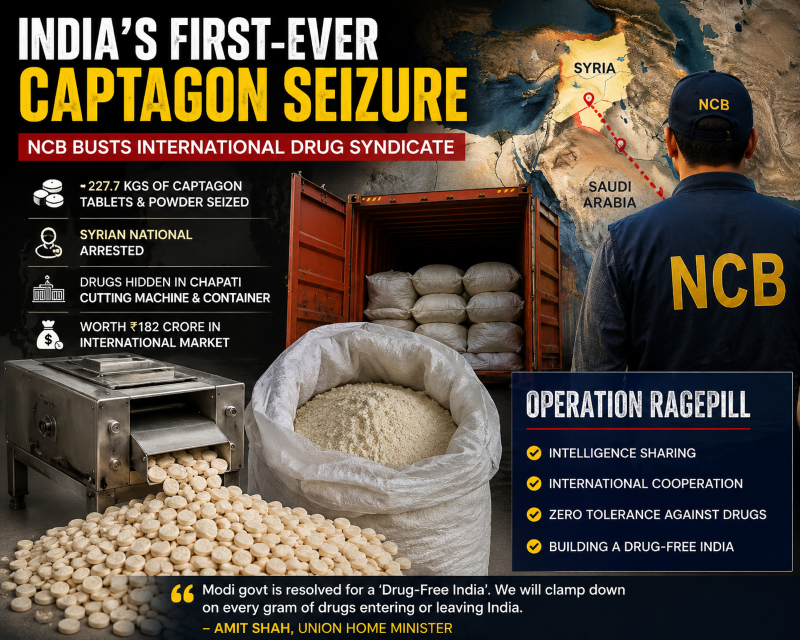
The Narcotics Control Bureau (NCB), under its high-profile Operation RAGEPILL, has unearthed an international drug trafficking syndicate and seized approximately 227.7 kilograms of Captagon tablets and powder, marking India’s first-ever seizure of the notorious psychotropic drug, according to an official government statement.
Authorities have arrested an overstaying Syrian national allegedly linked to the syndicate.
Captagon primarily contains Fenetylline and Amphetamine, both classified as psychotropic substances under India’s NDPS Act.
Modi govt is resolved for a ‘Drug-Free India’.
— Amit Shah (@AmitShah) May 16, 2026
Glad to share that through ‘Operation RAGEPILL’, our agencies have achieved the first-ever seizure of Captagon, the so-called “Jihadi Drug”, worth ₹182 crore.
The busting of the drug consignment destined for the Middle East and…
Union Home Minister Amit Shah congratulated NCB officials for the successful operation, describing it as a major breakthrough in India’s anti-narcotics crackdown.
In a post on X, Shah said: “The Modi government is resolved for a ‘Drug-Free India’. Glad to share that through Operation RAGEPILL, our agencies have achieved the first-ever seizure of Captagon, the so-called ‘Jihadi Drug’, worth ₹182 crore. The busting of the drug consignment destined for the Middle East and the arrest of a foreign national stand out as shining examples of our commitment to zero tolerance against drugs.”
He further asserted that the government would clamp down on every gram of narcotics entering or leaving India through its territory.
The operation was launched after actionable intelligence was received from a foreign drug law enforcement agency indicating that India was being used as a transit route for Captagon trafficking.
Acting on the tip-off, NCB officials identified a rented residence in Neb Sarai, New Delhi, and conducted a raid on May 11, 2026, recovering 31.5 kilograms of Captagon tablets concealed inside a commercial chapati-cutting machine. Preliminary findings suggest the consignment was intended for export to Jeddah, Saudi Arabia.
Investigators revealed that the arrested Syrian national had entered India on a tourist visa on November 15, 2024, which expired on January 12, 2025, after which he remained in the country illegally while renting the Neb Sarai property.
Further interrogation of the accused led investigators to a container at the Container Facilitation Station (CFS) in Mundra, Gujarat, where officials recovered an additional 196.2 kilograms of Captagon powder on May 14, 2026.
The container had been imported from Syria, with sheep wool declared as its official cargo. A detailed search uncovered three concealed bags containing the contraband.
Preliminary investigations suggest the seized consignment was intended for transshipment to the Gulf region, particularly Saudi Arabia and neighbouring Middle Eastern countries, where Captagon abuse has become a major law enforcement and public health challenge.
The total seizure under Operation RAGEPILL is estimated to carry an illicit international market value of approximately ₹182 crore across destination markets in the Gulf and Middle East.
The operation is significant not only because it marks India’s first Captagon seizure but also because it exposes attempts by international drug cartels to misuse India as a transit hub for global narcotics trafficking.
Officials said the case highlights the growing importance of international intelligence-sharing and coordinated enforcement action in dismantling transnational drug syndicates.
The seizure also follows another major recent NCB interception in Mumbai involving 349 kilograms of cocaine concealed in a container originating from Ecuador, pointing to an alarming rise in the misuse of commercial cargo and containerized trade routes for large-scale narcotics smuggling.
The NCB has now launched a comprehensive investigation to trace procurement sources, hawala and financial networks, logistics facilitators, international receivers, and the wider transnational syndicate involved.
India, officials said, remains committed to strengthening international cooperation through intelligence sharing, extradition efforts, and coordinated global action against narco-terrorism and drug trafficking networks.
Support Our Journalism
We cannot do without you.. your contribution supports unbiased journalism
IBNS is not driven by any ism- not wokeism, not racism, not skewed secularism, not hyper right-wing or left liberal ideals, nor by any hardline religious beliefs or hyper nationalism. We want to serve you good old objective news, as they are. We do not judge or preach. We let people decide for themselves. We only try to present factual and well-sourced news.
Support objective journalism for a small contribution.