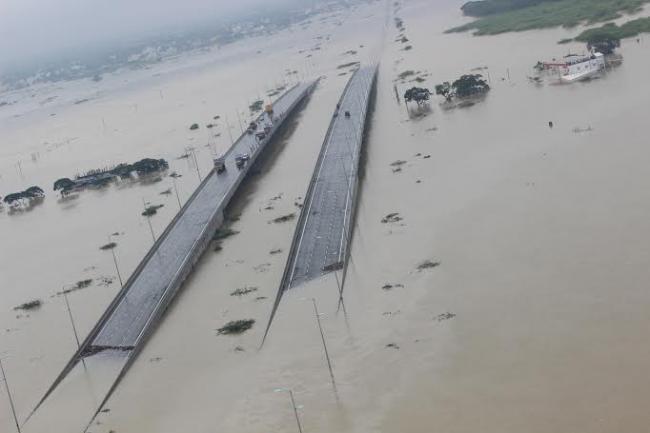
Unregulated urbanisation and climate change-induced extreme weather are the reasons behind the crisis in Chennai: CSE
However, point out experts in Centre for Science and Environment (CSE), Chennai could have fared better if it had protected and preserved its natural water bodies and drainage channels.
Speaking on the subject, CSE director general Sunita Narain said: “We have repeatedly drawn attention to the fact that our urban sprawls such as Delhi, Kolkata, Mumbai, Chennai, Srinagar etc have not paid adequate attention to the natural water bodies that exist in them. In Chennai, each of its lakes has a natural flood discharge channel which drains the spillover. But we have built over many of these water bodies, blocking the smooth flow of water. We have forgotten the art of drainage. We only see land for buildings, not for water.”
Down To Earth, the science and environment fortnightly that CSE helps publish, had earlier reported on the destruction of wetlands in Chennai. In July 2014, Narain wrote about the case of a building collapse in Chennai. The building had been built on the Porur lake. She wrote: “A water body provides services like groundwater recharge and flood management to an otherwise water-starved city. If you ask the obvious question of how construction was permitted on the wetland, you will get a not-so-obvious response: Wetlands are rarely recorded under municipal land laws, so nobody knows about them. Planners see only land, not water and greedy builders take over.”
Water scarcity and flooding
A number of cities including Chennai are both water-scarce as well as prone to flooding. Both problems are related – excessive construction which leads to poor recharge of groundwater aquifers and blocking of natural drainage systems. Says Sushmita Sengupta, deputy programme manager with CSE’s water team: “While Chennai has been struggling to meet its water needs and has been even desalinating sea water at a huge expense, it allowed its aquifers to get depleted.”
CSE’s research shows that Chennai had more than 600 waterbodies in the 1980s, but a master plan published in 2008 said that only a fraction of the lakes could be found in a healthy condition. According to records of the state’s Water Resources Department, the area of 19 major lakes has shrunk from a total of 1,130 hectares (ha) in the 1980s to around 645 ha in the early 2000s, reducing their storage capacity. The drains that carry surplus water from tanks to other wetlands have also been encroached upon.
The analysis also shows that the stormwater drains constructed to drain flood waters are clogged and require immediate desiltation. Chennai has only 855 km of stormwater drains against 2,847 km of urban roads. Thus, even a marginally heavy rainfall causes havoc in the city.
However, Chennai’s human-made drainage is no replacement for its natural drainage systems. A CSE analysis shows that there are natural canals and drains that directly connect the city with wetlands, waterbodies and rivers such as the Cooum and the Adyar that run through Chennai. The Cooum is supposed to collect surplus water from 75 tanks in its catchment area within the Chennai Metropolitan Area, while the Adyar is supposed to carry the surplus water of about 450 tanks in its catchment area and also from the Chembarambakkam tank (which is not in its catchment).
The climate angle
The rains in Chennai have broken a 100-year record (374 mm in just 24 hours). In November, the city had received 1,218 mm of rain, which was almost three times more than the average the city receives (407 mm).
Scientific research has already linked such intense weather phenomena to a changing climate. The IPCC’s 5th Assessment Report clearly says that frequency and intensity of such type of excessive rainfall events will increase in future. The Germany-based Potsdam Institute of Climate Impact Research, in its 2015 study, points out that of the total incidents of excessive rainfall events that happened in the last 30 years, 12 per cent can be contributed to climate change.
A 2006 study by the Indian Institute of Tropical Meteorology (IITM) in Pune had said that extreme precipitation events were increasing in frequency and intensity in India during the period 1950 to the 2000s.
CSE’s climate change experts point out that while detailed attribution studies needed to be done to find out more links between the Chennai catastrophe and climate change, existing scientific studies do establish the possibility of a connection.
Support Our Journalism
We cannot do without you.. your contribution supports unbiased journalism
IBNS is not driven by any ism- not wokeism, not racism, not skewed secularism, not hyper right-wing or left liberal ideals, nor by any hardline religious beliefs or hyper nationalism. We want to serve you good old objective news, as they are. We do not judge or preach. We let people decide for themselves. We only try to present factual and well-sourced news.
Support objective journalism for a small contribution.