 Blue-Collar Jobs
India’s 'blue-collar' exodus warning: Could the country face a plumber and electrician shortage within 5 years?
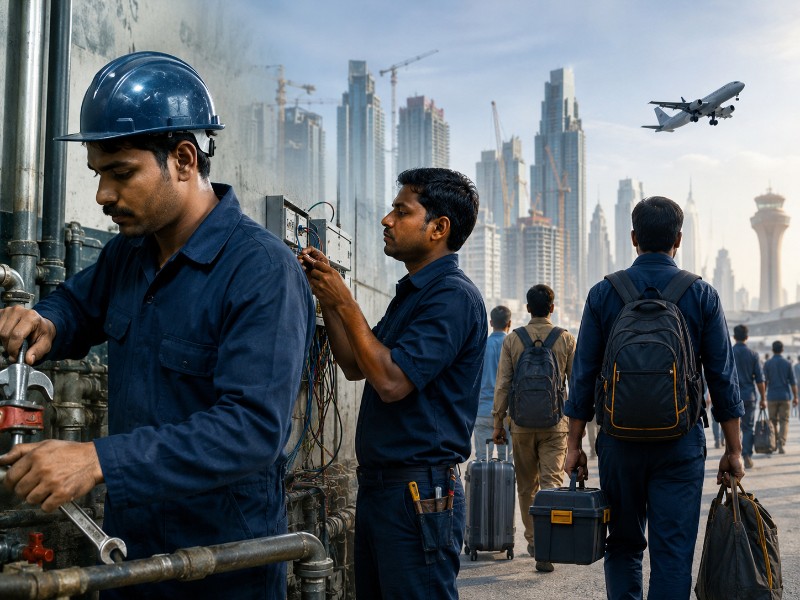
India may soon face an unexpected labour challenge: a shortage of blue-collar workers at home as developed economies increasingly look abroad to fill critical workforce gaps.
The warning comes from Ritesh Jain, founder of the Canada-based macro trends research firm Pinetree, who believes that a growing demographic imbalance across advanced economies is creating a major opportunity for skilled tradespeople in India.
According to Jain, the demand for workers such as plumbers, electricians, carpenters, drivers, nurses and caregivers is likely to surge as ageing populations and declining birth rates leave many wealthy nations struggling to maintain essential services.
In a recent LinkedIn post, Jain argued that the global labour market is becoming increasingly imbalanced, with an oversupply of white-collar workers and a shortage of blue-collar professionals.
He suggested that this trend could eventually leave India grappling with shortages of its own skilled tradespeople as more workers migrate overseas in search of better opportunities.
Ageing populations driving global labour demand
Many developed countries are facing significant demographic shifts.
Falling fertility rates and ageing populations are reducing the size of their working-age populations, creating growing labour shortages across sectors that rely heavily on practical and technical skills.
United Nations projections indicate that the global share of people aged 65 and above has nearly doubled since the 1970s and is expected to rise substantially over the coming decades.
At the same time, the United Nations Population Fund estimates that more than 60 percent of the world's population now lives in countries where fertility rates are below the replacement level required to maintain stable populations.
These demographic changes are creating mounting pressure on labour markets, particularly in industries such as construction, logistics, healthcare, maintenance and skilled trades.
As older workers retire, many countries are struggling to attract younger generations into professions that are essential for economic functioning.
Skilled trades shortages intensify
Labour shortages in skilled trades are becoming increasingly visible across Europe, North America and parts of Asia.
Occupations such as electricians, welders, mechanics, plumbers, and heating, ventilation, and air conditioning technicians are frequently cited as among the most difficult positions to fill.
Surveys conducted across the European Union have shown a sharp rise in the number of businesses reporting difficulties in finding suitably skilled workers.
In Germany, one of Europe's largest industrial economies, labour market data has highlighted widespread recruitment challenges, with employers increasingly struggling to fill vacancies.
The European Labour Authority has consistently identified electricians, mechanics and welders among the occupations experiencing the most acute shortages across member states.
Similar concerns have emerged in the United States, where industry forecasts suggest demand for plumbers, electricians and maintenance professionals will continue to outpace overall employment growth in the coming years.
Experts attribute much of this trend to demographic change.
As populations age and birth rates remain low, developed countries are finding it increasingly difficult to replace retiring workers, particularly in occupations requiring hands-on technical expertise.
Changing workforce strategies
Jain argues that demographic pressures are forcing wealthier nations to rethink how they source labour.
According to his assessment, countries facing shrinking workforces are likely to place greater emphasis on targeted migration programmes focused on sectors experiencing severe shortages.
At the same time, immigration policies in several Western countries have become more restrictive in response to political and social debates surrounding migration.
While businesses continue to advocate for access to foreign labour, governments are increasingly exploring selective pathways that prioritise workers needed in critical industries such as healthcare, construction, agriculture and skilled trades.
Data compiled by international organisations, including the OECD, has shown fluctuations in work-related migration flows as governments adjust visa regulations and labour market policies.
Nevertheless, demand for workers in shortage occupations remains high across many advanced economies.
Research examining migrant integration in Western Europe has also highlighted ongoing challenges in employment, education and social outcomes among some migrant communities, contributing to broader debates about immigration management and labour market needs.
India at the centre of global recruitment efforts
India's large and relatively young population places it in a unique position within the global labour market.
For decades, Indian workers have supplied labour to overseas markets, particularly in the Gulf region, while also contributing significantly to healthcare, construction and service sectors in developed economies.
As labour shortages intensify abroad, policymakers in several countries have proposed measures aimed at attracting foreign workers more efficiently.
These initiatives include expedited visa programmes for caregivers, healthcare professionals and workers in skilled trades.
Such developments could increase demand for Indian workers with technical and vocational expertise.
However, Jain warns that this growing international appetite for skilled labour may eventually create shortages within India itself.
Growing 'white-collar' and 'blue-collar' imbalance
While overseas demand for practical and technical skills rises, India continues to produce millions of graduates entering a highly competitive white-collar job market.
Labour market studies and workforce surveys have repeatedly highlighted elevated unemployment levels among young graduates.
Research indicates that graduate unemployment remains significantly higher than unemployment among less-educated youth, reflecting a mismatch between educational aspirations and available employment opportunities.
Several studies have also pointed to difficulties faced by graduates in securing stable employment during their initial years in the workforce.
At the same time, employers frequently report shortages of workers possessing industry-relevant technical and vocational skills.
This imbalance has fuelled concerns about whether India's education and training systems are adequately aligned with evolving labour market requirements.
Growing demand for skilled workers
Industry forecasts suggest that a substantial share of the jobs India will need to create over the next decade will emerge in sectors such as logistics, construction, manufacturing and essential services.
Many of these roles require technical competencies rather than traditional academic qualifications.
Policy institutes and consulting firms have projected growing demand for workers with vocational and trade-based skills, even as India maintains one of the world's largest labour forces.
However, many blue-collar occupations continue to be associated with informal employment, lower wages and challenging working conditions, factors that often discourage younger workers from entering these professions.
According to Jain, these trends could lead to a significant workforce mismatch.
As skilled tradespeople increasingly migrate to higher-income countries, India may find itself facing shortages in occupations critical to everyday economic activity while simultaneously dealing with a surplus of degree-holders seeking white-collar employment.
Jain has warned that within the next five years, India could experience shortages of plumbers, electricians, carpenters, drivers, nurses and caregivers as demand from developed economies continues to rise.
He argues that the country risks being left with a growing pool of job-seeking graduates while many of the workers most needed by both domestic and international labour markets choose opportunities abroad.
Support Our Journalism
We cannot do without you.. your contribution supports unbiased journalism
IBNS is not driven by any ism- not wokeism, not racism, not skewed secularism, not hyper right-wing or left liberal ideals, nor by any hardline religious beliefs or hyper nationalism. We want to serve you good old objective news, as they are. We do not judge or preach. We let people decide for themselves. We only try to present factual and well-sourced news.