Border peace, mutual trust should be basis of our relations: PM Modi to Xi Jinping at bilateral talks
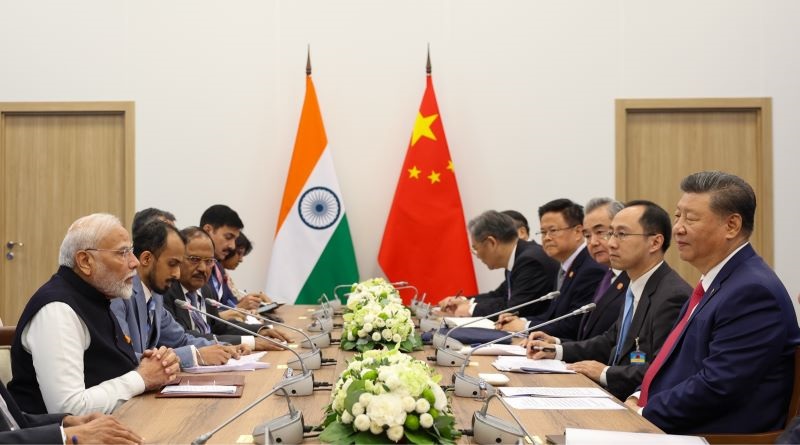
Kazan/IBNS: Prime Minister Narendra Modi and Chinese President Xi Jinping held bilateral talks in Russia on Wednesday for the first time since 2019.
Relations between India and China touched a low in 2020 during the military clash in Ladakh's Galwan due to Beijing's "unilateral" actions of violating the Line of Actual Control, the de-facto boundary between the two countries.
PM Modi and Xi Jinping held bilateral talks in Kazan on the sidelines of the BRICS Summit.
The meeting follows the successful patrolling arrangement between India and China along the Line of Actual Control, which has faced multiple turmoils over the last few years.
The breakthrough in the patrolling arrangement comes four years after the Galwan Valley clash and signals a move towards de-escalation in a region where both countries stationed tens of thousands of troops.
Speaking during the bilateral talks, PM Modi said: "Excellency, I am happy to meet you, and like you mentioned, this is a formal meeting between us after five years. It is my belief that the importance of India-China relations is not just for the citizens of our two countries, but also very significant for peace, stability, and progress for the entire world."
Modi underscored the importance of the consensus reached on the issues that sprung up in the last four years along the border.
"It should be our priority to ensure there is peace and stability along our border. Mutual trust, mutual respect, and mutual sensitivity should be the basis our bilateral relations. Today, we have got an opportunity to speak about all these issues and I trust that we will hold these talks with an open mind and that our talks will be constructive going forward. Thank you," the Indian PM said.
Met President Xi Jinping on the sidelines of the Kazan BRICS Summit.
— Narendra Modi (@narendramodi) October 23, 2024
India-China relations are important for the people of our countries, and for regional and global peace and stability.
Mutual trust, mutual respect and mutual sensitivity will guide bilateral relations. pic.twitter.com/tXfudhAU4b
The meeting is seen as an upturn in the India-China relationship following a consensus on patrolling arrangements along the Line of Actual Control that had faced multiple hiccups over the last few years.
Speaking at the meeting, Xi Jinping said: "Mr Prime Minister, it is my great pleasure to meet you here in Kazan. It is the first time for us to have a formal (bilateral) meeting in five years time.Both the people in our two countries and the international community are paying close attention to our meeting."
He said both China and India are ancient civilisations, major developing countries, and important members of the Global South.
"We are both at a crucial phase in our respective modernisation endeavours. It best serves the fundamental interest of our two countries and two peoples for both sides to keep to the trend of history and the right directions of our bilateral relations." Jinping stated.
He underscored the importance of having more communication and cooperation while properly handling "our differences and disagreements".
"It is also important for both sides to shoulder our international responsibility, set an example for boosting the strength and unity of the developing countries, and to contribute to promoting multipolarisation and democracy in international relations," he said.
What was the Galwan clash?
On June 15, 2020, Indian and Chinese troops engaged in a six-hour clash in the rugged terrain of Ladakh, engaging in hand-to-hand combat with makeshift weapons such as stones, batons, and iron rods.
The face-off occurred in near-complete darkness and freezing temperatures, leading to fatalities as soldiers fell or were pushed from ridges.
Twenty Indian soldiers were martyred in the clash, while China officially acknowledged four casualties, although reports indicate higher Chinese losses, as soldiers drowned in the choppy waters of the Galwan River.
Support Our Journalism
We cannot do without you.. your contribution supports unbiased journalism
IBNS is not driven by any ism- not wokeism, not racism, not skewed secularism, not hyper right-wing or left liberal ideals, nor by any hardline religious beliefs or hyper nationalism. We want to serve you good old objective news, as they are. We do not judge or preach. We let people decide for themselves. We only try to present factual and well-sourced news.
Support objective journalism for a small contribution.