Bengaluru ranked India's most congested city, Mumbai second
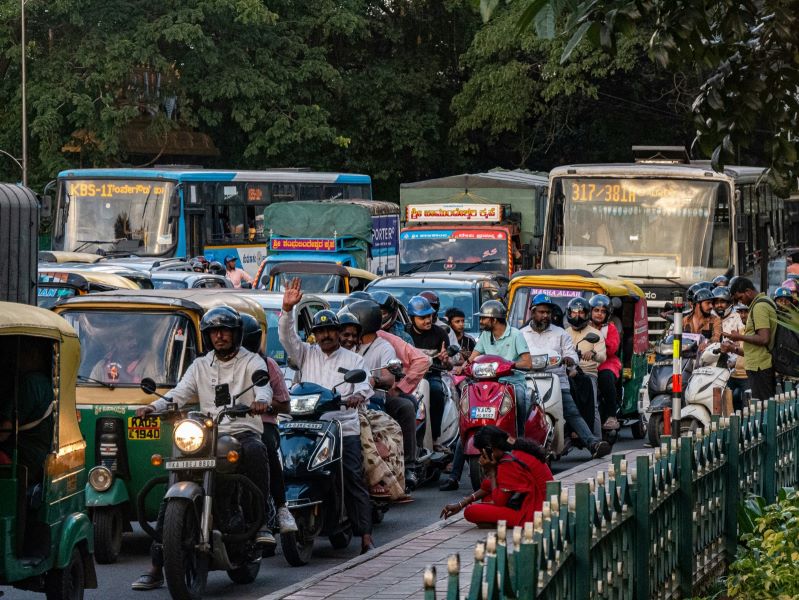
New Delhi: Bengaluru has claimed the title of India’s most congested city with the country’s financial capital Mumbai occupying the second position, according to the newly released Traffic Quality Index (TQI).
The index, which evaluates traffic conditions, places India's IT hub in the extreme congestion category with a score between 800 and 1,000.
Mumbai follows closely with 787 points, while Delhi and Hyderabad rank third and fourth with scores of 747 and 718, respectively.
The report was presented at the Mobility Symposium organized by Move In Sync, an employee commute solution provider. According to the data, 8 a.m. is the best time to navigate Bengaluru’s streets, while congestion peaks at 6 p.m.
Move In Sync co-founder Deepesh Agarwal noted that the TQI is modelled after the air quality index (AQI) to provide a clearer understanding of traffic conditions.
Bengaluru’s notorious Silk Board Junction, one of the city's most congested spots, has seen notable improvements in traffic flow.

Image Courtesy: wikipedia.org
However, the double-decker flyover inaugurated in July has significantly eased traffic congestion, reducing delays for commuters.
According to Deputy Commissioner of Police (Traffic-East) Kuldeep Kumar Jain, the number of congestion alerts at Silk Board has dropped by 50 percent, falling from 24 daily alerts to 15, said a Hindustan Times report.
The flyover has also shortened traffic queues, with the average queue length shrinking from 19 km to 10, offering much-needed relief to drivers.
Despite these improvements, Joint Commissioner of Police (traffic) Anucheth M N admitted that managing peak-hour traffic remains a major challenge, even with the aid of AI-powered cameras and 9,000 CCTV cameras that feed data into traffic management systems, reported Deccan Herald.
In an effort to further alleviate congestion, the traffic department plans to implement advanced traffic simulators at 55 major junctions.
O P Agarwal, a senior advisor at WRI India, highlighted the need for a deeper understanding of Bengaluru’s specific traffic problems, stressing that the solutions should be customized for the city's unique conditions, according to Deccan Herald.
Meanwhile, Bengaluru police are enhancing their AI-driven surveillance to address the city's widespread traffic violations, according to the Hindustan Times report.
The updated system will now monitor 13 types of offenses and automatically issue fines to violators.
Currently, the AI-powered cameras detect violations like speeding, using mobile phones while driving, not wearing helmets or seat belts, running red lights, and triple riding on two-wheelers.
The new upgrade will also capture offenses such as illegal number plates, wrong-side driving, overloaded goods vehicles, damaged mirrors, and illegal parking.
Infosys director Mohandas Pai has proposed that the Bangalore Metropolitan Transport Corporation (BMTC) consider public-private partnerships to tackle the bus shortage, in the same way the Ministry of Civil Aviation stepped back from operating airlines, according to Deccan Herald.
According to a report by TNIE, Pai proposed developing a "digital twin" of Bengaluru to track traffic patterns hourly, daily, and yearly over the past five years. He said that analyzing these trends would help pinpoint traffic congestion hotspots, allowing targeted interventions by specialized teams.
Pai further recommended that urban expert R K Misra form a team of top tech professionals, much like how Nandan Nilekani spearheaded the Aadhaar project, to help resolve Bengaluru's persistent traffic woes.
Support Our Journalism
We cannot do without you.. your contribution supports unbiased journalism
IBNS is not driven by any ism- not wokeism, not racism, not skewed secularism, not hyper right-wing or left liberal ideals, nor by any hardline religious beliefs or hyper nationalism. We want to serve you good old objective news, as they are. We do not judge or preach. We let people decide for themselves. We only try to present factual and well-sourced news.
Support objective journalism for a small contribution.