Hungarian author László Krasznahorkai wins 2025 Nobel Prize in Literature
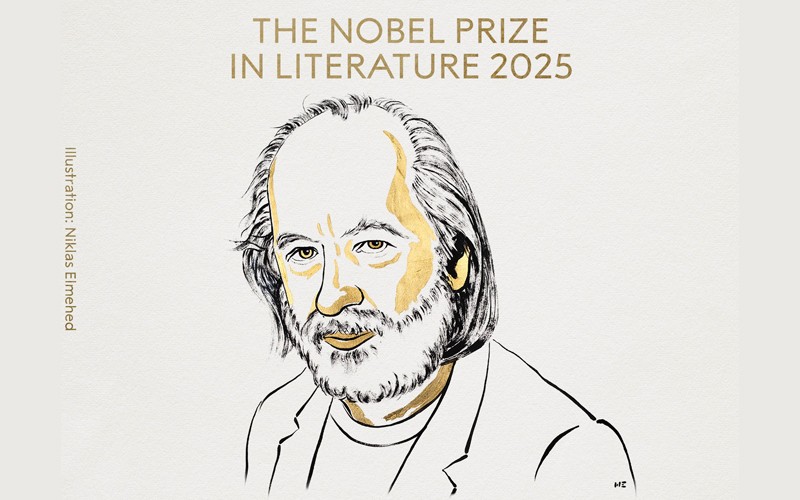
Hungarian novelist László Krasznahorkai, known for his darkly poetic, labyrinthine prose and haunting depictions of a collapsing world, has been awarded the 2025 Nobel Prize in Literature, the Swedish Academy announced on Thursday.
The Academy praised him for “a compelling and visionary body of work that, amid apocalyptic dread, reaffirms the enduring force of art.”
BREAKING NEWS
— The Nobel Prize (@NobelPrize) October 9, 2025
The 2025 #NobelPrize in Literature is awarded to the Hungarian author László Krasznahorkai “for his compelling and visionary oeuvre that, in the midst of apocalyptic terror, reaffirms the power of art.” pic.twitter.com/vVaW1zkWPS
At 71, Krasznahorkai becomes the first Hungarian writer to receive the Nobel Prize in Literature since Imre Kertész in 2002.
He joins a select group of European modernists whose works push the boundaries of language and narrative form.
Often described as a “master of the apocalypse,” Krasznahorkai is revered for novels that fuse philosophical depth with despairing humor.
His sentences stretch across pages, weaving together chaos and grace in portraits of individuals adrift in decaying societies.
His celebrated debut, Satantango (1985), set in a desolate Hungarian village, was adapted into a seven-hour film by director Béla Tarr, with whom Krasznahorkai has maintained a decades-long collaboration.
Other major works include The Melancholy of Resistance and Baron Wenckheim’s Homecoming, which won the U.S. National Book Award for Translated Literature in 2019.
Critics have compared his style to Kafka and Beckett for its bleak humor and unflinching confrontation with despair.
Krasznahorkai will receive the Nobel medal, diploma, and 11 million Swedish kronor (about $1 million) during the official award ceremony in Stockholm on December 10, the anniversary of Alfred Nobel’s death.
This year’s choice, literary observers noted, signals the Swedish Academy’s renewed appreciation for ambitious, complex writing rather than mass-market appeal.
News of the award sparked celebrations among Hungary’s literary community and global admirers of his work.
Critics called the selection “bold” and “fitting,” pointing out that Krasznahorkai’s novels, though often demanding, capture the anxieties of modern life and the persistence of hope through art.
Support Our Journalism
We cannot do without you.. your contribution supports unbiased journalism
IBNS is not driven by any ism- not wokeism, not racism, not skewed secularism, not hyper right-wing or left liberal ideals, nor by any hardline religious beliefs or hyper nationalism. We want to serve you good old objective news, as they are. We do not judge or preach. We let people decide for themselves. We only try to present factual and well-sourced news.
Support objective journalism for a small contribution.