


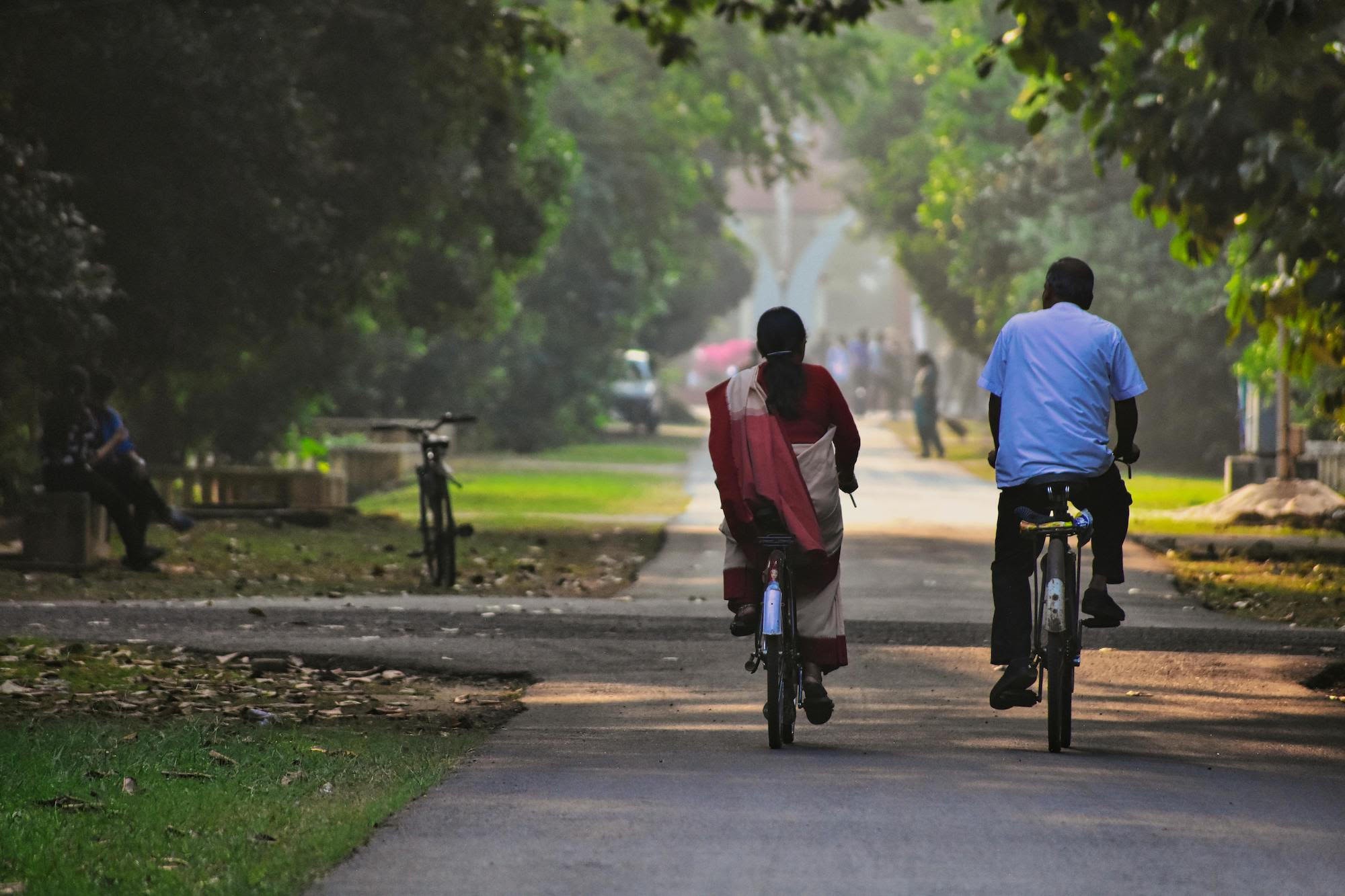
Cycling for Clean Air? India’s Riders Still Battle Dust, Danger and Neglect
Bicycling has been promoted in India to reduce emissions and improve public health, but a new study reveals gaps in policy, implementation and gender equity. Researchers recommend talking to cyclists to learn how they navigate the roads, and what their needs and concerns are, in order to create stronger policies. Mongabay India correspondent Aisiri Amin reports
In 2025, a district collector, a Union Minister, and a cycling advocacy group were motivated by the same thought: cycling for a pollution-free future. At the beginning of the year, BYCS India Foundation, a cycling advocacy group, urged major political parties to prioritise making Delhi a bicycle-friendly city.
In August, Union Minister for Youth Affairs and Sports, Mansukh Mandaviya, echoed the sentiment, framing cycling as “a solution to pollution.” And in December, Andhra Pradesh’s NTR District Collector G Lakshmisha emphasised the importance of cycling not just for personal fitness, but to reduce emissions.
With more research highlighting that cycling can reduce pollution and move towards net-zero carbon goals, there has been a push to promote the familiar leisure activity as a climate solution.
However, a new study, published in Nature Cities, examined bicycling culture in cities of four low- and middle-income countries — Delhi and Chennai in India, Dhaka in Bangladesh and Accra in Ghana — and found barriers including lack of physical infrastructure as well as policy, implementation and gender gaps.
India is the sixth most-polluted country, according to the 2025 World Air Quality Report by IQAIR, with Delhi ranking as the fourth most polluted city worldwide.
“Whenever air pollution rises in Delhi, the conversation turns to reducing vehicular emissions. The government and the media advocate using public buses and bicycles instead of cars. But this is ironic because the government acts as an advocate, but nothing is done to improve the actual conditions that discourage their use,” says Rahul Goel, co-author of the study and an assistant professor at the Transportation Research and Injury Prevention Centre at the Indian Institute of Technology Delhi.
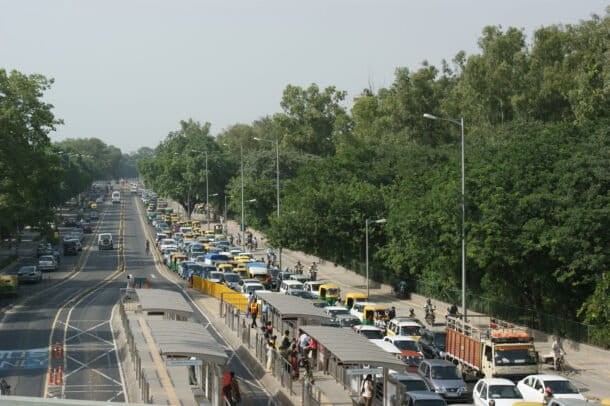 Traffic in Delhi. When air pollution rises in Delhi, the government advocates using public buses and bicycles. However, nothing is done to improve the actual conditions (like lack of public infrastructure) that discourage their use, say experts. Image courtesy of IFPRI via Flickr (CC BY-NC-ND 2.0).
Infrastructure gaps and beyond
In February, residents in Gurgaon took to the streets on foot and by cycle to protest against high pollution levels. The participants reportedly took a pledge to prioritise walking and cycling to encourage others to choose sustainable ways of transport. With pollution levels consistently increasing, causing severe health risks, there has been more attention on non-motorised transport.
But the study shows that over the last two decades, the motor vehicle fleet has increased by 600%, making transport the fastest-growing contributor to greenhouse gas emissions in India. In major cities, transport accounts for nearly 30% of emissions, the study highlights. The researchers also note that the largest reductions are linked to shifts to low-carbon transport such as bicycling, which is also recognised by the Intergovernmental Panel on Climate Change (IPCC).
The study finds that there is a limited understanding of how to increase cycling. The core issue is systemic, says Goel. “Bicycle infrastructure isn’t treated as routine practice in road engineering. Bicycle tracks are often added as special projects, as part of beautification. When major roads are built or upgraded, cycling infrastructure isn’t automatically included,” he explains.
He further adds that failure is most stark for cyclists because the infrastructure barely exists, and it’s minimal at best. Without basic infrastructure, how can cycling be promoted in the nation, he asks.
Sonal Shah, founder of The Urban Catalysts, an organisation focused on developing sustainable transport, points out that there are barely any unobstructed, levelled, and shaded paths, ones that don’t get encroached by vehicles during peak hours. “Compounding this is the lack of safe intersections such as traffic signals for pedestrians and cyclists and bicycle boxes,” she adds.
The study also reveals a stark disconnect. While urban planning mentions bicycling in cities such as Delhi, efforts to improve bicycling and equitable mobility through bicycle distribution under government schemes and philanthropic efforts are conducted with “little data on the mode and its user experience.”
Moreover, Sharif Qamar, fellow and associate director of the Transport and Urban Governance Division at The Energy and Resources Institute (TERI), notes that “transport decision-making has tended to prioritise motorised modes.” Interestingly, in a country where more than half of the working population travels by walking or bicycling, a major part of infrastructure investment focuses on motorised transportation.
Qamar points out that in Indian cities, in cases of road congestion, approvals for interventions such as flyovers, underpasses, and tunnels are often relatively straightforward. In contrast, cycling infrastructure typically involves lengthy, more complex processes and lacks enforcement against encroachment by motorised vehicles. He adds that similar patterns can also be observed in many Tier 2 and Tier 3 cities. “The big-ticket infrastructure projects that favour motorists are given preference over solutions that are economical or impactful in reducing pollution or emissions,” he says.
Qamar also adds that on Indian roads, highways, expressways, city roads, and even rural areas, cyclists lack acceptance. “People look down on cyclists in ways that directly threaten their safety. This is a major behavioural and social issue,” he says.
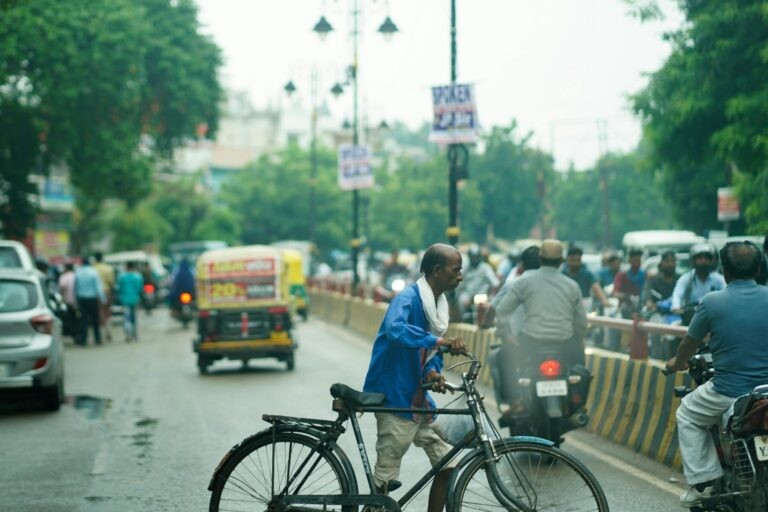 Experts say that despite over half of India’s working population travelling by walking or cycling, most infrastructure is designed for motorised transportation and is unsafe for cyclists. Hardly any unobstructed paths remain without encroachment by motor vehicles, while a lack of safe intersections persists. Image by Arto Suraj via Pexels.
Dust pollution and road conditions
Dust pollution and road conditions are causes of concern for cyclists, says Qamar. “Dust comes under the PM 10 category, and it is a major issue because cyclists and pedestrians are the first line of impact.”
Cyclists are exposed to vehicular fumes and dust from tyre friction on roads, Kannan shares. “As non-enclosed vehicle users who spend longer on roads, cyclists have extended exposure. For the same distance, cyclists stay on roads longer than two-wheeler or car users.”
When considering road conditions, there are multiple dimensions to consider, Kannan says. “Road surface condition, speed limits and management, how vehicles interact with each other, to name a few.” Potholes and sandy road surfaces can make cycling difficult. “Roads may also include medians, which are often designed for uninterrupted automobile movement but can make it difficult for bicyclists to cross. Any construction debris, fallen tree branches, or sand piles are usually pushed to the road edges, where cyclists usually ride,” she adds.
Qamar points out that dust pollution and road conditions are often not part of conversations regarding bicycling lanes. “The lanes are looked at from a construction and implementation perspective, not from the cyclists’ perspective. So, how many people are using the lanes and whether the existing lanes are usable by cyclists is still unclear,” he says.
Lack of policies puts cyclists at risk
Over the years, India has launched non-motorised initiatives such as the Cycles4Change Challenge in 2020, under the Smart Cities Mission, Ministry of Housing and Urban Affairs, Government of India, to support Indian cities in implementing cycling-friendly initiatives. However, bicycle lanes remain congested or absent in many cities in India.
The work undertaken under this initiative “has not met the expectations of the benefits they could accrue, particularly with respect to creation of dedicated cycle tracks,” Qamar says.
In cities like Delhi, Shah observes that many bicycle tracks are used by cars, two-wheelers and autos. “There is no enforcement ensuring that the bicycle track is accessible and safe. While cities like Bengaluru have implemented bicycle lanes, these were encroached by parked vehicles, and the lanes don’t provide security from unruly traffic,” she explains.
In 2023, 4,560 cyclist deaths were reported on Indian roads, according to the Road Accidents in India 2023 report by the Ministry of Road Transport and Highways (MoRTH).
Furthermore, Shah says that in the current ecosystem, there is limited political will for promoting bicycling. “The main argument provided is that we have a very low share of cyclists,” she says.
The study evidences that some cities in high-income countries have made large investments in bicycling infrastructures, which have led to increased bicycling, decreased car use, reduced vehicular emissions and improved air quality. Many low- and middle-income countries such as Bangladesh, Colombia and India have followed these examples to invest in bicycling infrastructure, but the researchers highlight that development plans, traffic, and demographics are different.
Qamar stresses that the same solutions and infrastructure as high-income countries cannot be replicated in India without taking the local context, including geographical and demographic factors, into account. “There is a need to understand what works for India and what cyclists need,” he says.
Bicycling is largely undertaken by low-income adult men, as observed on the arterial roads in Ghana, Delhi, and Dhaka, which reflects the difference between cycling as a necessity and as an option, according to the study. Even while implementing cycling policies, it’s often presented as an option, but for a significant number of people in the country, there is no other choice. This means the lack of physical infrastructure and safety constantly puts their lives at risk on a daily basis.
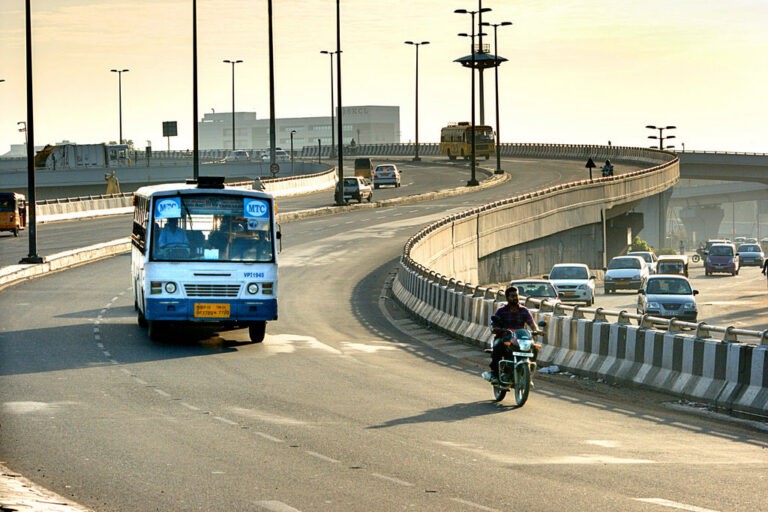 A flyover in Chennai. In Indian cities, solutions for road congestion often come as straightforward approvals for flyovers, underpasses, and tunnels. In contrast, cycling infrastructure typically involves lengthy, more complex processes and lacks enforcement against encroachment by motorised vehicles. Image by Simply CVR via Flickr (CC BY-ND 2.0).
Gender bias in cycling culture
While infrastructure and policy have been talked about in cycling cultures, gender barriers remain a key challenge, but are often underreported. Goel points out that India is an extremely gender-unequal country, and it seeps into transport as well. “Transport is only one of many spheres where gender inequality becomes extremely visible,” he says.
The inequality isn’t that women don’t cycle, it’s that they cycle in different spaces, says Smruthi Bala Kannan, the lead author of the study and an assistant professor at Madras Institute of Development Studies. “During the study, we saw women as pillion riders, as passengers on bicycles. But very few women were actively riding bicycles on arterial roads,” Kannan explains. The study also found more women cyclists on arterial roads in Chennai than in the other three cities.
Kannan also stresses that the unequal access to vehicles, especially in resource-poor households, is a reason for fewer female cyclists. “When there are multiple vehicles in the house, there seems to be a hierarchy of who gets to use which vehicle and how far they travel, and the kind of use they put these vehicles to,” Kannan says.
Moreover, while men learn riding by themselves or with friends, women are often dependent on family members to learn, Shah adds.
Kannan also highlighted that the women’s cycling patterns differed markedly from the men’s. “Women used bicycles for shorter trips to work and made multiple stops along the way, doing household errands, and stopping occasionally. But men travelled longer distances and took more direct routes,” she says.
Prakash P. Gopinath, co-founder of SheCycling, a women’s cycling programme, says there is a taboo that’s stubbornly cemented in cycling culture. “While it’s common for young boys and men to cycle, young girls and women are discouraged. They are told to depend on men for their travel needs and even mocked for wanting to learn,” he explains. SheCycling was started in Kochi, and now it’s present in other cities in Kerala and in Srinagar, Leh, and Pune.
Along with a lack of cycling space, accessibility to cycles, and training, Zeenath M A, co-founder of SheCycling, also points out that women constantly face eve-teasing and inappropriate behaviour on the road, which creates additional barriers for them.
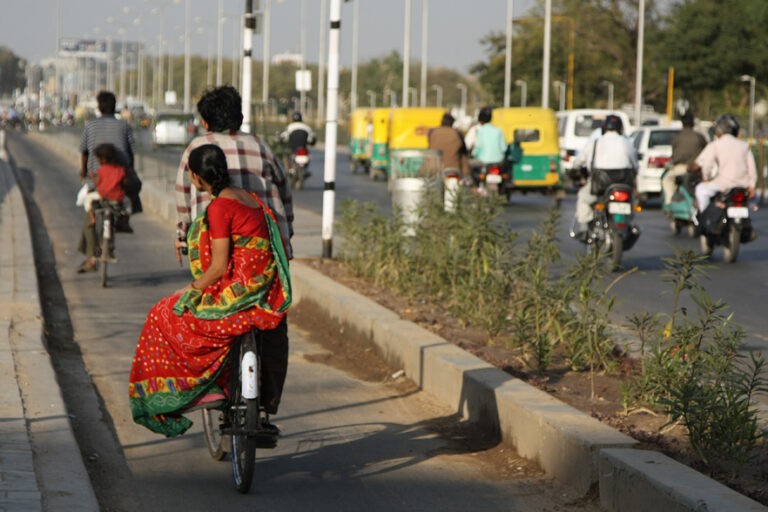 Aside from infrastructure and policy, gender barriers are also a key and often underreported challenge in cycling culture. During the study, researchers saw women as pillion riders, with very few riding bicycles themselves. Image by Meena Kadri via Flickr (CC BY-NC-ND 2.0).
What solutions could look like
The study also reveals an irony — bicyclists are “predominantly poor, politically disempowered and invisible to most policymakers.” But infrastructural interventions for bicyclists and organised advocacy usually happen in elite parts of the four cities aimed at converting car use. In this light, promoting cycling as a climate solution raises questions.
Goel emphasises that conversations about implementing cycling policies, building safer infrastructure, and providing comprehensive support for cycling to thrive are important, but they shouldn’t claim that they alone will solve the pollution problem, which is a multi-sectoral problem.
“Cycling requires sustained effort over years and a vision of widespread adoption before its pollution benefits materialise,” he says.
When it comes to addressing vehicular pollution, Shah questions why the focus is not on managing the demand for private vehicles. “A key change is to restrict and make it expensive to use your personal car simultaneously, while building the ecosystem for sustainable modes of transport,” he says.
For instance, SheCycling started in 2023 by teaching women from Kudumbashree, a women-led self-help group in Kerala that includes domestic workers and others doing small, informal jobs, mostly from lower-middle-income communities. To date, they have taught more than 800 women, including ASHA workers and anganwadi teachers. “About 40% of the women we taught are now riding,” says Gopinath. We need more such initiatives, he adds.
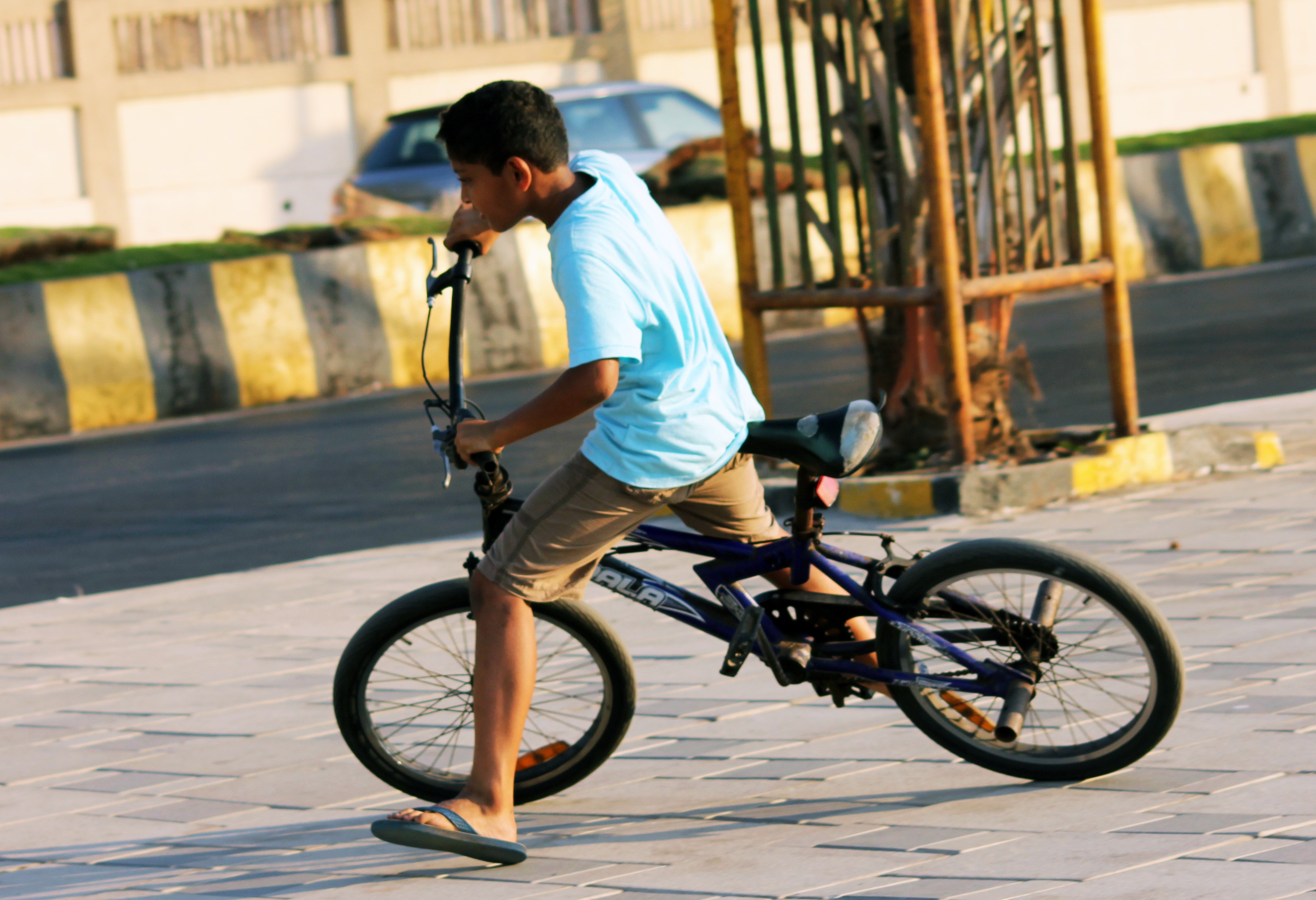 A young boy manoeuvres his bicycle. Photo: Pixabay
Kannan says talking to cyclists can help in learning from the geographies they occupy, how they navigate the roads, and what their needs and concerns are. “You don’t have to start from scratch, as there are already things that are working for bicyclists. For instance, there are bicycle distribution schemes offered by governments in different states, which are important to enable everyday bicycling alongside the policies’ goal of access to education and work,” she says.
However, the proposal of cycling as a solution for pollution contrasts with harsh realities. Shah also points out that it is also not safe to cycle when your city is polluted: “How do you promote cycling as a solution when it is unsafe to cycle or walk with extreme pollution and heat? How do you ask people to cycle when the environment makes it harmful?” she says.
While reducing vehicular emissions is a priority, there is a need for a long-term vision when it comes to seeing cycling through the solutions lens.
Mongabay India/TWF
Support Our Journalism
We cannot do without you.. your contribution supports unbiased journalism
IBNS is not driven by any ism- not wokeism, not racism, not skewed secularism, not hyper right-wing or left liberal ideals, nor by any hardline religious beliefs or hyper nationalism. We want to serve you good old objective news, as they are. We do not judge or preach. We let people decide for themselves. We only try to present factual and well-sourced news.
Support objective journalism for a small contribution.


