World in grip of ‘high impact weather’ as US freezes, Australia sizzles, parts of South America deluged
New York, Feb 2 (IBNS):“High impact weather” has gripped much of the world so far this year, the UN weather agency, WMO, reported on Friday, with “dangerous and extreme cold in North America, record high heat and wildfires in Australia, heavy rains in parts of South America, and heavy snow on the Alps and Himalayas.
The WMO assessment of January’s weather, published on Friday, describes it as “a month of extremes”, with large parts of North America gripped by bitterly cold temperatures, caused by the influence of the Polar Vortex.
In southern Minnesota, reports the UN weather agency, the wind chill factor pushed readings down to minus 65°F (-53.9°C) on 30 January. The national low temperature record was measured at minus 56 °F (-48.9°C).
“Disturbances in the jet stream and the intrusion of warmer mid-latitude air masses can alter the structure and the dynamics of the Polar Vortex, sending Arctic air south into middle latitudes and bringing warmer air into the Arctic. This is not a new phenomenon, although there is increasing research into how it is being impacted by climate change”, the agency said.
But climate sceptics should be careful before equating the frigid conditions, with a rejection of the inexorable rise in global temperatures due to global warming, or rising carbon dioxide emissions: “The cold weather in the eastern United States certainly does not disprove climate change”, said WMO Secretary-General Petteri Taalas.
“In general, and at global level, there has been a decline in new cold temperature records as a result of global warming. But frigid temperatures and snow will continue to be part of our typical weather patterns in the northern hemisphere winter. We need to distinguish between short-term daily weather and long-term climate’, he added.
While The eastern US and parts of Canada are seeing record-breaking cold temperatures, Alaska and large parts of the Arctic have been warmer than average.
During January, severe winter storms also hit the eastern Mediterranean and parts of the Middle East, severely affecting vulnerable populations lacking adequate shelter, including refugees.
A cold front in the third week of January that swept south through the Arabian Peninsula, bringing a widespread dust storm from Egypt to Saudi Arabia, Bahrain, Qatar, Iran and the United Arab Emirates, also brought heavy rain and precipitation to Pakistan and northwest India, reports WMO.
Record Alpine snow
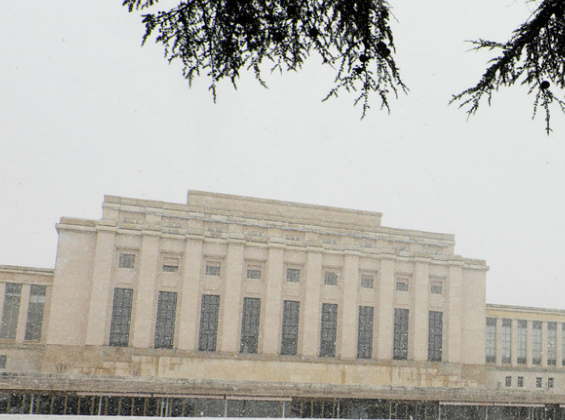
Parts of the European Alps saw record snowfalls earlier in January. In Hochfilzen in the Tirol region of Austria, more than 451 centimetres of snow fell in the first 15 days, an event statistically only expected once a century. On Friday, staff at the UN Office in Geneva were advised to leave early due to major whiteout conditions.
The German weather service or Deutscher Wetterdienst, DWD, also issued a number of top-level snow and winter weather warnings. Climate projections show that winter precipitation in Germany is expected to be more intense this winter.
The Indian Meteorological Department issued warnings on 21 January of heavy or very heavy rain and snow for Jammu and Kashmir and Himachal Pradesh, prompting warnings of avalanches amid an intense cold front.
Australia, warmest January on record
Meanwhile, down under, Australia had its warmest January on record, according to its Bureau of Meteorology. The month saw a new series of heatwaves unprecedented in their scale and duration, said the UN weather agency. Overall rainfall was 38% below average for January.
Australia saw an unusual extended period of heatwaves which began in early December 2018 and continued into January 2019. The city of Adelaide reached a new record high of 46.6°C on 24 January.
Australia's annual mean temperature has warmed by just over 1 °C since 1910, and summer has warmed by a similar amount. Australia's annual warming trend is consistent with that observed for the globe, according to the Bureau of Meteorology.
Heatwaves are becoming more intense, extended and frequent as a result of climate change and this trend is expected to continue.
South America: more record heat, rain, flooding
Elsewhere in the southern hemisphere, heat records tumbled in Chile. A weather station in the capital Santiago set a new record of 38.3°C on 26 January. In other parts of central Chile, temperatures topped 40°C.
Argentina has also been gripped by a heatwave, prompting a number of alerts about high temperatures. Northeast Argentina, and the adjacent parts of Paraguay, Uruguay and Brazil have been hit with extensive flooding, with well above the long-term expected average rainfall.
On January 8, the Argentine city of Resistencia recorded 224mm of rainfall, settin a new 24-hour rainfall record, much higher than the previous highest of 206mm, recorded in January 1994, according to the national meteorological service, SMN Argentina.
Support Our Journalism
We cannot do without you.. your contribution supports unbiased journalism
IBNS is not driven by any ism- not wokeism, not racism, not skewed secularism, not hyper right-wing or left liberal ideals, nor by any hardline religious beliefs or hyper nationalism. We want to serve you good old objective news, as they are. We do not judge or preach. We let people decide for themselves. We only try to present factual and well-sourced news.
Support objective journalism for a small contribution.