 Nepal PM
India, Nepal, China to join hands? Balen Shah’s big Himalayan climate proposal at UNGA
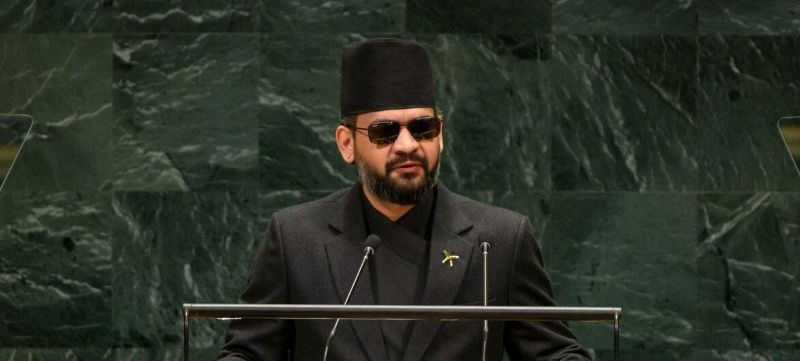
Nepal Prime Minister Balen Shah made his UN General Assembly debut on Friday, proposing the creation of a Himalayan Climate Resilience Mechanism led by Nepal, India and China to help combat the growing threat of climate-related disasters.
Shah said rising temperatures were destabilising the Himalayan ecosystem, with melting permafrost contributing to unstable mountain slopes and increasing the risks of avalanches, floods and landslides.
The devastation, he added, extends across Nepal’s border with China and downstream towards India.
“Climate change does not recognise borders. Glaciers and floods do not travel with a visa stamped on passports,” Shah said.
Nepal contributes less than 0.1 per cent of global greenhouse gas emissions, he said, yet climate-related disasters repeatedly destroy infrastructure and livelihoods, forcing the country to borrow money for reconstruction.
“Climate justice cannot just remain a beautiful phrase in a United Nations document,” Shah said.
He proposed a Himalayan Climate Resilience Mechanism led by Nepal, India and China that would facilitate the sharing of satellite data and technical expertise, monitor dangerous glacial lakes, strengthen early-warning systems and coordinate cross-border disaster assistance.
Shah also called for greater grant-based climate financing, arguing that the Loss and Damage Fund, Global Environment Facility and other existing mechanisms remain “grossly inadequate”.
“When the house is burning, we do not ask the family to complete fifty forms. We act,” he said.
Bringing a stark warning from the Himalayas to the UN General Assembly, Shah said catastrophic floods that killed at least 1,400 people in Nepal had exposed the human cost of climate change and the failure of the international system to adequately protect those least responsible for it.
Addressing the general debate of the Assembly’s 81st session, Shah said the Bhotekoshi-Trishuli disaster in northern Nepal four weeks earlier had swept through mountain communities with a ferocity he described as a “Himalayan tsunami”.
More than 6,000 people remain missing, while the damage is estimated at around 10 per cent of Nepal’s gross domestic product, he said.
“The Bhotekoshi-Trishuli disaster was not just a local tragedy, it was a warning to the world,” Shah said. “And I ask you today: Have we really heard that warning?”
Support Our Journalism
We cannot do without you.. your contribution supports unbiased journalism
IBNS is not driven by any ism- not wokeism, not racism, not skewed secularism, not hyper right-wing or left liberal ideals, nor by any hardline religious beliefs or hyper nationalism. We want to serve you good old objective news, as they are. We do not judge or preach. We let people decide for themselves. We only try to present factual and well-sourced news.
Support objective journalism for a small contribution.