 August Heat
Earth just recorded its hottest August ever — Here’s what’s driving the heat
Newly released weather data has revealed that Earth recorded its hottest August on record, with the effects of extreme heat felt across the globe.
The record was documented in monthly climate reports from the European Union’s Copernicus Climate Change Service, the United States National Oceanic and Atmospheric Administration (NOAA) and NASA.
The World Meteorological Organization (WMO) said on Friday that the extreme temperatures had impacts around the world.
August 2026 was the warmest August on record. It was also the warmest summer on record for North America and Western Europe.
— World Meteorological Organization (@WMO) September 11, 2026
From record-high temperatures to heavy storms, This map from @NOAA shows the recent weather & climate events around the world. https://t.co/uzEoTDVkoQ pic.twitter.com/59fHdhsBBH
The Northern Hemisphere experienced its hottest summer on record, while the Southern Hemisphere recorded a near-record warm winter.
Meanwhile, sea ice coverage in both the Arctic and Antarctic remained below average in August.
Heatwaves and drought
Western Europe experienced heatwaves in August, extending an exceptional period of extreme heat that began in May. Severe drought conditions were reported in France, Hungary, Romania, Serbia and the United Kingdom.
Large parts of central and eastern Europe also experienced widespread dryness during August, with some areas continuing to face drought conditions that began in May.
Water flow levels were exceptionally low in several major European rivers, including the Rhine, Danube, Southern Bug and Dnieper.
Why was August so hot?
El Niño was among the factors contributing to the record climate conditions in August, according to the WMO.
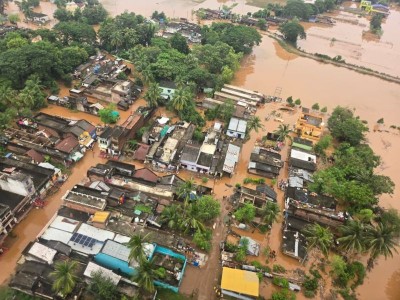
The climate pattern influenced global tropical cyclone activity, as well as heavy rainfall and flooding in some countries.
Other regions experienced drought, with El Niño conditions contributing to the intensification of seasonal wildfires in Indonesia, according to the Copernicus Atmosphere Monitoring Service (CAMS).
What does it mean?
Data shows that all 10 of the warmest Augusts on record have occurred since 2016.
The global average surface air temperature in August was 1.65°C above the estimated pre-industrial baseline, according to the latest data.
Meanwhile, global surface temperatures were 1.32°C above the 20th-century average, making it the warmest August since records began in 1850, according to the US National Centers for Environmental Information.
Predictions for the impact of El Niño are also concerning.
“It is now firmly established and will intensify into a very strong event in the coming months, with big impacts on rainfall and temperature patterns well into 2027,” the WMO said in its latest El Niño Update.
Tracking the global climate
Organizations around the world monitor and track global climate conditions.
The WMO uses datasets from the Copernicus Climate Change Service, NOAA, NASA and other institutions for its State of the Global Climate reports.
The UN weather agency is expected to present an update on this year’s climate at the next UN climate conference, COP31, which will be held in Antalya, Turkey, in November.
Support Our Journalism
We cannot do without you.. your contribution supports unbiased journalism
IBNS is not driven by any ism- not wokeism, not racism, not skewed secularism, not hyper right-wing or left liberal ideals, nor by any hardline religious beliefs or hyper nationalism. We want to serve you good old objective news, as they are. We do not judge or preach. We let people decide for themselves. We only try to present factual and well-sourced news.
Support objective journalism for a small contribution.