


Reef 'sun shield' trials show promise to prevent coral bleaching
New York, Mar 27 (IBNS): A ‘sun shield’ made from an ultra-thin surface film is showing promise as a potential weapon in the fight to protect the Great Barrier Reef from the impacts of coral bleaching.
Great Barrier Reef Foundation Managing Director Anna Marsden said the results from a small-scale research trial led by the scientist who also developed Australia’s polymer bank notes were very encouraging.
The project was supported by The Tiffany & Co. Foundation, made possible through a grant to the University of Melbourne USA Foundation.
“We’ve partnered with scientists from the University of Melbourne and the Australian Institute of Marine Science to develop sun protection for the Reef,” Marsden said.
“The ‘sun shield’ is 50,000 times thinner than a human hair and completely biodegradable, containing the same ingredient corals use to make their hard skeletons – calcium carbonate. It’s designed to sit on the surface of the water above the corals, rather than directly on the corals, to provide an effective barrier against the sun.
“While it’s still early days, and the trials have been on a small scale, the testing shows the film reduced light by up to 30%.
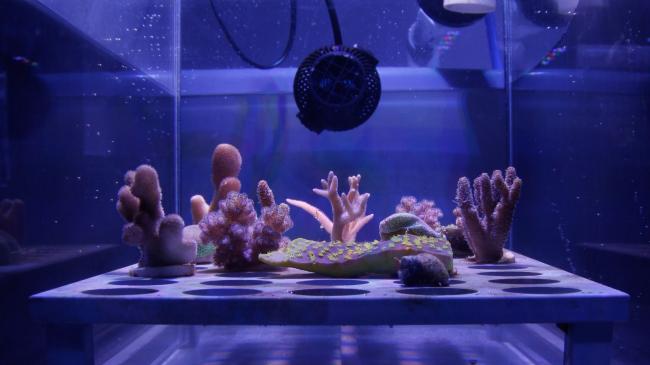
“Scientists tested the effectiveness of the one molecule thick film on seven different coral species in simulated coral bleaching event conditions at the Australian Institute of Marine Science’s National Sea Simulator (SeaSim).
“The surface film provided protection and reduced the level of bleaching in most species.”
With the surface film containing the same ingredient that corals use to make their skeletons, the research also showed the film had no harmful effects on the corals during the trials.
“This is a great example of developing and testing out-of-the-box solutions that harness expertise from different areas. In this case, we had chemical engineers and experts in polymer science working with marine ecologists and coral experts to bring this innovation to life,” Marsden said.
“The project set out to explore new ways to help reduce the impact of coral bleaching affecting the Great Barrier Reef and coral reefs globally and it created an opportunity to test the idea that by reducing the amount of sunlight from reaching the corals in the first place, we can prevent them from becoming stressed which leads to bleaching.
“It’s important to note that this is not intended to be a solution that can be applied over the whole 348,000 square kilometres of Great Barrier Reef – that would never be practical. But it could be deployed on a smaller, local level to protect high value or high-risk areas of reef.
“The concept needs more work and testing before it gets to that stage, but it’s an exciting development at a time when we need to explore all possible options to ensure we have a Great Barrier Reef for future generations.”
The research team comprised of Professors Greg Qiao and David Solomon and Dr Joel Scofield from the University of Melbourne, Dr Emma Prime (formerly University of Melbourne, now Deakin University), and Dr Andrew Negri and Florita Flores from the Australian Institute of Marine Science.
Professor Solomon (AC) was the winner of the Prime Minister’s Prize for Science in 2011 for his exceptional contributions to polymer science.
Image: Great Barrier Reef Foundation website
Support Our Journalism
We cannot do without you.. your contribution supports unbiased journalism
IBNS is not driven by any ism- not wokeism, not racism, not skewed secularism, not hyper right-wing or left liberal ideals, nor by any hardline religious beliefs or hyper nationalism. We want to serve you good old objective news, as they are. We do not judge or preach. We let people decide for themselves. We only try to present factual and well-sourced news.
Support objective journalism for a small contribution.


