


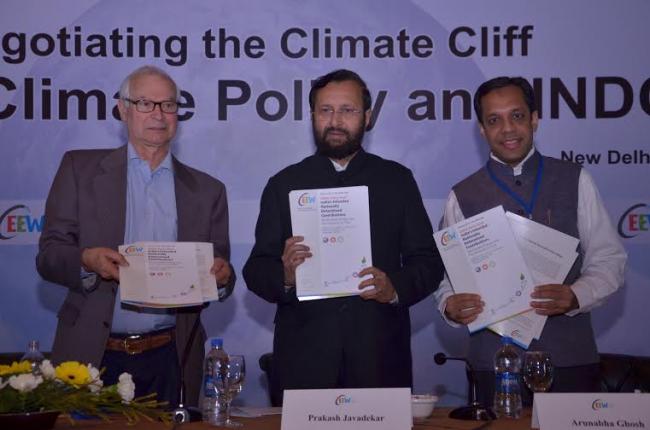
India playing a leadership role in fight against climate change: Javadekar
He elaborated, “Since the last half century, emissions across the world have only been increasing. The developing world is now asking the developed world if they will vacate carbon space. In India’s case INDCS are not just intended, as we have already started implementing some of the actions that will form of the core of India’s contributions. My government has already begun work on achieving India’s 100 GW solar target and we are optimistic about meeting our clean energy goals. We are committed to make our earth liveable and business doable, where every citizen will have access to fresh air and water. But we can’t have supernormal profits built into technology costs. India can do more if finance and technology were available.”
Javadekar was speaking at a climate conference organised by the Council on Energy, Environment and Water (CEEW), focusing on the road to the Paris climate negotiations scheduled for later this year.
He also released CEEW’s report on ‘India’s INDCs: Renewable Energy and the Pathway to Paris’ CEEW is India’s top-ranked climate think-tank and specialises in integrated modelling and analysis of energy, climate, water and other natural resources.
Every country has to submit its “Intended Nationally Determined Contributions” (INDCs) before the Paris climate negotiations, to announce its actions and targets regarding mitigating or adapting to climate change. After the US-China announcement in November 2014, all eyes are on India and what its INDCs would constitute. Any strategy for India has to be based on analytical approaches, which seek to understand potential transition pathways, role of key technologies, investment requirements, and impact on India’s energy systems and emissions. A potential framework would be to integrate India’s concerns and develop a strategy, which would focus on (energy) access, (resource) efficiency and (environmental) externalities within the climate negotiation agenda.
Explaining the key objective of the conference, Jamshyd Godrej, Co-Chairperson CEEW, said, “2015 is a crucial milestone in the long journey that we have to collectively embark upon in confronting the challenge of man-made climate change. Post the announcements from the EU, US and China; the world is waiting for India’s announcements to see how a large economy with many core development needs is able to balance them with the need to respond to climate change. This Climate Conference is the start of a conversation in India, which ought to deepen through this year, leading up to the Paris Conference of the Parties and beyond.”
Dr Arunabha Ghosh, CEEW’s CEO, added, “The INDCs present an important opportunity for India to showcase its climate leadership through the communication of its past, present and future ambitions in the climate arena. India’s climate strategy should be developed on two formats: pressing major emitters to increase their mitigation targets; and ramping up its own ambition to reduce the vulnerability of its own population to climate risks. CEEW’s analysis suggests that India could push its ambition towards a target of 1,041 billion units of electricity from renewable energy sources by 2030. This would be greater than the cumulative electricity generation from all sources in 2013-14. However, this ambitious target would add a significant burden to the economy and may even make electricity unaffordable to a large section of its population. Therefore, it is imperative that discussions around technology partnerships and financial mechanisms be an important pillar of any new climate agreement.”
Support Our Journalism
We cannot do without you.. your contribution supports unbiased journalism
IBNS is not driven by any ism- not wokeism, not racism, not skewed secularism, not hyper right-wing or left liberal ideals, nor by any hardline religious beliefs or hyper nationalism. We want to serve you good old objective news, as they are. We do not judge or preach. We let people decide for themselves. We only try to present factual and well-sourced news.
Support objective journalism for a small contribution.


