


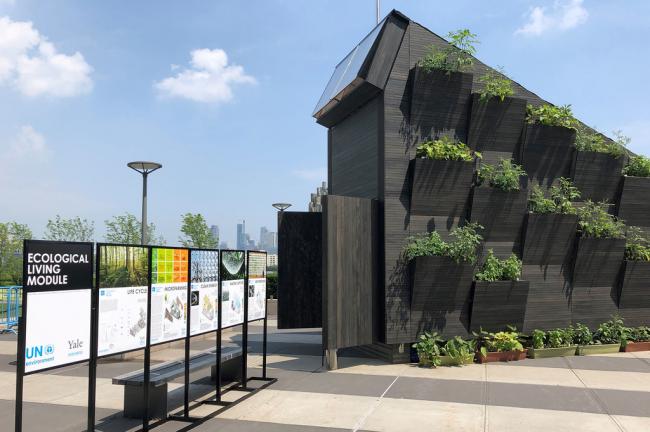
COP24: Huge untapped potential in greener construction, says UN environment agency
New York, Dec 8 (IBNS): Noting some progress in greening the global construction industry, the United Nations environment agency (UNEP) co-released a report on Friday at the COP24 climate conference in Katowice, Poland, sounding the alarm on the need for “dramatic action” to reduce the sector’s greenhouse gas emissions.
“It’s critical we have a big change over the next couple of years in how we do buildings and construction”, said Joyce Msuya, Deputy Executive Director of UNEP. “We only need to look at the current norms and quality of many buildings to see that we can do so much better,” she said, emphasizing that “we need to raise the bar in energy-efficient, green buildings and far better practice in construction.”
Currently, buildings account for close to 40 per cent of the world’s greenhouse gas emissions and 36 per cent of all energy consumption. In the report, which was co-authored by the International Energy Agency (IEA), UNEP warned that “dramatic action will be needed by governments, cities and business if the global buildings and construction sector is to cut its carbon footprint in line with international agreements.”
Titled ‘Towards a Zero-Emission, Efficient and Resilient Buildings and Construction Sector’, the report was presented against the backdrop of ongoing COP24negotiations on how to move ahead with the implementation of the climate action agreement adopted in Paris, in 2015, when 197 parties committed to limiting global warming to 1.5°C above pre-industrial levels.
The development of new techniques, tools, products and technologies – such as heat pumps, better windows, stronger insulation, energy-efficient appliances, renewable energy and smarter design – has enabled emissions to stabilize over the past few years.
There are other encouraging signs. Several property, construction, cement and steel-manufacturing firms are among the 500 companies (representing trillions of dollars in revenue) which have aligned their emission reduction targets with the Paris Agreement; and the 71-member private sector network, the World Green Building Council non-profit organisation, is advocating for all buildings to emit zero net emissions by 2050.
There is huge potential to reduce the current level of emissions, but action has been too slow, environmentalists say. To meet the goals of the Paris Agreement, the Global Alliance for Buildings and Construction, hosted by UNEP, is targeting a 30 per cent energy use improvement in the buildings and construction sector.
Buildings are ‘key driver of energy demand’
What will make things even more challenging, is that the number of new buildings is anticipated to grow rapidly in the coming years, especially in the urban areas of Africa and Asia.
“Buildings are a key driver of energy demand, and developments within the sector such as the growing uptake of air conditioners are having a big impact on energy and environmental trends at the global level,” said Dr. Fatih Birol, Executive Director of the International Energy Agency, which is an autonomous intergovernmental organization.
In particular, the data raises a red flag over the sharply rising demand for cooling systems and air conditioners; linked with improving living-standards in developing countries coupled with rising temperatures in many parts of the globe, due to climate change. Since 2010, the energy used by cooling systems has increased by 25 per cent and there are now more than 1.6 billion air conditioning units in service.The new report highlights a major gap between the amount of money spent on energy efficient solutions and the rapidly growing amount invested in building construction and renovation. “If we don’t make buildings more efficient, their rising energy use will impact us all, whether it be through access to affordable energy services, poor air quality or higher energy bills,” warned Dr. Birol.
One of the commitments of the Paris Agreement is for countries to develop and scale-up their own national climate action plans but, to date, only 104 plans mention specific actions to enhance energy-efficiency in buildings, building codes and energy certifications. Very few tackle the issue of construction materials – such as steel and cement – and the carbon emissions involved in their manufacturing.
Another area of action recommended by the report is the need for building standards to evolve towards buildings that are more resilient in the face of climate change and extreme weather events, such as storms and hurricanes, floods, high winds and soaring temperatures.
UN News/Matt Wells
Support Our Journalism
We cannot do without you.. your contribution supports unbiased journalism
IBNS is not driven by any ism- not wokeism, not racism, not skewed secularism, not hyper right-wing or left liberal ideals, nor by any hardline religious beliefs or hyper nationalism. We want to serve you good old objective news, as they are. We do not judge or preach. We let people decide for themselves. We only try to present factual and well-sourced news.
Support objective journalism for a small contribution.


