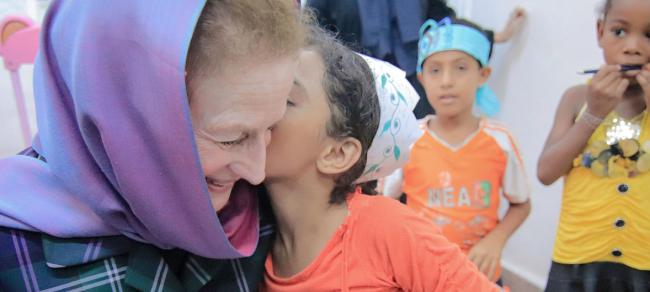
Yemen: ‘No justification for this carnage,’ says UNICEF chief, as children in need now outnumber population of Switzerland
New York, July 4 (IBNS): The relentless conflict in Yemen has pushed a nation already on the brink “deep into the abyss,” said the United Nations Children’s Fund (UNICEF) chief on Tuesday, after returning from a four-day visit to the war-torn country.
“Social services are barely functional. The economy is in ruins. Prices have soared. Hospitals have been damaged. Schools have turned into shelters or have been taken over by armed groups,” UNICEF Executive Director Henriette Fore told journalists in Geneva on Tuesday, describing her trip to the key cities of Aden and Sana’a.
Having witnessed first-hand the effects of three years of intense war, after decades of underdevelopment and chronic global indifference can do to children, Ms. Fore spelled out some of what children there are going through.
She said that they were routinely “taken out of school, forced to fight, married off, hungry, dying from preventable diseases,” she began, adding that “today, 11 million children in Yemen – more than the entire population of Switzerland – need help getting food, treatment, education, water and sanitation.”
Since 2015, health facilities have been cut by more than half; 1,500 schools have been damaged by airstrikes and shelling; and at least 2,200 children have been killed with around 3,400 injured, according to the UNICEF chief.
“These are only numbers we have been able to verify. The actual figures could be even higher,” she said. “There is no justification for this carnage.”
“It was the opposite of the world surrounding her, one of displacement, destruction and fear,” Ms. Fore said.Ms. Fore described some of the individual children she met, such as a young girl receiving psychological support after fleeing violence in the port city of Hodeida - which is living under the threat of a major offensive - who presented her with a drawing of the world she wished to live in.
She described visiting health facilities, and a ward for malnourished children where an eight-month old child weighed that of a newborn. In a neonatal intensive care unit, she heard how a pair of conjoined twins simply could not get the surgery they needed to survive. She said she had met committed, overstretched health staff who had not been paid in two years: “And yet the conflict goes on,” said the UNICEF chief.
She explained that around 5,000 families had fled Hodeida over the past two weeks, where basic commodities including flour and cooking gas were dwindling, electricity was unavailable in most of the city and damage to the water supply had caused severe shortages
The Executive Director called it “critical” that families be allowed to voluntarily leave and that infrastructure be kept safe. “The protection of children – from landmines, recruitment, exploitation and attack – should remain paramount at all times,” Ms. Fore added
Since January, more than 250 UNICEF staff have remained in Aden, Sanaa, Idlib, Hodeida and Saada – serving children while dealing with life in a war zone.
“We are committed to doing all we can to help the children and young people of Yemen but there should be a political solution to the conflict,” she stressed. “We all need to give peace a chance. It is the only way forward,” concluded the UNICEF chief.
UNICEF
Support Our Journalism
We cannot do without you.. your contribution supports unbiased journalism
IBNS is not driven by any ism- not wokeism, not racism, not skewed secularism, not hyper right-wing or left liberal ideals, nor by any hardline religious beliefs or hyper nationalism. We want to serve you good old objective news, as they are. We do not judge or preach. We let people decide for themselves. We only try to present factual and well-sourced news.
Support objective journalism for a small contribution.