


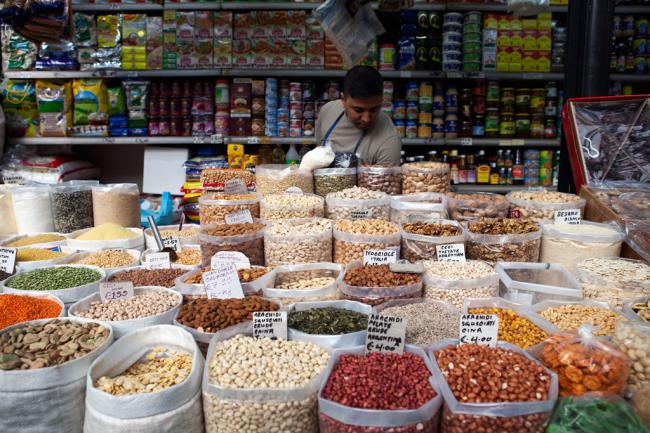
'Year of Pulses' closes with call to build on strong momentum among famers, private sector – UN
“It is essential to maintain the momentum,” FAO's Deputy Director-General Maria-Helena Semedo told the Year's official closing ceremony on Friday, which was hosted by Burkina Faso, according to a news release.
Realizing that pulses – defined as edible dried seeds of plants in the legume family – are “small but powerful allies” in achieving the Sustainable Development Goals (SDGs), the UN General Assembly designated 2016 as the International Year and nominated FAO to lead implementation.
Since the Year's launch, connections have been fostered among key actors from farmers' organizations to the private sector to facilitate information exchange and policy dialogue on the production, trade and consumption of pulses.
Leaders in policy and research have tackled the top pulse issues at several international forums, and national committees have been established. A technical pulses database was created, a cookbook featuring recipes from international chefs was published, and the official multilingual website, with over half a million visits, promoted a rich array of information on pulses.
Though the Year has now officially closed, there has been a sound call to keep the momentum alive and continue activities beyond 2016.
“Training programmes on the value of pulses should be supported, particularly for schoolchildren, farmers and extension workers. Policies and programmes should focus more on pulse producers, particularly small-holder farmers and young people,” Semedo said, noting that FAO will carry on working with stakeholders from governments to family farmers to promote pulses.
Pulses are packed with minerals such as iron, zinc and folate and have been an important part of diets around the world for centuries.
Pulses are a valuable ingredient in achieving UN Sustainable Development Goal 2 which aims to end hunger, achieve food security and improved nutrition, and promote sustainable agriculture.
The plants contribute to climate change adaptation and mitigation. They add large amounts of beneficial nitrogen to the soil and require little fertilizer. Growing pulses with other crops enhances soil fertility, improves both crops' yields, and contributes to a more sustainable food system.
In addition, pulses have a very low water footprint compared to other protein sources, can be grown in very poor soils, and help reduce the risk of soil erosion and depletion. For poor farmers, growing pulses contributes to stable livelihoods, additional income and improved nutrition.
Burkina Faso's President, Roch Marc Christian Kaboré, said: “To better cope with the triple problem of soil fertility management, reducing the adverse effects of climate change and the issue of food security, producing and consuming pulses is a great opportunity, especially for the most vulnerable people.”
Overall, global pulse production has been slowly but steadily increasing. In 2014, global production reached 77 million tonnes, up 21 million metric tonnes since 2001.
Photo: FAO/Marco Salustro
Source: www.justearthnews.com
Support Our Journalism
We cannot do without you.. your contribution supports unbiased journalism
IBNS is not driven by any ism- not wokeism, not racism, not skewed secularism, not hyper right-wing or left liberal ideals, nor by any hardline religious beliefs or hyper nationalism. We want to serve you good old objective news, as they are. We do not judge or preach. We let people decide for themselves. We only try to present factual and well-sourced news.
Support objective journalism for a small contribution.


