 AI
AI
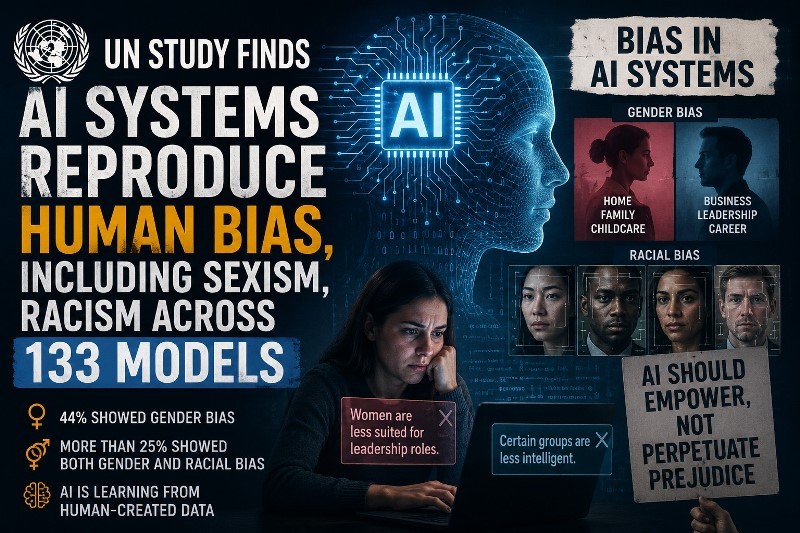
UN study finds AI systems reproduce human bias, including sexism, racism across 133 models
With the widespread use of generative AI, a UN report which studied 133 AI systems found that 44 per cent demonstrated gender bias, while more than a quarter showed both gender and racial bias.
Large language models have repeatedly associated women with the home, family and childcare, while linking men to business, leadership and career success.
In some cases, AI systems have generated responses portraying women as sexual objects or as subordinate to men.
According to UN Women, when researchers asked large language models to simply complete a sentence that began with a person's gender, about one in five responses came back sexist or misogynistic.
Some even described women as property, as objects.
Not a design flaw
These outcomes, experts say, are not random errors or a glitch in AI, but instead a pattern documented across systems at scale.
They are the predictable output of AI systems trained on decades of unequal representation of women and men, UN Women notes.
Speaking to UN News, Jayathma Wickramanayake, UN Women Lead on Digital Technologies, explained that AI models “pull bias from decades of text written by people, about people, in a world where women were filed under home and family, and men were filed under business and career”.
For Wickramanayake, the most worrisome part is that this is not a design flaw – “it’s a real policy gap that was left wide open”.
Of 138 countries assessed worldwide, only 24 referred to gender in their national AI strategies, and just 18 included substantive gender-responsive measures.
For the UN Women digital expert, this isn’t a bug waiting to be fixed in the next update, “it’s a choice that we make over and over in training data, in design rooms, in policy documents that stay silent on half of the population”.
Online harms intensifying
For many women and girls, the risks extend beyond stereotypes. Women already face disproportionate levels of abuse online, and AI is making some forms of violence easier to create and spread.
According to UN Women data, nearly one in four surveyed women human rights defenders, activists and journalists reported experiencing AI-assisted online violence. Twelve per cent said personal images had been shared without their consent, while six per cent reported being targeted by deepfakes or manipulated images and videos.
As AI-generated content becomes the norm, concerns are growing that harassment, manipulation, and image-based abuse will become harder to detect and prevent.
Missing from the table
At the same time, women remain underrepresented in the industries developing the technology, raising concerns that the future of artificial intelligence is being built without their perspectives reflected in the blueprint.
Although AI is expected to drive growth across technology-focused sectors, women account for only 30 per cent of the global AI workforce, the International Labour Organization (ILO) said.
UN Women warns that the people building these systems do not adequately reflect the diversity of the populations they are intended to serve.
Without greater participation by women and other underrepresented groups, the organisation says, existing biases risk becoming embedded in future technologies.
Economic disruption falls hardest on women
The economic impact of AI may also fall unevenly. Women are nearly twice as likely as men to hold jobs that face a high risk of automation outside the AI sector. The effects can be compounded by other factors, including race, disability, income and geography.
As AI transforms labour markets, UN Women warns that communities already facing exclusion may be pushed further behind unless targeted action is taken.
A choice that will shape the future
UN Women stresses that when developed responsibly, artificial intelligence can help identify stereotypes, expand representation and improve accessibility. But whether these benefits are realised will depend on who is involved in shaping the systems, and whose experiences are reflected in their design.
UN Women is calling for gender equality — and the rights and experiences of women and girls — to be integrated at every stage of the AI lifecycle, from development through to deployment and governance.
As governments, technology companies and international organisations gather in Geneva next month, its message is clear: if women and girls are not included in building the future of AI, the inequalities of the past risk being carried into the technologies of tomorrow.
UN Women stressed that when designed with safety and used with intention, AI can do the opposite of the harms now being documented. It can detect stereotypes rather than reproduce them, broaden representation instead of narrowing it, and improve accessibility at scale for those current systems often overlook.
Support Our Journalism
We cannot do without you.. your contribution supports unbiased journalism
IBNS is not driven by any ism- not wokeism, not racism, not skewed secularism, not hyper right-wing or left liberal ideals, nor by any hardline religious beliefs or hyper nationalism. We want to serve you good old objective news, as they are. We do not judge or preach. We let people decide for themselves. We only try to present factual and well-sourced news.
Support objective journalism for a small contribution.