


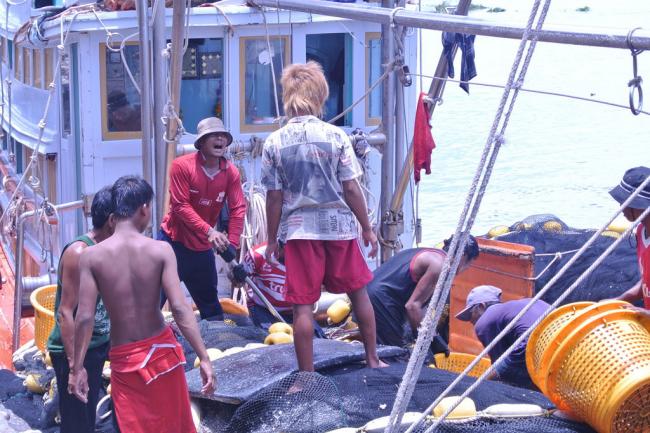
UN agencies, Vatican issue call to stamp out illegal fishing and ‘modern-day slavery’ on high seas
“We have to guarantee that the seafood reaching our plates has been produced not only in an environmentally sustainable manner, but also in a manner that supports the socio-economic well-being of those who harvest and process it,” the Director-General of the UN Food and Agriculture Organization (FAO), José Graziano da Silva, told a gathering on Monday.
Cardinal Pietro Parolin, the Vatican Secretary of State delivered a message of the Holy See, condemning “the tragic reality that within the fishing industry there are hundreds of thousands of internal and transnational migrants who are trafficked for forced labour.”
Similarly, Gianni Rosas, the Director of the International Labour Organization (ILO) Office for Italy and San Marino, equated the situation of abused fisheries workers to “modern-day slavery,” suffering horrific conditions on board vessels for months, even years at a time.
Worse still, at times they are “doped up” on amphetamines – extremely potent central nervous system stimulants – to “keep up” with the workload. They also lack the most basic of labour protection – deceptive recruitment, hardly any written contracts and few trade unions. Where regulations do exist, enforcement is poor.
Tackling these conditions is even more challenging given the vastness of oceans where these ships operated, constantly moving from one country to another or operating in high seas areas not under any national jurisdiction.
It is therefore no surprise that such illegal, underreported and under reported (IUU) fishing not only creates conditions ripe for a variety of abuses, it also robs an estimated 11-26 million tonnes of fish from the oceans each year, undermining national and regional efforts to conserve and manage fish stocks.
However, thanks to growing consumer awareness, media attention and development of international legal instruments, such as the 2014 Protocol to the International Labour Organization Convention on Forced Labour and its Convention 188 on Work in Fishing, there are indications that things might change for the better.
It is also particularly promising that the Convention 188 – designed to ensure that workers in the sector benefit from labour protection such as safety and health care, written work agreements, and social security – will enter into force in November next year as it has been ratified by sufficient countries.
Another useful tool, particularly to counter IUU fishing is the FAO Port State Measures Agreement (PSMA) – the first-ever binding international treaty targeting the practice – that aims to increase port inspections of fishing vessels and allow for better controls to ensure that the crews are not being abused.
These two instruments, together combined with increased international awareness on labour and social issues, have provided ILO and FAO as well as industry partners, labour and fisher-folk communities and consumers associations with a new momentum to end instances of labour abuses in the entire value-chain.
“Only by working together, and coordinating our efforts, will we be able to break the chain of exploitation that affects the fishing industry in many countries,” underscored Cardinal Parolin.
Graziano da Silva, Rosas and Cardinal Parolin were speaking at a joint ILO-Vatican event discussing labour conditions within the fisheries sector which was held on Monday to mark World Fisheries Day.
Photo: ILO (file)
Source: www.justearthnews.com
Support Our Journalism
We cannot do without you.. your contribution supports unbiased journalism
IBNS is not driven by any ism- not wokeism, not racism, not skewed secularism, not hyper right-wing or left liberal ideals, nor by any hardline religious beliefs or hyper nationalism. We want to serve you good old objective news, as they are. We do not judge or preach. We let people decide for themselves. We only try to present factual and well-sourced news.
Support objective journalism for a small contribution.


