


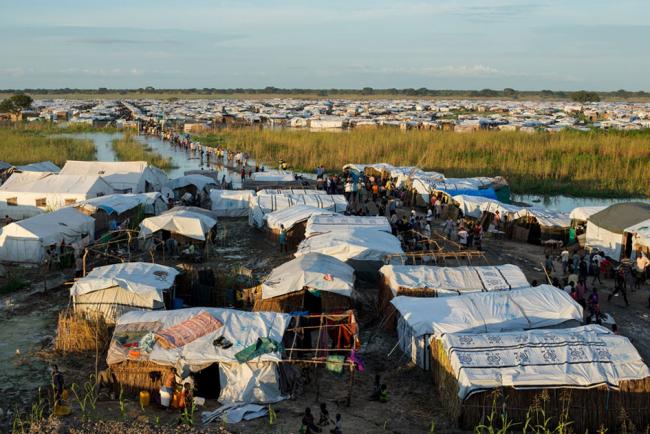
UN agencies launch new tool to help displaced populations manage fuel needs
The handbook, Assessing woodfuel supply and demand in displacement settings, prepared jointly by the UN Food and Agricultural Organization (FAO) and the Office of the UN High Commissioner for Refugees (UNHCR), and launched yesterday, offers new tools and methodologies that can be used to tackle issues such as access to fuel, environmental damage and conflicts with local communities.
“Growing numbers of refugees and displaced people often puts pressure on forests due to rising demand for biomass fuel,” said FAO in a news release. “Left unmanaged, this increased competition for natural resources can lead to conflicts with local populations,” the agency added.
According to UNHCR, at the end of 2015, over 65 million people worldwide were displaced and many were living in refugee camps or improvised settlements. Cooking fuel therefore has become one of the most critical resources as both the displaced and the communities that host them depend on it for their food security and nutritional needs.
Lack of this resource manifests in different kinds of problems: people spending their wages or selling off food rations to buy fuel; undercooking or skipping meals; and respiratory illness due use of open flames or inefficient cooking techniques. Refugee women, in particular, face a risk of violence and fear for their safety when collecting fuelwood.
Additionally, overexploitation of forest resources for fuel purposes can lead to forest degradation or deforestation in areas surrounding the camps, further compounding the problem.
The handbook contains a methodology that humanitarian workers and camp managers can use to tackle such issues. The agency added that the approach will help mitigate the impact of displaced people on forest resources.
It outlines a step by step process that includes assessment of energy needs, analysis of local fuelwood sources, and use of geographic information system and remote sensing data to map the distribution and changes over time of woody biomass resources.
The methodology relies on field inventory data and high-resolution satellite images as well as relevant technical and socio-economic data, permitting an in-depth assessment of woodfuel supply and demand dynamics.
Field tested methodology
One of the places this methodology was field-tested was the Shimelba camp in Ethiopia. Established in 2004, the camp now hosts 6,000 people with very limited access to natural resources.
Due to the scarce availability of fuelwood, residents had to walk long distances, sometimes up to nine hours, to gather fuelwood. The local population was reportedly unhappy, and refugee women, in particular, expressed concern for their safety during wood collection.
According to the authors of the handbook, the information collected through the application of the methodology enabled camp managers and other field-based actors to take better informed decisions.
The collected data can be used to monitor fuel consumption and evaluate trends, support decisions to boost afforestation and reforestation activities or to introduce changes to how fuel is sourced or used – for example with the introduction of alternative fuel and more efficient cooking technologies.
The handbook also notes that fuelwood can be supplied through a variety of tree and forest systems, such as mixed forest plantations, or through integrated food energy systems that produce both food and energy, such as agro-forestry or multiple cropping syste
UN Photo/JC McIlwaine
Source: www.justearthnews.com
Support Our Journalism
We cannot do without you.. your contribution supports unbiased journalism
IBNS is not driven by any ism- not wokeism, not racism, not skewed secularism, not hyper right-wing or left liberal ideals, nor by any hardline religious beliefs or hyper nationalism. We want to serve you good old objective news, as they are. We do not judge or preach. We let people decide for themselves. We only try to present factual and well-sourced news.
Support objective journalism for a small contribution.


