


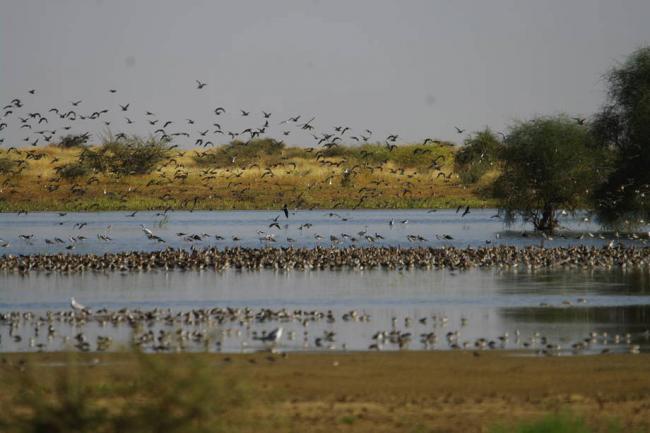
Sahel: UN and French conservation group partner on sustainable water bird management for food security
“Our goal is to adapt water bird hunting by promoting sustainable hunting management and bird conservation policies which will benefit those local communities who rely on birds for their livelihoods,” Eva Muller, Director of FAO's Forestry Policy and Resources Division, said in a new release.
The newly-signed agreement between FAO and FFEM will co-fund one third of the five million euros project, specifically targeting the following main wetlands in the Sahel region: Chad, Egypt, Mali, Senegal and Sudan.
The ‘Strengthening expertise in Sub -Saharan Africa on birds and their rational use for communities and their environment’ (RESSOURCE) project will focus on wetlands situated in the Senegal River Valley, Inner Niger Delta, Lake Chad and the lower and middle reaches of the Nile.
These are ecosystem sites of critical importance where the food security and livelihoods of nearly a billion people depend on agriculture, livestock and natural resource use, including fishing and bird hunting, said FAO.
Many water bird species, including Garganey and Ruff spend the winter in the Sahel wetlands before returning to breed in Europe. Since 1960, the number of water birds in the area has declined by about 40 percent – a dramatic fall that possibly relates to three main factors: the shrinking of flood plain size due to drainage, reduced rainfall and other climate change related events; changing plant biodiversity, including the introduction of invasive species; and, unsustainable hunting.
“In many Sahelian wetlands, hunting is crucial to local food security and the economy,” said Muller. Nearly a billion people depend on agriculture, livestock and natural resource use, including fishing and bird hunting.
However, the number of water birds in the region has declined by about 40 per cent since 1960, due to climate change, shifting biodiversity, and drainage-caused shrinking of flood plain size.
“This project is about improving management of wetlands, water birds and their habitats,” said Francois Xavier Duporge, General Secretary of FFEM.
FAO, FFEM and other partners will promote sustainable management of migratory water birds through bird census, surveying, and monitoring techniques, as well as capacity building activities.
Not only will these efforts support the creation or adaptation of a legal and regulatory framework, and foster policies on sustainable hunting and enhanced bird conservation, but they will also benefit the ecosystems and local communities that rely on them for food and other resources, including income.
“It will eventually benefit local populations and for the first time we will work at the regional level mobilizing multi-stakeholders partnerships,” said Duporge.
Photo: FAO/ONCFS
Source: www.justearthnews.com
Support Our Journalism
We cannot do without you.. your contribution supports unbiased journalism
IBNS is not driven by any ism- not wokeism, not racism, not skewed secularism, not hyper right-wing or left liberal ideals, nor by any hardline religious beliefs or hyper nationalism. We want to serve you good old objective news, as they are. We do not judge or preach. We let people decide for themselves. We only try to present factual and well-sourced news.
Support objective journalism for a small contribution.


