


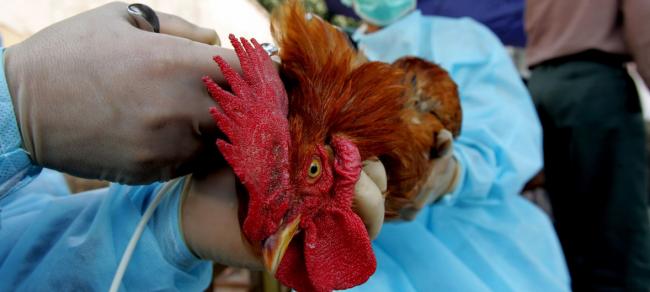
Over 4,700 UN agency trained veterinarians new vanguard against deadly disease outbreaks
New York, Mar 10 (JEN): More than 4,700 veterinary health professionals who have just completed a United Nations training to tackle disease outbreaks are the new front line of defence protecting farm animals against deadly illnesses in 25 countries across Africa, Asia and the Middle East.
In addition to keeping fowl, cattle, pigs and other animals safe, the freshly trained veterinarians will also help keep at bay diseases that are deadly to humans.
“Some 75 per cent of new infectious diseases that have emerged in recent decades originated in animals before jumping to us Homo sapiens, a terrestrial mammal,” says Juan Lubroth, the Chief Veterinary Officer at the UN Food and Agriculture Organization (FAO), which has been organizing the trainings over the past year.
“This is why adequately discovering and tackling animal disease threats at-source represents a strategic high-ground in pre-empting future pandemics.”
According to the UN food security agency, beyond the risks posed to human health, animal diseases can cost billions of dollars and hamstringing economic growth.
For instance, outbreaks of high impact disease in recent decades all had an animal source, including H5N1 highly pathogenic avian influenza, H1N1 pandemic influenza, Ebola, severe acute respiratory syndrome (SARS) and Middle East Respiratory Syndrome (MERS).
The H5N1 outbreak of the mid-2000s alone caused an estimated $30 billion in economic losses, globally. A few years later, H1N1 racked up as much as $55 billion in damages.
As with any disaster, the worst affected are often the poorest and most vulnerable.
“Animals are their primary capital assets – ‘equity on four legs’. Losing them can push these families out of self-reliance and into destitution,” states FAO.
Backed by United States Agency for International Development (USAID) support, the FAO trainings covered critical areas related to animal health, including disease surveillance and forecasting, laboratory operations, biosafety and biosecurity, prevention and control methods and outbreak response strategies.
A proactive approach to animal health and disease is critical, highlights Lubroth.
“For that [approach], the world needs well-trained, up-to-speed professionals – biologists, ecologists, microbiologists, modellers, physicians and veterinarians which is why the United States’ consistent support for building up that kind of capacity has been invaluable,” he stressed.
FAO/Giulio Napolitano
Support Our Journalism
We cannot do without you.. your contribution supports unbiased journalism
IBNS is not driven by any ism- not wokeism, not racism, not skewed secularism, not hyper right-wing or left liberal ideals, nor by any hardline religious beliefs or hyper nationalism. We want to serve you good old objective news, as they are. We do not judge or preach. We let people decide for themselves. We only try to present factual and well-sourced news.
Support objective journalism for a small contribution.


