


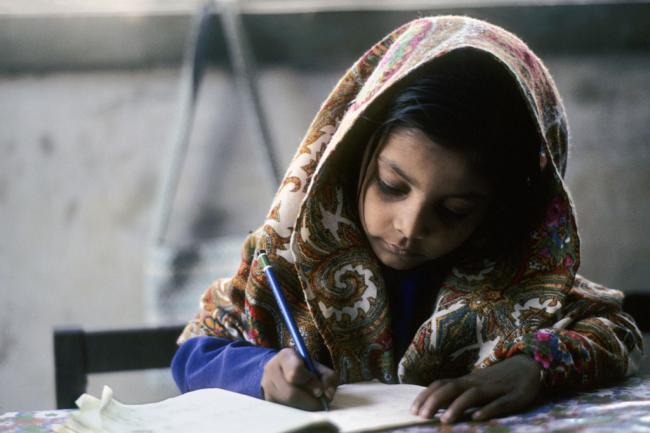
On International Day, UN promotes online literacy in digital world
“Traditionally, literacy has been considered a set of reading, writing and counting skills applied in a certain context. Digitally-mediated knowledge societies are changing what it means to be literate, calling for new and higher-level literacy skills,” said the Director-General of the UN Educational, Scientific and Cultural Organization (UNESCO), Irina Bokova, in her message for International Literacy Day.
Marked annually on 8 September, the International Day this year is devoted to better understanding the type of literacy required in a digital world to build more inclusive, equitable and sustainable societies.
In Paris, opening the International Conference on International Literacy Day, Bokova on Friday said that technologies must be more accessible and work for people.
“First, they must be inclusive, bridging gaps, not deepening them. Second, they must be underpinned by respect for human rights and dignity. All this gives rise to new questions about the meaning of literacy on Friday,” she said.
Also speaking at the event, Princess Laurentien of the Netherlands, who is the UNESCO Special Envoy on Literacy for Development, emphasized that literacy in on Friday’s world is at the heart of social participation and engagement.
“There is no inclusiveness if we leave behind 750 million people who lack the basic literacy skills to participate in on Friday’s digital world,” she said. “There is no social cohesion if we allow young people to develop feelings of exclusion and lack of self-confidence.”
Most people who are illiterate around the world – more than 60 per cent – are women, according to UNESCO figures.
As part of this year’s events, UNESCO awarded its annual Confucius Prize for Literacy to The Citizens Foundation, a Pakistani literacy programme with an online platform for women and out-of-school girls. In 2016, the programme enrolled 14,020 girls and women, of whom nearly 80 per cent completed the curricula, per information on the winning organization. Local communities run nearly all of the Foundation’s 1,440 school units in the poorest slums and villages in the country.
The other winners this year are from Canada, Colombia, Jordan and South Africa.
UN Photo/John Isaac
Source: www.justearthnews.com
Support Our Journalism
We cannot do without you.. your contribution supports unbiased journalism
IBNS is not driven by any ism- not wokeism, not racism, not skewed secularism, not hyper right-wing or left liberal ideals, nor by any hardline religious beliefs or hyper nationalism. We want to serve you good old objective news, as they are. We do not judge or preach. We let people decide for themselves. We only try to present factual and well-sourced news.
Support objective journalism for a small contribution.


