


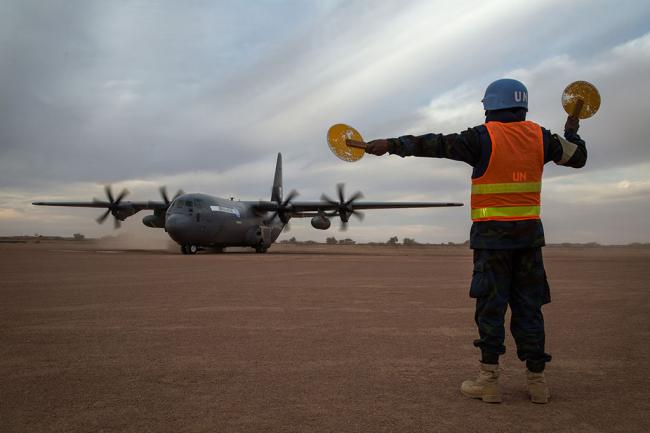
International cooperation crucial to safe flights, UN says at counter-terrorism meeting
“Terrorism is not someone else’s problem. States and industry must commit necessary resources and provide necessary governance,” the Secretary-General of the UN International Civil Aviation Organization (ICAO), Fang Liu, told the opening of a special meeting of the Counter-Terrorism Committee on “Terrorist threats to civil aviation.”
The concept note for the meeting cited recent attacks against airports in Belgium, Turkey and the United States, and the explosion of a terrorist bomb aboard Daallo Airlines flight 159, as “stark reminders that landside attacks, the threat posed by insiders and airport staff, and the use of increasingly sophisticated improvised explosive devices are all significant concerns.”
The meeting aimed to give government representatives an opportunity to discuss enhanced security measures – such as explosive detection and new cargo rules, as well as new challenges, such as cybercrime and “porous airport perimeters.”
In her speech, Liu called for greater access to current threat information between States and within the local and federal authorities, as well as political will to work together.
“Aviation security authorities must be provided adequate information by the State’s own law enforcement and intelligence organizations, in order to create a meaningful and effective threat assessment,” said Liu.
She noted one “pointed” example of information sharing, such as the recent laptop restrictions imposed by the United States, which were then transitions to more extensive screening measures of passengers.
In his address, Jean-Paul Laborde, Executive Director of the UN Counter-Terrorism Committee Executive Directorate (CTED), said “more and more strict measures” are clearly needed “to address challenges of terrorism and to protect our lives.”
But effective work “can only happen through cohesiveness and cooperation, and this is what the Security Council does,” he said, urging governments to implement measures cited in recent resolutions related to aviation safety.
Last September, the Security Council unanimously adopted its first resolution to address terrorist threats to civil aviation. Resolution 2309 (2016) urged governments to ensure that effective, risk-based measures are taken to protect airports, for example, to strengthen security screening procedures and utilize technology to detect explosives and other threats.
More recently, Security Council adopted resolution 2341 (2017), which recognized the urgent need to ensure reliability and resistance of critical infrastructure.
Laborde stressed the importance of collecting and sharing advance passenger information (API) to detect the departure from, entry into, or transit through their territories of individuals on the Al-Qaida sanctions list.
He said only 57 countries are capable of implementing and sharing such information with INTERPOL, which has 68 million entries.
Reiterating the importance of sharing information and cooperation in his closing remarks, Laborde again spoke about the need to cut red tape and to implement the Security Council resolutions.
“Along with our hesitations and weaknesses, this is one area where multilateralism has its advantages,” he said.
Photo: UN Photo/ Marco Dormino
Source: www.justearthnews.com
Support Our Journalism
We cannot do without you.. your contribution supports unbiased journalism
IBNS is not driven by any ism- not wokeism, not racism, not skewed secularism, not hyper right-wing or left liberal ideals, nor by any hardline religious beliefs or hyper nationalism. We want to serve you good old objective news, as they are. We do not judge or preach. We let people decide for themselves. We only try to present factual and well-sourced news.
Support objective journalism for a small contribution.


