


Indonesia: Psychological impact on earthquake survivors turns villages into ‘ghost towns’
New York, Aug 8 (IBNS): Following the magnitude 7 earthquake which rocked the Indonesian island of Lombok at the weekend, more than 130 aftershocks have been felt with some villages being turned into “ghost towns”, journalists at the UN in Geneva heard on Tuesday.
Mathew Cochrane, Spokesperson for the International Federation of the Red Cross and Red Crescent Societies (IFRC) , briefed reporters saying that “about 80 per cent of buildings had been damaged or destroyed,” in the north of the island, which is home to around 200,000 people, adding to the destruction caused by an earlier quake on 29 July.
“Thousands of people were displaced and the main needs right now are emergency shelter and basic relief,” he said, elaborating that because the IFRC is still unable to access some remote villages, “we are far from having a complete picture of the damage.”
The earthquake not only cut power and communication lines in the area, but physical access as well.
Turning to the psychological toll of the earthquake, he said that teams spoke of coming across “ghost towns and villages” that had been abandoned.
Cochrane explained that after an earthquake, “a sense of terror,” was often experienced, as people struggled with differentiating between “what’s an aftershock and what’s actually the beginning of the next major one.”“People have left homes. They are fearful of staying inside, or perhaps fearful of another major earthquake and a possible tsunami,” Cochrane said. He flagged that “there had been more than 130 aftershocks over the past 24 hours,” adding his suspicion that the figure had risen.
“One of the needs going forward, in addition to emergency shelter and basic relief, will be to address these emotional scars and the concerns of communities, particularly remote communities,” he stated.
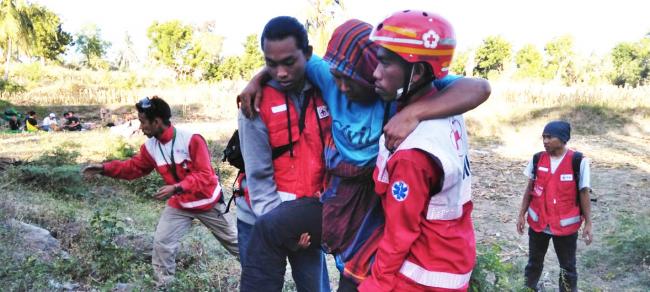
He underscored that colleagues from the Indonesian Red Cross (PMI) had been active from the outset.
“About 110 staff and volunteers from the Lombok branch were activated really within the first minutes after the earthquake and they had been involved in search and rescue operations, transporting people to hospitals, and providing first aid, including for many tourists”, he continued.
Pointing out that some teams had also provided advanced medical care and distributed relief supplies, he explained that many suffered personal family loss and would also need support, in addition to additional capacity.
According to Cochrane, discussions were underway on what international assistance might be needed.
Indonesian Red Cross
Support Our Journalism
We cannot do without you.. your contribution supports unbiased journalism
IBNS is not driven by any ism- not wokeism, not racism, not skewed secularism, not hyper right-wing or left liberal ideals, nor by any hardline religious beliefs or hyper nationalism. We want to serve you good old objective news, as they are. We do not judge or preach. We let people decide for themselves. We only try to present factual and well-sourced news.
Support objective journalism for a small contribution.


