


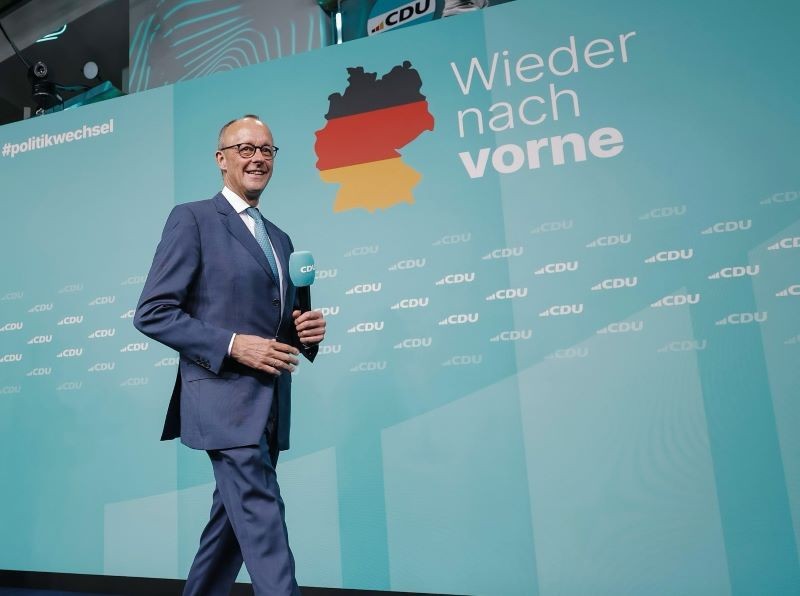
Friedrich Merz of Germany's Conservative Alliance claims victory, far-right AfD finishes second
Berlin/IBNS: As polls closed in for Germany's crucial parliamentary elections, exit polls revealed a win for the Christian Democratic Union (CDU/CSU) while the far-right Alternative for Germany (AfD) is at the number two position.
CDU/CSU has secured votes between 28.5 and 29 percent. according to the first TV exit polls.
With the CDU/CSU registering a win, Friedrich Merz has claimed victory and is set to become the next chancellor.
Merz, the 69-year-old CDU leader, has vowed to resolve major issues within four years—an ambitious promise for Europe’s largest economy, which is grappling with a faltering infrastructure.
The far-right Alternative for Germany (AfD) followed in second place with 19.5 to 20 percent, roughly doubling its result in the last election in 2021, based on initial figures from public broadcasters ARD and ZDF.
However, the AfD is set to stay out of power for now despite getting votes as all coalition partners refuse to ally with the far right.
“Our hand remains outstretched to form a government,” announced Alice Weidel, the head of the AfD.
Her party is expected to secure 20 percent support, a historic gain.
Germany recorded a high voter turnout across the nation, particularly in the state of Thuringia, which is an AfD stronghold.
The counting of votes begins immediately.
Four main candidates who were vying in the elections included: Chancellor Olaf Scholz from the centre-left Social Democrats (SPD), Friedrich Merz of the conservative Christian Democratic Union (CDU), Vice Chancellor Robert Habeck of the Greens, and Alice Weidel of the far-right Alternative for Germany (AfD).
While German Chancellor Olaf Scholz earlier conceded defeat, and claimed responsibility for the results.
"The election result is poor and I bear responsibility," Scholz told SPD party members, while congratulating Friedrich Merz.
Germany's electoral system favours coalition governments, meaning the CDU/CSU will need at least one partner to secure a majority.
Key issues: Economy, war, and migration
Throughout the campaign, Merz intensified his criticism of Scholz, who struggled to defend his government’s performance.
Germany's economy has been shrinking for three consecutive years, and Merz blames left-wing policies for the crisis.
"We are in a recession for the third year in a row. That has never happened before in Germany's post-war history," he said, according to the DW report.
The economic downturn was exacerbated by Russia’s 2022 invasion of Ukraine, which triggered an energy crisis and inflation.
Migration also became a central issue following a fatal knife attack by a rejected Afghan asylum seeker in Bavaria.
Merz sought to tighten asylum policies even before the election, a move welcomed by AfD lawmakers, who supported a non-binding motion he introduced in parliament, the report said.
This sparked mass protests against a rightward shift in German politics, with Scholz accusing Merz of aligning with the AfD.
No alliance with the far-right
Amid growing tensions, Merz however, repeatedly ruled out any cooperation with the AfD, stating that the right-wing party aims to "destroy" the CDU and CSU.
"Under no circumstances will we form a coalition with the AfD," he vowed, DW reported.
With Germany at a crossroads, the outcome of this election will shape the country’s political and economic landscape for years to come.
Support Our Journalism
We cannot do without you.. your contribution supports unbiased journalism
IBNS is not driven by any ism- not wokeism, not racism, not skewed secularism, not hyper right-wing or left liberal ideals, nor by any hardline religious beliefs or hyper nationalism. We want to serve you good old objective news, as they are. We do not judge or preach. We let people decide for themselves. We only try to present factual and well-sourced news.
Support objective journalism for a small contribution.


