


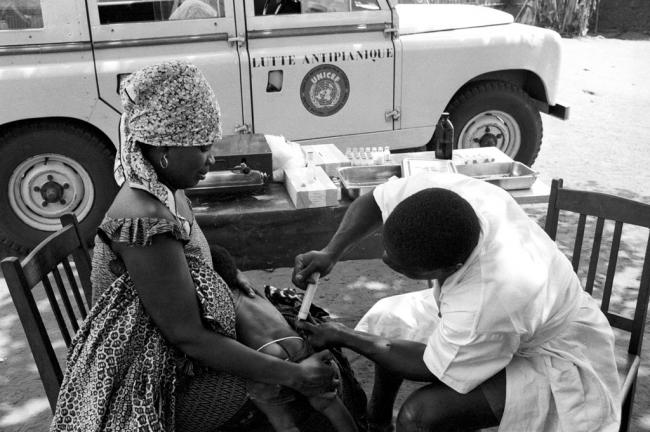
FEATURE: Eradication of Yaws, disease that ‘begins where roads end,’ is within sight, says WHO doctor in new film
“Yaws is an infection caused by bacteria that is transmitted by direct contact,” Dr. Mitjà told the UN News Centre yesterday in an interview at the UN Headquarters in New York.
Transmitted by skin contact, the disease affects mostly children between the ages of five and 15, and appears as multiple lesions which eat away at faces, arms and hands, and deepen to the bones, disfiguring the child. Yaws is part of a family of disabling disease that affect the skin – along with leprosy – preventing children from attending school and placing an undue economic burden on local communities.
Incidents of the disease were 95 per cent decreased by 1970, but nearly half-a-million people in 13 tropical countries in Africa, Asia and the Pacific, and Central America continue to battle with the disease on Wednesday.
“Yaws is a neglected tropical disease,” said Dr. Mitjà. “It affects the communities in rural and remote areas, which do not have access to media and to policy decision-making people. So no one cares about them.”
These people live “where the roads end” and where extreme poverty begins, and with it overcrowding, a lack of sanitation and few opportunities for medical services.
This unsettling phrase is also the name of a new documentary film by director Noemí Cuní and her crew, which highlights Dr. Mitjà’s crusade to eradicate Yaws.
“What really moved us to do the documentary was the strength of the doctor. His conviction with his mission of helping all people in the world, and his iron will in fighting and researching until he found this cure that affects mainly children,” Cuní said ahead of a screening of the film.
The cure, as it turned out, was medically simple – one tablet of an inexpensive antibiotic, Azithromycin. The cost to provide these tablets to all 500,000 people who need them is about $300,000. Raising this amount is part of a WHO campaign to eradicate Yaws by 2020. If successful, it will only be the second human disease eradicated in history, after small pox.
“Many people are going to discover this disease and I think the documentary can move them to help and try to raise the funding,” said Cuní.
Mitjà was only 29 years old when he arrived in Lihir Island, and he had never seen Yaws before.
“Changing something at the local level is changing the world,” Mitjà said in the trailer to the film. “Our experience at the local level can be extrapolated to other areas. It can have an international impact. The effort of my team, my efforts, can make a difference.”
UN Photo/BZ
Source: www.justearthnews.com
Support Our Journalism
We cannot do without you.. your contribution supports unbiased journalism
IBNS is not driven by any ism- not wokeism, not racism, not skewed secularism, not hyper right-wing or left liberal ideals, nor by any hardline religious beliefs or hyper nationalism. We want to serve you good old objective news, as they are. We do not judge or preach. We let people decide for themselves. We only try to present factual and well-sourced news.
Support objective journalism for a small contribution.


