


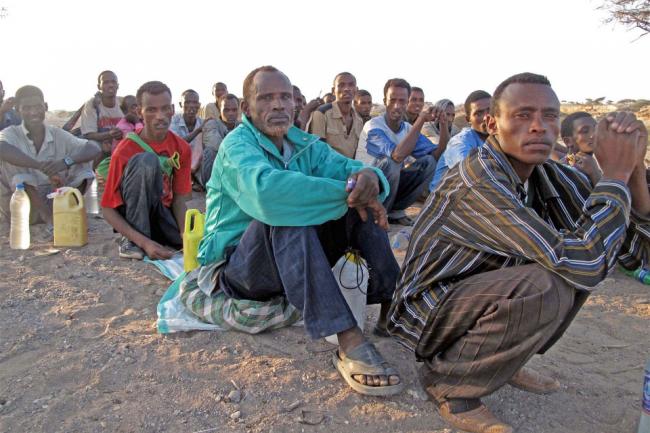
African regional consultations on UN global compact on migration begin in Ethiopia
“On Thursday's consultation is an opportunity to analyse migratory trends, challenges and opportunities at the regional and sub-regional levels,” the Secretary-General's Special Representative for International Migration, Louise Arbour, told the African Regional Consultative Meeting on the proposed global compact, which opened in Ethiopia's capital, Addis Ababa.
Arbour said that most migration takes place within the same region, noting that in Africa, 52 per cent of migrants moved within the region, mostly between neighbouring countries.
She also emphasized the importance of an increased variety and scope of legal pathways for non-refugee migrants to access labour markets.
Indeed, both the push factors, such as conflict, poverty and climate change, and the pull factors, including labour shortages and informal economies in destination countries, remain too strong for migratory flows to be significantly curtailed.
In such a situation, she said, “the impact of policies seeking to stop migration will only encourage recourse to irregular channels and increase the cost of the journey for the individuals concerned, including them engaging the services of smugglers – too often, fatally.”
“We must therefore better understand what compels people to migrate through irregular channels, and expand regular and legal pathways to better manage the supply and demand in the world's labour markets,” she stressed.
Consultations at the African regional meeting, which runs through Friday, will inform the process leading up to the adoption of the global compact on migration by the UN General Assembly in 2018.
The process to develop this global compact for migration started in April 2017. It will be the first, intergovernmentally negotiated agreement, prepared under the auspices of the UN, to cover all dimensions of international migration in a holistic and comprehensive manner.
Photo: Kristy Siegfried/IRIN
Source: www.justearthnews.com
Support Our Journalism
We cannot do without you.. your contribution supports unbiased journalism
IBNS is not driven by any ism- not wokeism, not racism, not skewed secularism, not hyper right-wing or left liberal ideals, nor by any hardline religious beliefs or hyper nationalism. We want to serve you good old objective news, as they are. We do not judge or preach. We let people decide for themselves. We only try to present factual and well-sourced news.
Support objective journalism for a small contribution.


