‘Spotlight Initiative’ can make violence against women a thing of the past, says UN deputy chief
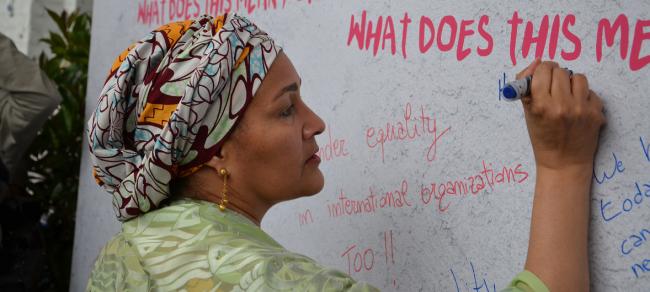
New York, June 6 (IBNS): The launch of a new partnership between the United Nations and European Union, is an essential tool to make violence against women and girls “a thing of the past”, said UN Deputy Secretary-General Amina Mohammed on Tuesday.
Addressing a leading forum on development in Brussels, known as European Development Days, Mohammed said that the joint Spotlight Initiative was a key element for making Global Goal 5 on women’s empowerment, of the 2030 Sustainable Development Agenda, a reality.
Now in the third year of working towards the Sustainable Development Goals (SDGs), the forum this year is shining a spotlight on gender equality.
“Without equality and empowerment, we will simply perpetuate today’s paradigm: trying to address all the world’s challenges with only half the world’s assets,” said UN Deputy Secretary-General Amina Mohammed in her opening remarks.
She painted a picture of women not fully included in decision-making, being subjected to a “global pandemic” of violence against women and girls.
“Attacks and discrimination are deeply embedded in social norms, attitudes and practices,” she asserted. “Addressing these mindsets will require significant investments of time, resources and political will.”
The UN deputy chief cited the World Bank in detailing how women’s equal participation in the labor force had the potential to unlock $160 trillion for sustainable development reinvestment.
Mohammed pointed to the benefit of reaching SDG 5 — for the more than 190 countries around the world who signed up to the Goals in 2015 — which calls for gender equality and women’s empowerment.“Yet a stark reality prevails: more women than men live in extreme poverty,” she continued, adding that the worldwide pay gap stands at 23 per cent, and gender roles have been too slow to change.
“I often call it the ‘docking station’ for all the goals,” she said, flagging that Spotlight builds on civil society leadership and aims to address some of the imbalances women face.
Noting that worldwide, almost one-in-two women murdered are killed by a partner or ex-partner, she said that in some countries, “Spotlight will focus on the most extreme form of violence – femicide.”
“Often,” she continued, “in the wake of these murders, we find that women have indeed reported to the police, or sought medical care. But service providers did not have adequate information or the means to identify the risk.”
Some of the violence takes place due to the broader insecurity that women face, particularly where they are advocating for women’s rights.
Mohammed also underscored the UN’s commitment to lead by example by empowering women within the Organization itself, working towards – for the first time in UN history – full gender parity in the Senior Management Group and among those nominated to be Resident Coordinators, the UN’s team leaders on the ground.
“We have a long way to go. But we have a plan and we have the will,” she stressed.
UNRIC/Christophe Verhellen
Support Our Journalism
We cannot do without you.. your contribution supports unbiased journalism
IBNS is not driven by any ism- not wokeism, not racism, not skewed secularism, not hyper right-wing or left liberal ideals, nor by any hardline religious beliefs or hyper nationalism. We want to serve you good old objective news, as they are. We do not judge or preach. We let people decide for themselves. We only try to present factual and well-sourced news.
Support objective journalism for a small contribution.