‘Pressure’ on Palestinian households to move raises risk of forcible transfers – UN official
“Repeated rounds of demolitions, restrictions on access to basic services and regular visits by Israeli security personnel promoting ‘relocation plans’ are all part of a coercive environment that now surrounds these vulnerable Palestinian households,” Robert Piper, UN Coordinator for Humanitarian Assistance and Development Aid in the occupied Palestinian territory said on Monday in a news release after returning from a visit to the Palestinian community of Abu Nuwar in the Jerusalem governorate.
“The cumulative pressure to move to other parts of the West Bank continues to be ratcheted-up; in this environment, we cannot expect people to make decisions based on genuine consent so the risk of forcible transfers remains high,” he added.
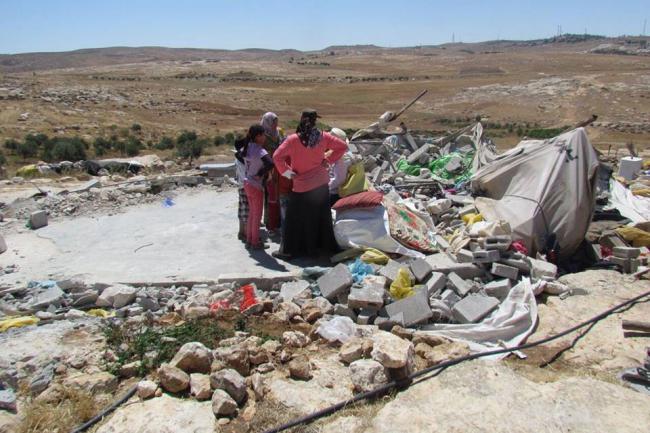
According to the release, there has been a surge in demolitions and confiscations across the West Bank this year, with 786 Palestinian-owned structures demolished so far in 2016. These demolitions have cumulatively displaced 1,197 people, including 558 children. Over 200 of the demolished structures had been provided as humanitarian relief.
Since the start of August, Israeli security forces have destroyed or confiscated a total of 85 civilian structures across 28 West Bank communities. 29 structures across eight locations were demolished in the last week alone, resulting in the displacement of 64 Palestinians, including 24 children.
The structures demolished in August included emergency shelters following previous home demolitions, animal sheds, latrines, a community centre and a new drinking water network.
Damage to the water network, that was supported by the UN Children’s Fund (UNICEF), has affected nearly 1,000 Palestinians in five herding communities in the Jordan Valley who suffer extreme water scarcity especially during summer months, added the release.
“As the occupying power, international law requires that Israel ensures that the basic needs of Palestinians are met and that the conditions necessary for their development are present, including a fair and lawful planning and zoning regime,” it further noted.
The news release also said that facilitating the delivery of humanitarian aid is also a legal obligation whilst the forcible transfer of populations is prohibited under International Humanitarian Law, as is the destruction of property unless absolutely necessary for military operations.
There is also renewed concern for the community of Susiya in the southern West Bank, where over 170 civilian structures are under threat of demolition and where the Israeli authorities abruptly ended negotiations with community representatives last month.
“Dkaika. Khan al Ahmar. Um al Kheir. Abu Nuwar. Susiya… these are just some of the highly vulnerable communities where families, many of whom are Palestine refugees, live in permanent fear of becoming homeless and children wonder if they will still have a school to attend on Tuesday,” said Piper.
Photo: OCHA
Source: www.justearthnews.com
Support Our Journalism
We cannot do without you.. your contribution supports unbiased journalism
IBNS is not driven by any ism- not wokeism, not racism, not skewed secularism, not hyper right-wing or left liberal ideals, nor by any hardline religious beliefs or hyper nationalism. We want to serve you good old objective news, as they are. We do not judge or preach. We let people decide for themselves. We only try to present factual and well-sourced news.
Support objective journalism for a small contribution.