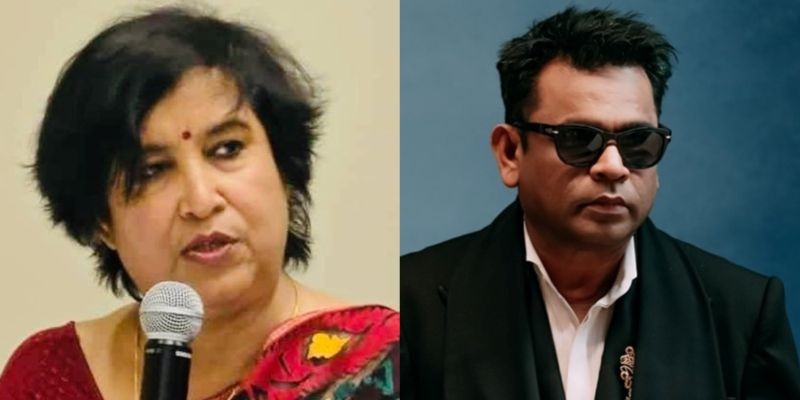
'Doesn’t suit him to be pitied': Taslima Nasreen attacks AR Rahman’s discrimination claim
Mumbai/IBNS: Exiled Bangladeshi writer Taslima Nasreen has joined the chorus of voices criticising iconic composer A.R. Rahman’s claim that he faces discrimination in Bollywood because of his Muslim identity.
In a detailed post on X, Nasreen argued that Rahman, despite being Muslim, is immensely successful, wealthy and widely respected across India, and therefore does not encounter real prejudice in the Hindi film industry.
She cited the prominence of Muslim figures such as Shah Rukh Khan, Salman Khan, Aamir Khan, Javed Akhtar and Shabana Azmi as evidence that fame and wealth shield celebrities from religious bias.
“A.R. Rahman is a Muslim and is extraordinarily famous in India. His remuneration, as far as I have heard, is higher than that of all other artists. He is probably the richest musician,” she wrote, adding, “The famous and the rich never face difficulties anywhere—no matter what religion, caste or community they belong to.”
Contrasting Rahman’s stature with her own experiences, Nasreen described the struggles of being a poor atheist often mistaken for a Muslim because of her name.
She claimed to have faced housing discrimination, mistreatment in hospitals, physical attacks and social exclusion in different parts of India. Ordinary people, she said, bear the brunt of religious prejudice, not elite celebrities.
“These problems do not even come within the farthest boundaries of A.R. Rahman’s life or of Muslim stars in Bollywood,” wrote Nasreen, known for her outspoken criticism of Islamic radicalism.
A. R. Rahman is a Muslim and is extraordinarily famous in India. His remuneration, as far as I have heard, is higher than that of all other artists. He is probably the richest musician. He is complaining that he is not given work in Bollywood because he is a Muslim. Shah Rukh…
— taslima nasreen (@taslimanasreen) January 18, 2026
She lamented that most Indians fail to understand atheism or humanism and continue to stereotype non-believers. Concluding her post, Nasreen said Rahman is admired by people of all faiths and does not need to present himself as a victim. “It does not suit him to be pitied,” she remarked.
Rahman’s comments had triggered a debate in the Hindi film industry after he suggested in an interview that changing power structures—possibly with a communal dimension—might have led to fewer work opportunities for him.
Speaking to the BBC recently, Rahman said he had received fewer Hindi film projects in recent years and that the reasons were rarely communicated directly.
“It comes to me as Chinese whispers,” he explained, adding that some projects proceed with multiple composers despite his initial involvement. He also pointed to the growing influence of non-creative decision-makers in hiring choices.
Following backlash from several industry figures, Rahman clarified that he never intended to hurt anyone.
In a video shared on Instagram, the Oscar-winning composer said: “Music has always been the way to connect, celebrate and honour India’s culture. India is my inspiration, my teacher and my home. I understand that intentions can sometimes be misunderstood. But my purpose has always been to uplift, honour and serve through music. I have never wished to cause pain, and I hope my sincerity is felt.”
Support Our Journalism
We cannot do without you.. your contribution supports unbiased journalism
IBNS is not driven by any ism- not wokeism, not racism, not skewed secularism, not hyper right-wing or left liberal ideals, nor by any hardline religious beliefs or hyper nationalism. We want to serve you good old objective news, as they are. We do not judge or preach. We let people decide for themselves. We only try to present factual and well-sourced news.
Support objective journalism for a small contribution.