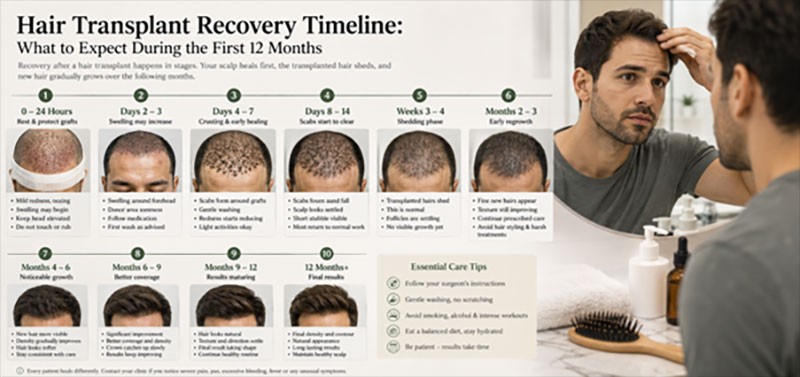
Hair Transplant Recovery Timeline: What to Expect During the First 12 Months
A hair transplant may be completed within a day, but the result develops over many months. For people considering the procedure, this gap between surgery and visible growth is often where most of the questions begin.
Is swelling normal? Why are the transplanted hairs falling out? When should new hair appear? And at what point can the final result actually be judged?
Understanding the recovery timeline before undergoing a hair transplant can help set realistic expectations and prevent normal stages of healing from becoming a source of unnecessary concern.
While recovery varies from person to person and depends on factors such as the technique used, the number of grafts, scalp condition and individual healing, there are several commonly observed milestones during the first year.
The First Few Days: Protecting the Newly Transplanted Grafts
The initial days after a hair transplant are primarily about healing.
It is common for the recipient area to appear red and for small crusts or scabs to develop around the transplanted follicles. Mild swelling around the forehead may also occur during the early recovery period.
The newly implanted grafts need to be treated carefully at this stage. Patients are generally advised to avoid rubbing, scratching or putting unnecessary pressure on the recipient area and to follow their surgeon's instructions on washing and sleeping position.
According to NHS guidance, bandages can often be removed within a few days, while gentle hair washing may usually begin around the end of the first week depending on the surgeon's protocol.
The exact post-operative instructions can differ between patients, so the treating surgeon's recommendations should always take priority over generic recovery advice.
Week 1 to Week 2: The Scalp Starts Looking More Normal
During the first one to two weeks, swelling generally reduces and the small crusts around the transplanted area begin to clear.
For many patients, this is also the period when the procedure becomes less noticeable in everyday life. Some may feel comfortable returning to desk-based work within several days, while others prefer additional recovery time.
The donor area also continues healing during this stage. Recovery can differ depending on whether follicular unit extraction (FUE), follicular unit transplantation (FUT), DHI or another technique has been used.
This period is important because good aftercare is not simply about appearance. Protecting the scalp while the grafts settle is part of creating favourable conditions for subsequent growth.
Weeks 2 to 8: The Shedding Phase Can Be Surprising
One of the most misunderstood parts of hair transplant recovery begins a few weeks after surgery.
Many of the newly transplanted hairs may start falling out.
Although this can initially make patients worry that the transplant has failed, post-transplant shedding is expected in many cases. The American Academy of Dermatology notes that transplanted hair commonly falls out approximately two to eight weeks after surgery.
What is visible above the scalp is the hair shaft. The transplanted follicle remains beneath the skin and can later begin producing a new hair.
The scalp may consequently look similar to how it appeared before the transplant for a period of time. In some cases, it can temporarily appear thinner.
This is why the first few months are generally too early to assess the success or density of a transplant.
Month 3 to Month 4: Early Regrowth Begins
The third and fourth months are when many patients begin looking closely for signs of new growth.
New hairs may start emerging during this stage, although they are often thin, fine and uneven. Not every follicle begins growing at exactly the same time.
The NHS states that new hair will usually start appearing after approximately four months, while hair-transplant guidance from the American Academy of Dermatology similarly cautions that the scalp may still look thin around month three.
Patients should therefore avoid comparing early growth too closely with a final before-and-after photograph.
The first visible strands represent the beginning of the growth process rather than the finished result.
Month 4 to Month 6: Coverage Gradually Improves
Between months four and six, more transplanted follicles may begin producing visible hair.
For many patients, this is when the change becomes easier to notice in photographs. However, density and texture may still look immature.
Some areas can grow faster than others, making the hair appear uneven temporarily. Newly growing strands can also look finer or have a slightly different texture before maturing over subsequent months.
This is also why transplant planning matters before surgery.
The number of grafts required is not identical for every person with hair loss. It depends on the size of the thinning area, donor density, hair characteristics and the coverage that can be created safely.
An online hair graft calculator can provide an approximate starting point for understanding graft requirements, but it should not replace an examination by a qualified hair transplant surgeon. Kibo's calculator itself notes that a clinical scalp assessment is required to determine the appropriate graft plan.
Month 6 to Month 9: The Result Becomes More Noticeable
For many patients, the six-to-nine-month period is one of the most encouraging stages of recovery.
Hair that began emerging earlier has had time to grow longer and become thicker, while additional follicles may continue entering their growth phase.
The overall hairline and coverage can therefore start looking substantially more defined.
The American Academy of Dermatology says that most patients see hair-transplant results between six and nine months, although some require 12 months.
Importantly, visible improvement at this stage still does not necessarily represent the final density or texture.
Hair continues to mature, which means two photographs taken a few months apart can show meaningful changes even when the patient does not notice them from day to day.
Month 9 to Month 12: Maturation of the Transplanted Hair
By months nine to twelve, many transplanted hairs have had sufficient time to grow and mature.
The strands may appear thicker, the hairline can look better integrated with existing hair, and the overall result becomes easier to evaluate.
However, there is no single date on which every transplant becomes "complete."
The NHS notes that full results may take approximately 10 to 18 months. Factors such as the transplanted area, individual growth cycles and the characteristics of the patient's hair can all influence how quickly the result matures.
The crown, for example, can sometimes take longer to show mature growth than the frontal hairline.
This is why surgeons generally assess outcomes over months rather than weeks.
Why Graft Numbers Are Only Part of the Result
People researching hair transplants often focus heavily on graft count. While the number of available and required grafts is important, a higher number does not automatically mean a better outcome.
Hairline design, donor-area management, graft survival, implantation angle, distribution of density and the experience of the medical team all contribute to how natural the final result looks.
The goal is therefore not simply to implant as many grafts as possible. It is to use the available donor hair strategically while considering the patient's current and possible future pattern of hair loss.
At kibo clinics, hair-transplant planning includes assessment of the donor area, hair-loss pattern and individual restoration goals before deciding graft numbers and placement. The clinic also describes post-procedure follow-ups and progress tracking as part of its hair-transplant journey.
What Can Affect the Recovery Timeline?
Although a general timeline is useful, recovery and growth are not identical for everyone.
Factors that may influence the experience include:
- the hair-transplant technique used;
- the number and location of grafts;
- the quality and density of donor hair;
- scalp characteristics;
- adherence to post-operative instructions;
- smoking and other lifestyle factors;
- underlying medical conditions; and
- individual hair-growth cycles.
Patients should therefore be cautious about comparing their progress with another person's transplant at exactly the same month.
The more useful comparison is usually with their own baseline photographs taken under similar lighting and angles.
When Should You Contact Your Surgeon?
Mild redness, crusting, temporary shedding and some discomfort can occur during normal recovery. However, patients should contact their treating medical team if they develop symptoms that seem unusual or progressively worsen.
These may include significant pain, excessive or persistent bleeding, signs of infection, marked swelling or any symptom that causes concern.
Hair transplantation is a medical procedure, and post-operative concerns are best evaluated by the surgeon or clinical team familiar with the individual's case.
The Bottom Line
Perhaps the most important thing to understand about a hair transplant is that surgery and results operate on very different timelines.
The procedure may take place in a matter of hours, but hair growth follows its own biological cycle.
The first weeks are largely about healing and temporary shedding. Early regrowth may become noticeable around months three to four. More visible coverage typically develops over the following months, while maturation can continue for a year or longer.
For patients, knowing this timeline before the procedure can make recovery easier to understand and help ensure that the result is judged at the right time rather than too early.
Medical disclaimer: This article is intended for general educational purposes and does not replace personalised medical advice. Hair-transplant suitability, recovery and results vary between individuals. Consult a qualified dermatologist or hair-transplant surgeon for assessment and post-operative guidance.
Support Our Journalism
We cannot do without you.. your contribution supports unbiased journalism
IBNS is not driven by any ism- not wokeism, not racism, not skewed secularism, not hyper right-wing or left liberal ideals, nor by any hardline religious beliefs or hyper nationalism. We want to serve you good old objective news, as they are. We do not judge or preach. We let people decide for themselves. We only try to present factual and well-sourced news.
Support objective journalism for a small contribution.