


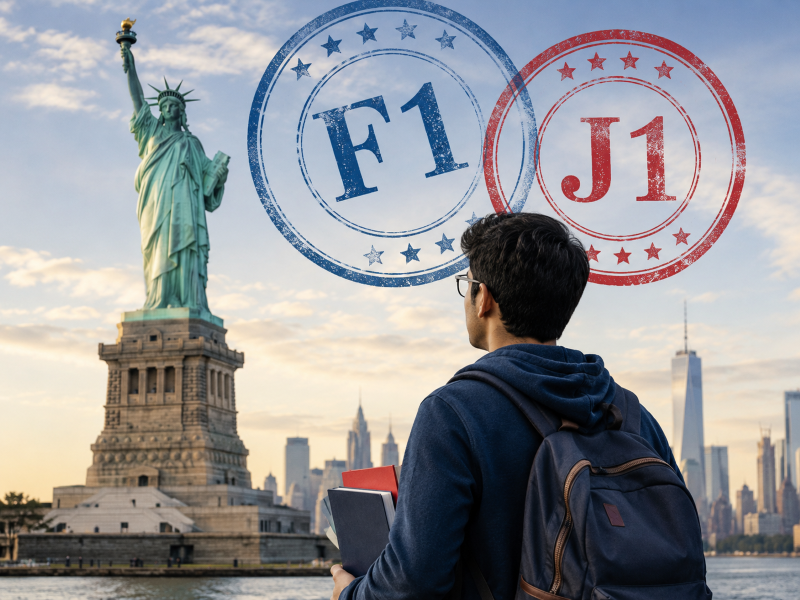
US urges foreign students to return before Sept 15 ahead of new visa rule
International students studying in the United States, including thousands from India, are being advised by universities to return to the country before September 15, when a major overhaul of US immigration rules for student and exchange visas comes into force.
Several institutions, including Columbia University, have issued advisories to students currently abroad for summer or academic breaks, urging them to re-enter the US before the new regulations take effect.
Universities issue travel advisory
In a notice to students, Columbia University said those holding F and J visas should return before classes begin to avoid potential complications under the revised immigration framework.
"This final rule has a 60-day implementation period. We recommend that all students return to New York before the beginning of classes on September 8, 2026," the university said.
What changes from September 15?
The US Department of Homeland Security (DHS) has finalised a new rule replacing the long-standing "Duration of Status" (D/S) system with a fixed admission period.
Under the new framework:
- F-1 student visa holders, J-1 exchange visitors and I visa holders for foreign journalists will generally be admitted for a maximum of four years.
- Students completing their studies will have only 30 days to remain in the US, down from the current 60-day grace period.
- Those requiring additional time must apply for an extension through Form I-539, subject to approval by US Citizenship and Immigration Services (USCIS).
The rule takes effect on September 15.
Who remains protected?
According to the DHS, students already in the United States under the current Duration of Status (D/S) system on September 15 will be allowed to continue until the programme completion date listed on their Form I-20 or until the end of approved Optional Practical Training (OPT) or STEM OPT.
However, that protection will be subject to an overall four-year limit from the rule's effective date and cannot extend beyond November 14, 2030, including the post-completion departure period.
Concerns over academic disruption
The policy has sparked concern among international students, universities and advocacy groups, particularly because many degree programmes extend well beyond four years.
Khanderao Kand, Chief of Policy and Strategy at the Foundation for India and Indian Diaspora Studies (FIIDS), warned that the move could undermine US competitiveness.
"This is a self-inflicted wound on US competitiveness," he said, noting that the median completion time for a bachelor's degree is about 52 months, while doctoral programmes typically take nearly six years.
He argued that the new cap could force students to leave before completing their research, disrupt laboratories and weaken America's innovation ecosystem.
Research programmes could be hit
FIIDS said research-intensive doctoral programmes, medical training and J-1 research scholar programmes routinely last between five and seven years, making them particularly vulnerable under the revised rules.
The organisation warned that uncertainty surrounding visa extensions could delay graduations, disrupt ongoing research projects and complicate faculty recruitment dependent on international talent.
Calling for a rethink, Kand urged the US administration to delay implementation and protect existing students.
"If the goal is integrity, do it without blowing up degree pathways that power American labs and startups," he said.
Support Our Journalism
We cannot do without you.. your contribution supports unbiased journalism
IBNS is not driven by any ism- not wokeism, not racism, not skewed secularism, not hyper right-wing or left liberal ideals, nor by any hardline religious beliefs or hyper nationalism. We want to serve you good old objective news, as they are. We do not judge or preach. We let people decide for themselves. We only try to present factual and well-sourced news.
Support objective journalism for a small contribution.


