


 US-India
'US can’t dictate terms to India': American journalist Tucker Carlson backs New Delhi’s rising power in trade talks
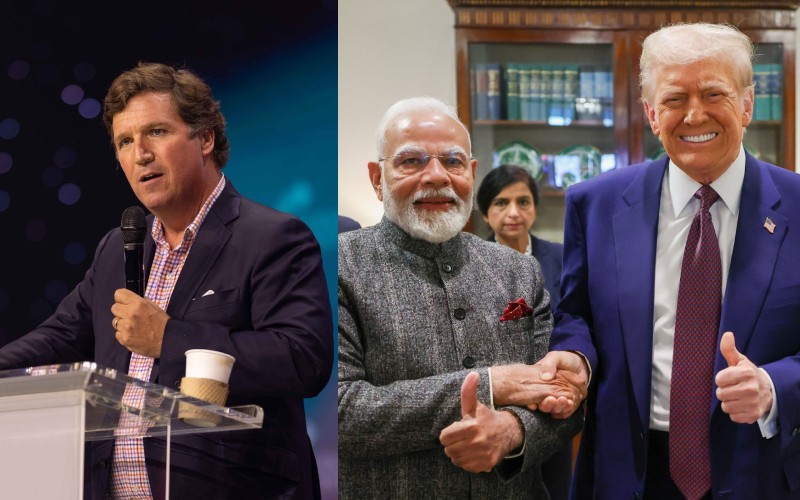
As negotiations over the India-US trade deal gather momentum, American journalist and former Fox News host Tucker Carlson has said that the United States no longer has the authority to dictate terms to India.
In an exclusive interview with India Today Global, Carlson described India as a transformed global power and praised Prime Minister Narendra Modi as one of the defining leaders of the current era.
Carlson also criticised Washington’s pressure on New Delhi over its foreign policy choices, particularly India’s continued purchase of Russian oil, arguing that such tactics belong to an outdated world order.
'Not the India of 25 years ago'
Emphasising India’s evolution over the past two decades, Carlson said the country should no longer be viewed through an old geopolitical lens.
He said modern India is fundamentally different from the nation the West engaged with in the late 1990s and early 2000s.
“This is not the India we visited 25 years ago,” Carlson said, adding that the United States must now engage India as an equal partner. “This is a completely different country. And this is not a country to whom you can dictate terms. You negotiate terms.”
His remarks directly challenge long-standing assumptions in Washington about India’s role in the global hierarchy.
Carlson praises PM Modi’s leadership
Carlson reserved particular praise for Prime Minister Narendra Modi, calling him a historic figure whose influence will be studied for generations.
He described Modi as an impactful leader regardless of political alignment.
“Whether you like Modi or not, Modi is impressive. Nobody doubts that,” Carlson said, adding that he hopes to interview the Indian prime minister in the future.
He described Modi as “clearly an amazing person” and a leader who has reshaped India’s global standing.
US pressure on Russian oil draws criticism
One of Carlson’s sharpest criticisms was directed at US efforts to influence India’s energy purchases, especially pressure to curb imports of Russian oil.
He said Washington has no authority to interfere in India’s sovereign economic decisions.
“Of course, the United States can’t dictate to India what oil it should buy,” Carlson said, arguing that many policymakers in the US have failed to adjust to shifting global realities.
Carlson said the era of emerging powers is over, as countries like India have already arrived as independent centres of influence.
He said resistance to this reality reflects slow adaptation within Western political circles.
A multipolar world order has arrived
Carlson framed the India-US dynamic within a broader transformation of the global order.
He argued that major countries now operate independently rather than as junior partners to Western powers.
He grouped Prime Minister Modi alongside leaders such as Vladimir Putin, Donald Trump, Recep Tayyip Erdoğan, Saudi Crown Prince Mohammed bin Salman, and UAE President Mohammed bin Zayed, calling the present moment one of “historical leadership.”
“These are real people. Books will be written about them,” Carlson said, underlining the long-term significance of current global power shifts.
Trump’s tariffs: Strategy or risk?
Commenting on former US President Donald Trump’s aggressive use of tariffs, Carlson described them as an ongoing experiment rather than a settled policy success.
He noted that tariffs had not been widely used as diplomatic tools for decades before Trump revived them.
“Tariffs hadn’t been used in generations,” Carlson said, referring to Trump’s so-called “Liberation Day” trade strategy.
However, he framed the move as part of negotiation tactics rather than outright economic punishment.
“There’s the opening bid and the real bid. That’s how deals work,” Carlson said, suggesting that trade tensions should be viewed through the lens of bargaining rather than confrontation.
Support Our Journalism
We cannot do without you.. your contribution supports unbiased journalism
IBNS is not driven by any ism- not wokeism, not racism, not skewed secularism, not hyper right-wing or left liberal ideals, nor by any hardline religious beliefs or hyper nationalism. We want to serve you good old objective news, as they are. We do not judge or preach. We let people decide for themselves. We only try to present factual and well-sourced news.
Support objective journalism for a small contribution.


